I found some interesting stories when I documented the tharu indigenous folklore.
Originally published in Global Voices in Spanish

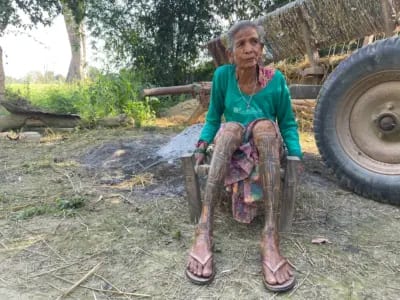
A tharu woman from Kailali district in western Nepal with tattoos on her legs. Photo by Indu Tharu, used with permission.
This publication is part of the special series Spotlight of August 2026 of Global Voices, "Indigenous rights. "This series provides a vision of the lives and experiences of indigenous peoples in order to establish links between regions, highlight indigenous experiences and tell stories of leaders, activists, community members and others. You can support this coverage with a donation.
As a child, I was sitting with my grandmother near a borais (small mud vessel used to make fire) in the hard winter days. He listened to his stories about benevolent and evil characters: geniuses, spirits, ghosts, witches and magicians, trees, birds and animals that had a special meaning in culture and tradition tharu. She sang popular songs and then explained its meaning to me.
I never thought of documenting the tharu indigenous folklore until she left us. Now that he is not with us, I want those invaluable words of wisdom. Fortunately, I had the opportunity to collaborate with Amrit Sufi andSubhasish Panigrahiwho have been documenting India's oral culture, and have also inspired and helped many lovers of culture and traditions to document their own cultures.
Documenting indigenous folklore is a work that takes a lot of time. We must spend a lot of time with the community until its members feel comfortable enough to open up and tell popular stories, songs, phrases and idiomatic expressions, not to mention their personal experiences.
While documenting the tharu oral culture in eastern Nepal, I found many interesting data that, if further research were undertaken, would reveal unknown facets of indigenous stories.

A tattoo hides many stories. Tattoos of a fish in the hand of Bhuti Devi of Sunsari district in Nepal. Photo by Sanjib Chaudhary, used with permission.
Morangsair: Song on seasonal migration
When I recorded the popular song Morangsair or Morangesari, which continues to be sung in the eastern part of the plains of southern Nepal, I discovered the seasonal migration of the young people of the Saptari district in the most eastern area of the province of Madhesh towards the Morang districtin Koshi province, eastern Nepal, where the land was more fertile and offered work to men who wanted to earn additional money.
The Sunsari district, which is named after the Sunsair River (now called the Sunsari River), was part of the Morang district before 1962. Now, to get to Sunsari (formerly Morang) from Saptari you have to cross two rivers, the Koshi River and the Sunsari River. The journey was much more difficult at the time, before the bridges were built.
The popular song is the lament of a young woman who begs her husband not to go to Morang. He speaks of the dense forest, the hot climate and the Sursair River, which he would have to cross to get to Morang. However, the song does not mention the Koshi River, Nepal's largest river and is before the Sunsari River on its way to Morang.
In this video, Chandrakala Chaudhary of Itahari, in the district of Sunsari, sings "Morangsair," also known as "Morangesari":
In further research, I discovered that the current Koshi River was running many kilometres east of where it is now. In Indian territory, it has moved almost 100 kilometres west. In addition, the Ganges River is called Sursuri or Sursari in Hindu sacred writing Guru Granth Sahib. The Sursair and Koshi rivers finally lead to the Ganges.
Biyahi: When a river bears the name of a married woman
Speaking with Mahabir Chaudhary, an ethnic Tharu, in the Saptari district of Nepal, I discovered an interesting fact: a river and its tributary are named after a married woman in tharu.
The administrators who speak Nepali have renamed the river as Behai. However, according to the tharu elders, the original name of the river is Biyahi, which means "first wife" in kochila tharu or the eastern tharu language. The tributary Samdahi feeds the river. Samdahi is the word that means "second wife" in eastern tharu. The Samdahi River and the Biyahi River, after their confluence, continue their course as the Biyahi River.
Sabudana ke gachi: The reason for the tattoo that tells the story of sagu pearls

Kashia Chaudhary of the Sunsari district of Nepal with tattoos of a sagu palm and calendars in the forearms. Photo by Sanjib Chaudhary, used with permission.
Today, the Sabudan or sago which is found on the markets is made mainly from the root starch of yuca. However, traditionally sagu pearls are also made from the marrow of sagu palm trees. I discovered this process of making the sagu pearls during an interview with East Tharu-speaking old women. One of them showed me a tattoo that looked like a palm tree, and he told me it was Sabudana ke gachhi. In tharu, "gachhi" means tree. I also tell myself that the Sabudan was made from a palm tree.
Then I investigated a little more and found that, before, they cut the palm trees, ripped the starch core of the trunk and processed it to make sagu pearls. This tradition remains in force in some countries in the south-east.
There are many more stories that I have heard while documenting the oral culture of the tharu and that must be told to a wider audience.
But I still want to remember the stories my grandmother told me when we were both sitting by the fire in the cold winter days.