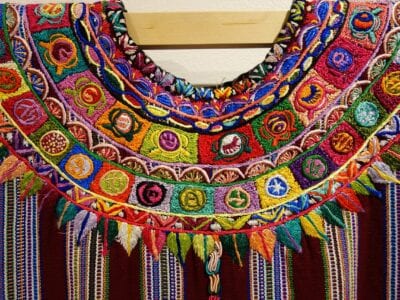
Indigenous traditions are extracted, transformed and exploited for the benefit of third parties.
Originally published in Global Voices in Spanish

Huipil de Patzún, belonging to the Mayan people kaqchikel, exhibited in the Textile Museum of Canada, from the late 20th or early 21st century. These textiles are a fundamental Mayan tradition that the Mayan weavers continue to develop. Image of Wikimedia Commons (CC0).
This article is part of the Global Voices "Spotlight" series of August 2026, "Indigenous rights. "This series provides a vision of the lives and experiences of indigenous peoples in order to establish links between regions, highlight indigenous experiences and tell stories of leaders, activists, community members and others. You can support this coverage with a donation.
Traditions, art and ceremonies are at the heart of the collective identity of many indigenous communities, fundamental to commemorating important events, promoting a sense of community and transmitting history to younger generations. However, too often, these traditions are extracted, reformulated, marketed or appropriated by someone for foreign benefit.

Broken clay jars: Part of a wedding ritual in Juchitán de Zaragoza, Oaxaca. Image of Flickr (CC BY-NC-ND 2.0).
Spiritual ceremonies are recreated for tourists. The manufacturers take on indigenous artistic expressions without recognizing their creators or paying them. Governments incorporate indigenous heritage to legitimize their own power. The mechanisms vary according to region and culture, but the result is the same: resources and meaning move away from the community that created them and enrich people who are foreign to them, often belonging to the same groups that have oppressed that community for centuries.
In Oaxaca, Mexico, wedding organizers market so-called "oaxaqueña weddings" as tourist packages that include traditional, mezal, and dance, but that strip these elements of ceremonies and reciprocity that give them their meaning.
In the meantime, important international fashion houses are appropriate of indigenous textile designsthey benefit from their creations and do not recognize or pay those who thought of them. But the appropriation does not end there: in Guatemala, the Mayan weavers struggle for the legal recognition of their collective intellectual property rights.

Wedding ceremony in the temple of Santo Domingo, Oaxaca, Mexico. Image of Wikimedia Commons (CC BY-SA 2.0).
In southern Mexico, the Oaxaca communities have a rich tradition of elaborate marriage ceremonies that are becoming commercial products to attract outside audiences. The Oaxaca weddings often include elements such as the calenda - a traditional procession of Oaxaca -, the guelaguetza - the traditional Oaxaca celebration - as well as meals, music, dances, drinks and rituals of their own.
These "oaxaca wedding packages" strip celebrations of all their cultural meaning and reduce them to a transaction. As the author explains Kupijy Vargas:
The concept of oaxaqueña weddings is offered in a commercial market, offered to the public by packages, built from the cultural appropriation of a calenda, including the mezal, music and women dancing.
These packages offer this concept and then have a party in the ethnobotanical garden, where you serve gourmet oaxaqueous food, foods that are eaten within the region but served in a stylized way. Those who prepare and serve them, that is, the waiters, the cooks, etc., are those who support with their attention to that party where there is no Guelaguetza, nor the act of giving and receiving, but there is a monetization for the services. It is there that colonialism retriumphs, making all those people of the culture in which they grew up and were born into their own lands.
A similar dynamic is observed with textiles from this region and other indigenous communities. The Oaxaquean Writer Tajëw B. Diaz Robles claims that to extract traditional textiles without recognizing or compensating the communities that created them is a form of appropriation.
... I propose that the plagiarism and / or appropriation of Tla-hui's blouse and its graphic patterns by Isabel Marant and Antik Batik (another French-fashion company that also incurred in the copy of Tlahui's textile in its 2014 Bartra collection) is the conversion of various forms of collective-communal property rights to private property, since up to the time of plagiarism the embroidery were considered part of the cultural identity of a collective, a textile whose graphic patterns identify a specific community and that is relegated community. This does not mean that it is not specific people who make them or that there is no local marketing, but these people create and produce in a delimited Community context and the clothes are in a market that clearly identifies their origin. Therefore, Marant and Antik Batik, in the words of the Community authorities of Tla-huitolte-pec in their June 2015 pronouncement, have committed something that they state as' the appropriation of a cultural heritage. '
Some Mayan communities of Guatemala is fighting this situation promotion of legal measures to protect traditional handicrafts and textiles.
The fight has been over ten years. In 2016, the Women's Association for the Development of Sacatepéquez (AFEDES) and a coalition of workers' cooperatives presented an action of unconstitutionality in which they argued that Guatemala's silence of indigenous textile rights was also unconstitutional. The Constitutional Court ruled twice in its favour and ordered Congress to adopt protection legislation. So far, Congress has failed. Two projects were left in the legislative process: the 5247 initiative in 2017, and the 6136 initiative in 2022.

Huipil de San Antonio Aguas Calientes, small town of Guatemala. Image of Wikimedia Commons (CC BY-SA 4.0).
In June 2026, the movement, which now works under the name "Ru Chajixik ri Qana'ojb'äl" ("safeguard our knowledge," in kaqchikel), presented a third proposal: the 6788 initiative.
Like its predecessors, the initiative defines intellectual property over textiles as "collective, inalienable and imprescriptible." This means that it belongs to the community and not to a particular person, that it cannot be sold or given up and that it is not subject to expiry.
If approved, it would formally recognize indigenous peoples as copyright holders over their tissues, designs and techniques, including motifs, patterns, symbols, colors, glyphs and specific petroglyphs transmitted from generation to generation. It would also create a National Intellectual Property Council on Indigenous Textiles and Clothing in charge of enforcing these rights. The weavers have also asked Congress for three concrete commitments along with the initiative: a favourable decision to reaffirm the international constitutional and legal foundation of indigenous collective intellectual property; accelerated legislative treatment; and a permanent dialogue between Congress and the movement to monitor the progress of the project.
Regardless of what happens with the initiative in the Guatemala Congress, the proposal is a model for other indigenous peoples around the world who seek to protect their intellectual property rights.





.jpg)
