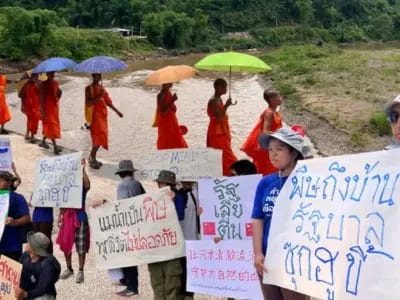
Protesters organized a walk for peace to demand that they take responsibility for mining activities affecting rivers and rural communities
Originally published in Global Voices in Spanish

Communities demand measures while the Kok River pollution remains unresolved. Photo: Prachatai, Global Voices content partner.
East edited article of Sheikh Mehzabin Chitra was originally published in Prachatai, independent news media from Thailand. Global Voices reproduces a version edited under a content collaboration agreement. This article is also part of the special series of August 2026 of Global Voices, "Indigenous rights. "You can support this series with a donation.
In July 2026, hundreds of villagers, indigenous leaders, environmental defenders, monks and civil society activists completed a six-day walk for peace along the Kok River in northern Thailand to demand urgent action as water pollution has become worse. His message was clear: the river that has sustained these communities for generations is becoming less and less secure, and more forceful measures are needed to stop cross-border pollution before the damage is irreversible.
The Kok River is born in Shan State, Myanmar, across the provinces of Chiang Rai and Chiang Mai, and flows into the Mekong River. For communities living on its shores, the river provides drinking water, irrigation, fishing and transport, as well as being a fundamental element of their cultural identity. However, today many people fear that these livelihoods are threatened by heavy metal pollution, linked to upstream mining activities in Myanmar.
The walk for peace has become one of the most recent demonstrations to hold responsible for the pollution affecting the Kok, Sai, Ruak and Mekong rivers. Participants urged the Thai Government to strengthen cross-border cooperation, investigate the origin of pollution and protect communities whose livelihoods depend on healthy river ecosystems.
Growing cross-border pollution crisis
The concern about Kok River pollution has increased following the detection of high concentrations of heavy metals, including arsenic, in several rivers flowing from Myanmar to northern Thailand. Environmental organizations and local communities link this pollution to the expansion of rare land and other mineral extraction activities in Myanmar, which, according to various reports, would be funded from Chinese investors.
The problem goes beyond environmental deterioration. Farmers depend on water from these rivers to water their crops, while fishing communities need healthy aquatic ecosystems to ensure their food and income. The health authorities have also recommended that precautions be taken when using fish and other aquatic animals from contaminated rivers, given the risk of exposure to heavy metals.
Civil society organizations warn that pollution is no longer limited to the Kok River, it also affects the Sai, Ruak, Salween and Mekong rivers. According to the NGO Coordinating Committee for Developmentwater turbidity has increased significantly over several sections of the Thailand-Myanmar border, while arsenic and lead concentrations have exceeded the recommended safety levels in several communities.
As rivers across national borders, downstream communities often assume the environmental consequences of activities that take place outside Thailand & apos; s jurisdiction. Environmental organizations argue that there is a need to strengthen regional cooperation between Thailand, Myanmar and China to identify sources of pollution, improve monitoring systems and prevent further progress in environmental degradation.
Communities demand responsibility
Public concern has increased, along with frustration over what many consider to be a lack of effective action.
On 6 July, members of the People's Network for the Protection of the Kok, Sai, Ruak and Mekong Rivers They marched. to the Chinese Consulate General in Chiang Mai to deliver a petition urging the Chinese authorities to regulate the activities of the Chinese companies operating mines in Myanmar. Protesters claim that these mining activities have contributed to the pollution of rivers with heavy metals, putting millions of people living downstream at risk.
However, before reaching the consulate, the demonstrators found themselves in a police blockade. The confrontation took place when the police tried to remove a banner by one of the participants. Two demonstrators were injured: one suffered a fracture in one arm and another a shoulder placement. The demonstrators filed a complaint with the Police for alleged excessive use of force. For their part, the authorities claim that the police acted in accordance with the procedures established by law. One of the wounded, Wisarut Srichan, too. evaluates filing court claims against the police.
Two days later, civil society organizations concentrated in front of the Chinese embassy in Bangkok to demand action against water pollution and condemn police action in Chiang Mai. The protesters called for an independent investigation into the use of force against those involved in the protest, and asked the authorities to identify the investment networks and business operations responsible for environmental damage and possible human rights violations.
Environmental defenders under pressure
The protesters in Chiang Mai said they did not expect the protest to end in confrontation, as it was a small mobilization and had informed the Police of the march. However, physical violence is not the only threat faced by environmental activists in Thailand.
Human rights organizations have documented an increase in the use of so-called strategic demands against public participation against community leaders, journalists, researchers and activists who report the environmental impact of real estate projects. Although these processes eventually end up being rejected, they often impose an important economic and psychological burden on those who face them.
One of the most cited cases is that of the environmental defender Sumeth Rainpongnamwhich faced a demand of 50 million baht (about $1.5 million) when defending the environmental rights of its community. Human rights organizations argue that such legal actions seek to discourage citizen participation and make it more difficult for affected communities to report environmental problems.
Indigenous communities that protect rivers
For indigenous communities in northern Thailand, protecting the Kok River is inseparable from protecting their territories, livelihoods and cultural heritage.
For decades, the Karen and other indigenous peoples have been opposed to projects that, in their view, threaten the region's forests and river systems. In the Omkoi district, Karen communities questioned a coal extraction project, considering that environmental impact assessments did not take sufficient account of indigenous knowledge and the particularities of local ecosystems. Communities have also opposed the Yuam-Salween water diversion project, because of its possible effects on forests, fishing and water resources, as well as questioning whether the affected populations were actually consulted during the approval process.
These mobilizations reflect a broader concept of environmental protection. For many indigenous peoples, rivers are living ecosystems that support the culture, food and well-being of future generations, and not simple natural resources for exploitation.
The participants in the Kok River Peace Walk stressed that the communities that have lived for generations on the banks of these rivers have a valuable knowledge of the environment that should be taken into account in conservation initiatives. They also called for greater recognition of indigenous territorial rights, effective participation of communities in environmental decisions, transparent monitoring systems and greater protection for those who defend the environment.
While northern Thailand continues to face the effects of cross-border pollution, many people claim that protecting the Kok River requires more than emergency responses. Sustained regional cooperation, mechanisms to hold companies accountable and more recognition of the role of indigenous communities, whose historical relationship with the territory has for generations contributed to protecting the rivers in the region.
For those who participated in the walk for peace, protecting the Kok River ultimately means much more than preserving a watercourse. It means defending public health, cultural survival and the right of future generations to inherit safe, living and uncontaminated rivers.