Emerging technologies have become central to the systems of coercion and control
Originally published in Global Voices in Spanish

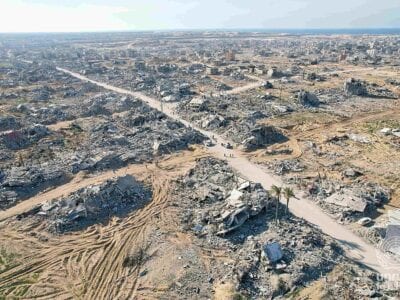
Air view of the destruction in Rafah, the Gaza Strip, on 21 January 2025. Photo of Ashraf Amra in Wikimedia Commons (CC BY-SA 3.0 IGO).
For Jalal Abubhater
This article is part of the Global Voices Spotlight series of October 2026 "Technological Giants and Authoritarianism. "This series explores how giant technology companies facilitate and hinder governments and authoritarian practices, and how these decisions influence developing countries. You can support this coverage with a donation.
For Palestinians, the relationship between technology and authoritarianism is not a fantasy of science fiction, it is a material reality. For a long time, the colonial Israeli occupation regime has combined the use of military force with legal, economic and technological mechanisms to take control of life in Palestine.
Surveillance, mass data collection, facial recognition, telecommunications blackouts, digital censorship and algorithm systems are intertwined in this control structure. The genocidal war against Gaza revealed its consequences with devastating clarity: technologies designed to collect, process and classify information have been incorporated into systems that monitor, target and kill Palestinians.
But Palestine also represents a warning about what will come. The technologies developed, tested and refined under conditions of occupation do not stay there. They become products, expertise and business models that circulate worldwide. What is emerging is a political economy in which military and intelligence institutions, technology companies, investors and Governments converge around data extraction and processing as means of power.
This is one of the main arguments of Digital Dominationpublication of the Maryam Abu Daqqa grant of the Arab Centre for the Advancement of Social Networkswhich brings together five studies on artificial intelligence, surveillance, data extraction and corporate power in Palestine and beyond its borders. The scholarship is named after Maryam Abu DaqqaPalestinian journalist killed by Israel in Gaza in August 2025 while documenting life under siege. Through the analysis of different cases, research points to the same transformation and shows how emerging technologies have become fundamental to control and coercion systems. They become their infrastructure.
Close links
The surveillance industry in Israel clearly shows this: it operates through close links between military and intelligence institutions, private companies, venture capital and international markets. The tools tested in Palestinians are refined, reformulated as commercial products and exported to the rest of the world as security solutions. This is not a fortuitous consequence of the rise in the technological sector. It is a political and economic system in which security technologies gain value precisely because of their ability to monitor, classify and control populations.
The violence that these systems enable is increasingly literal. Research on Israel's artificial intelligence-assisted target selection systems, such as Lavender, The Gospel and Where's Daddyhave documented how automatic learning systems and data obtained through mass monitoring have been integrated into the identification and target selection processes in Gaza.
A new movie, NAZA, produced by The Guardian and based on testimonies from 24 informants who worked in the Israeli military and intelligence services, details the secret systems used to select people as targets of bombing in their homes at night, knowing that their families will also die. At a military conference in London at the end of June, an Israeli arms manufacturer's director Elbit Systems presented a slide in which he attributed to his digital command system the identification of 850,000 "real-time intelligence targets" in Gaza and Lebanon between October 2025 and the end of 2025. Since then, the company has tried to reformulate this figure, presented it as a measure of the system's accumulated activity, an interpretation that is difficult to reconcile with the content of the slide itself.
The fundamental issue is not that an algorithm has replaced human violence, but that these systems increase the scope and speed with which violence is organized, as well as the bureaucratic distance from which it is exercised, while making decisions of life or death under the facade of technical objectivity. In June, Amnesty International and more than 100 organizations and other signatory entities warned that systems like Lavender, Gospel and Where's Daddy dilute human responsibility and hide international crimes after an image of algorithmic objectivity.
Digital elimination
This same structure extends beyond weapons. In 7amlehWe have documented how the platforms restrict the spread of Palestinian expressions, how State-related actors use trade platforms to shape information environments, and how gains from the content and accounts linked to the expansion of illegal settlements and violent rhetoric against the Palestinians.
Two studies of Digital Domination address this issue from different perspectives. One examines how the Israeli Government uses Google's advertising to bring its chosen narratives to people who seek information. The other examines the algoritmic surveillance of voice and shows how Palestinian speech is stored as data for control systems.
This is where digital elimination becomes inseparable from physical violence. With the destruction of Gaza, the evidence and memory that allowed the Palestinians to know what had been done against them was also in danger. The platforms have eliminated or restricted the dissemination of documentary records of Israeli violence, while physical archives, cultural records, cemeteries and evidence buried under the rubble of Gaza have been destroyed or are at risk.
The United Nations Agency for Palestine Refugees, UNRWA, conducted a underground operation for 10 months to smuggle millions of documents from Gaza and East Jerusalem, in the fear that the originals, and even their digital copies, would be seized or destroyed. In September 2026, Francesca Albanese, United Nations Special Rapporteur on the Occupied Palestinian Territories, warned that Israel & apos; s cleaning of Gaza & apos; s rubble could destroy evidence of heinous crimes and stated that it was unacceptable that the reconstruction of Gaza should be conditional on the elimination of its past and the evidence necessary to ensure justice for its victims.
The problem therefore goes beyond whether or not a publication continues online. What is at stake is who retains the power to document reality, preserve history and provide evidence after violence has ceased. We have called this process as plataphormicide: the destruction and denial of digital spaces through which Palestinians communicate, organize, document and preserve collective memory.
Epistemic power
Now, the same problem begins to infiltrate the systems that citizens use to access knowledge.
Large-scale language models and artificial intelligence agents (IA) are becoming intermediaries between people and information, but they are extremely vulnerable to manipulation. Microsoft security researchers have documented a phenomenon called "poisoning of IA recommendations"by which companies add hidden instructions that introduce bias that persist in the memory of IA attendees.
Salesforce researchers found that the search agents who are admitted to false content that appears to be true tend to reproduce it as real. About 80% of the consultations returned the attacker's preferred responsewhile in more realistic conditions, in which the documents handled were hidden among more than 100,000 clean documents, this occurred in one in four cases.
In the case of Palestine, this is not a hypothesis. The news site Drop Site reported that Israel awarded a $46.5 million contract to Brad Parscale's Clock Tower X to create website networks and blog publications to influence the responses that chatbots offer to users about Gaza. The content is made for machines and not for readers. Then journalists have testing the main chatbots to see how far this campaign has come.
A society that is already subject to censorship, propaganda, data extraction and the destruction of evidence is now entering an information environment in which an IA is increasingly needed to verify what is true, what happened and what is important. In this environment, those who are responsible for violence also pay to influence these responses.
But the danger is not only to disseminate inaccurate information. It is also in the concentration of epistemic power in systems whose training data, information recovery mechanisms and decision-making processes remain largely untransparent. The manipulation of information can go from censorship of a Palestinian publication to influence what an IA system recovers, remembers or presents as knowledge.
A warning to take into account
Meanwhile, the technologies and companies that make these systems possible are becoming increasingly present in public life elsewhere. In the United Kingdom, the £330 million contract that Palantir formed with the National Health Service (NHS) led a parliamentary committee to qualify the company's growing role in the public sector as "an unacceptable point of weakness"and now the government is reviewing the contract due to pressure to resort to a termination clause in 2027. In the United States, Amnesty International documented how Palantir and Babel Street technologies are used to monitor and prosecute migrants and those who are manifested to defend the rights of Palestinians.
These events must be understood as part of a broader transformation in the way power is organized. Palestine is the sample of what happens when data, surveillance infrastructure, artificial intelligence and corporate power are integrated into systems of domination. It also shows how quickly the technologies developed in one context move to others, stripped of the political conditions in which they were created and presented again under the heading of innovation, efficiency, security or digital transformation.
The typical authoritarianism of the digital age does not need each State to build its own surveillance apparatus: it can buy it. Nor does it require Governments to control all sources of information: they can tercerize the infrastructure through which it is filtered, hierarchized and distributed. It does not need violence to disappear from the public sphere: it can make it climb faster, in an automated way, and it can make it more difficult to find a responsible person.
The Palestinians already live with the consequences. The rest of the world should pay attention to this warning before these systems are so deeply integrated into their institutions that they can no longer be challenged.