Public enterprise is accused of promoting crimes against humanity
Originally published in Global Voices in Spanish

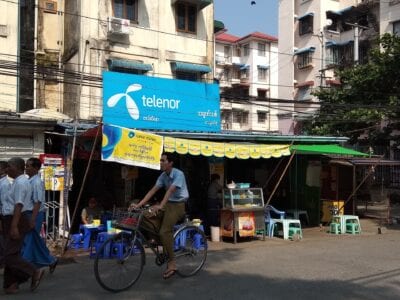
Telenor operated in Myanmar between 2014 and 2022. Photo Bjoertvedt. Source: Wikipedia (CC BY-SA 4.0).
This article is part of the Global Voices Spotlight series of October 2026 "Technological Giants and Authoritarianism. "This series explores how giant technology companies facilitate and hinder governments and authoritarian practices, and how these decisions influence developing countries. You can support this coverage with a donation.
Norwegian telecommunications multinational Telenor faces charges for her involvement in disseminating confidential client data to the Myanmar military government.
If the demand is successful, it would be the first case in history where a telecommunications company is held responsible for not protecting users' data from the abuse of an authoritarian regime.
Telenor operated in Myanmar between 2014 and 2022 with 18 million subscribers. After coup d'état February 2021, Telenor faced pressure after the board demanded compliance with its monitoring and content blocking instructions. Telenor decided leave Myanmar, but several civil society organizations opposedthat its local operations were sold to a company linked to the board.
In December 2024, the Justice for Myanmar activist group presented a complaint against Telenor in Norway for failure to comply with the approval law. Norway rejected it, but the complaint was refiled in October 2025 together with an additional charge for complicity in crimes against humanity.
The Norwegian State has a 54% share in Telenor. In December 2025, the Norwegian Parliament started an investigation into Telenor's operations in Myanmar. The head of the Parliament's disciplinary committee stated: "We must clarify how a state company could cooperate with a brutal military regime (and give in) client information about the opposition [in Myanmar]."
In April 2026, Myanmar citizens filed a collective civil complaint in Norway against Telenor for sharing their sensitive personal data with the military junta. The complaint claimed that Telenor had provided the regime with at least 1255 telephone numbers. These data also included call records and location data, names, addresses, identification numbers, Facebook accounts and bank accounts linked to mobile numbers.
Among the complainants is Tha Zin, widow of the rapper and deputy Phyo Zeya Thawarrested on a false charge, convicted and then executed by the military junta. Tha Zin saidthat her husband was arrested immediately after the military junta had access to the information on his account.
I lost my husband. It is not just a wife losing her husband. It is also a loss to the movement. It is also a loss to democracy because my husband was committed to democracy and a youth leader. Losing him means a loss to the country.
I lost my husband. It's not just a wife who loses her husband. It is also a loss to the movement, and a loss to democracy, as my husband was committed to democracy in addition to being a youth leader. Their loss is a loss to the country.
Attorney Jan Magne Langseth summarized the content of the complaint.
Telenor ASA in Norway clearly contributed to the practice of handling over user data, despite the inherent risks for its custodians in Myanmar. We have evidence of cases where the team at HQ expressly recommended the data to be handed over.
Telenor ASA in Norway clearly contributed to the delivery of user data, despite the inherent risks to its clients in Myanmar. We have evidence of cases in which the headquarters team specifically recommended that the data be delivered.
In September 2026, the Norwegian National Criminal Investigation Service and the Internal Security Service recorded Telenor's offices on charges against the company.
Justice spokesman for Myanmar, Yadanar Maung, welcomed the decision of the Norwegian authorities of investigate Telenor.
Telenor's transfer of spyware to a military-linked company and sharing of sensitive data with the military junta was extensively documented
We hope this will finally lead to accountability for the harms Telenor has caused Myanmar people through its conduct and its dangerous diversification.
Telenor's transfer of spy programs to an army-related company and the exchange of confidential data with the military junta were widely documented.
We hope that this will finally help Telenor to assume responsibility for the damage he has caused to the people of Myanmar by his conduct and dangerous departure from the country.
In several statements sent to the media, Telenor said which is working with the authorities in the ongoing investigation. He added that he had to defend his employees in Myanmar.
In Myanmar, refusing requests from the military authorities could, in the worst case, have led to imprisonment, torture or the death penalty.
Telenor Myanmar had no real options. We could not play Russian roulette with the lives of our employees.
Refusal to comply with the orders of the military authorities in Myanmar could, at worst, lead to imprisonment, torture or the death penalty.
Telenor Myanmar had no real alternatives. We couldn't play Russian roulette with the lives of our employees.
Telenor's media director, David Fidjeland, reiterated this same point.
Our employees risked imprisonment, torture or the death penalty if the military authorities' orders were not complied with. We found that we had no real choice and that we could not put our employees' lives at risk.
Our employees were at risk of being imprisoned, tortured or sentenced to death if they did not comply with the orders of the military authorities. We realized that we had no choice and that we could not endanger the lives of our employees.
Telenor recognized the violence of the board, but held that the well-being of its employees should not be endangered.
Telenor acknowledges that human rights due diligence must consider all rights- holders. However, when faced with the brutal force of the military, Telenor maintains that an employer cannot give instructions that put employees' lives at direct risk.
Telenor recognizes that due diligence in the field of human rights must take into account all rights-holders. However, in the face of the violence of the military, Telenor argues that an employer cannot give instructions that directly endanger the lives of the employees.
Civil society organizations noted that research is a step forward in the fight against impunity. Civicus stated that companies should not allow human rights violations.
The Telenor case has the potential to challenge impunity. It should refocus the minds of democratic states and companies headed in them, offering a warning that they can be exposed for complicity in the junta's atrocities. It should give fresh impetus to civil society's efforts to hold states and companies to account.
The Telenor case has the potential to question impunity. It should make democratic States and companies based in those countries reflect and warn them that they may be accused of complicity in the atrocities committed by the board. It should give new impetus to the efforts of civil society to hold States and businesses accountable.
Faiz Naeem, policy analyst for Asia-Pacific in Access Now, added that Telenor's case reminds companies that their obligations to users do not end when they leave a country under an autocratic regime.
The decision to investigate Telenor for crimes against humanity should be a wake-up call for every technology and telecom company operating in a high-risk environment: leaving a market does not mean leaving your human rights responsibilities behind.
The decision to investigate Telenor for crimes against humanity should be a Attention call for all technology and telecommunications companies operating in a high-risk environment: leaving a market does not mean leaving behind their own human rights responsibilities.
The civil collective claim claims compensation of 9000 euros (about $10,500) per client.