The facial recognition system in Georgia is purchased in Moscow.
Originally published in Global Voices in Spanish

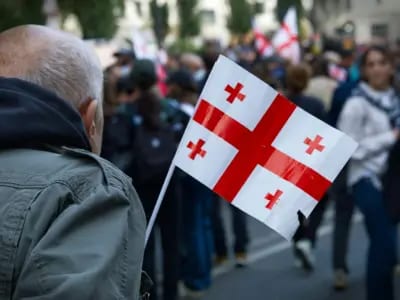
Photo from Sheldon Kennedy in Unsplash
East Article was originally published on Algorith Wathc on June 27, 2026. Global Voices reproduces a version edited under a Creative Commons Attribution 4.0 International License (CC BY 4.0). It's also part of the series Global Voices Spotlight of September 2026, "Protest in democracy. "You can support this series with a donation.
For the past two years, the Georgian Government has built a comprehensive system of control through facial recognition, acquired from a Moscow-based company linked to the Federal Security Service (FSB), and its impact on the protesters is worrying.
In mid-March 2025, Nino, a Georgian who was about 40 years old, received a call from the Tiflisto quote her to an audience for blocking a route in the Georgian capital two and a half months ago. The call surprised her. Nino had protested against the alleged fraud in the last elections as well as the suspension of the EU integration discussions. He knew for a long time that the site of the demonstration surrounding the Georgian Parliament it was covered with surveillance cameras, but it had not considered that they were effective enough to identify it.
At the hearing, Nino saw a film of her at the demonstration; he was accused of starting the roadblock. The system had identified her with a software of facial recognition and prosecuted her as a protestor who failed to comply with the law; the fine allocated reached 5000 laris (about 1620 euros or 1878 dollars). Five months later, Nino's bank accounts were frozen. He was forced to organize a collective funding campaign to pay the fine.
Like many others in Tbilis, Nino could not afford the risk of receiving more fines and stopped manifesting. His case resonated with many other Georgians who, since 2025, stopped participating in protests against the ruling party, Georgian dreamin power since 2012, and led behind the scenes by its founder, Bidzina Ivanishvili, a billionaire whose fortune was built in post-Soviet Russia.
The latest monitoring mechanisms, including software facial recognition and a wide network of cameras with artificial intelligence, help the authorities achieve what physical force had not been able to: break the movement of protesters.
Nomination to the European Union for authoritarian repression
In 2023, Georgia was granted candidate status for the European Union, a milestone that for many citizens meant more than diplomatic formality. After allegedly fraudulent parliamentary elections of 26 October 2024, many Georgians took to the streets and Protest for 580 consecutive days. The European Parliament asked a new vote.
In response, the Prime Minister, Irakli Kobakhidze, announced that his government suspension the process of accession to the European Union until 2028. This interruption was widely considered unconstitutional, since the Georgian Constitution provides that all public bodies must facilitate the accessionthat 86 per cent of Georgians support.
The demonstrators have been progressively stripped of their rights. In 2023, no authorization was required for a meeting and freedom of expression was guaranteed; by 2026, the considered to cover his face as an administrative offence, and the penalty for blocking a route increased from 500 laris (165 euros or 192 dollars) to 5000 laris (1654 euros or 1920 dollars).
In 2025, both acts were turned in crimes, and even the assemblies needed state registration. By 2026, calling the Government illegitimate or criticizing it in line with terms considered offensive also became a criminal act, which led Transparency International to conclude that, "in practice, the amended laws of Georgian Dream had abolished the freedom of assembly guaranteed by the Constitution of Georgia. "
Facial recognition: technological basis of repression
By December 2024, the protests had spread dozens of cities in Georgia, and many local media described them as the largest demonstrations since the country's independence in 1990.
The Government responded with force, and the police used water cannons and rubber bullets on the demonstrators. Be documented beatings: the Office of the Public Defender registered 282 cases of physical abuse, and at least 486 people were detained only in November and December 2024. Yet the crowds continued to protest, spent Christmas and New Year in the streets. Thematic demonstrations led by teachers, musicians, athletes and doctors, and extendedto 37 of the 55 cities of Georgia and more than 40 foreign cities.
Then, once the authorities were able to identify protesters accurately, the fines began to arrive. By March 2025, had imposed at least two million laris (about €640,000 or $767.893) in fines to the protesters. At first, no one knew how they could have identified them so easily. However, the answer had been there for years.
Under the wing of Russian surveillance machines
Georgia's surveillance infrastructure is called Polyface; its Ministry of Internal Affairs buys the facial recognition system of Papillon AO, a Moscow-based company punished by several countries. Their products are mostly used by Russian security forces and autocracy close to Russia, such as Tajikistan, Turkmenistan, Kazakhstan and Belarus.
Russia, which now provides surveillance technology to Georgia, invaded in August 2008 in a five-day war, after which it recognized - unlike the international community - the separatist regions of South Ossetia andAbkhazia as independent States. Russian troops have been there since. Almost two decades later, Moscow still controls about 20% of Georgian territory.
According to an update of contract of 2018, Russian staff had reportedly trained ministerial officials directly. According to Russian law, like any other Russian company operating in Georgia, Paillon AO is obliged to cooperate with Russian security services if required.
In the meantime, the documents obtained show that the Ministry of Internal Affairs of Georgia has been expanding its facial recognition capabilities. Many protesters interviewed for this article were first seen in the recording during the hearings and admitted to being surprised by the accuracy of the system's capture.
The manifestant Elene reported that her friend Levani "was just on the edge of the frame, but the camera approached the point where each expression and smile was visible. It was unimaginable."
Through the system lenses
Polyface 3.7.0, the latest update acquired by the Ministry of Internal Affairs, was delivered in early June 2025. Polyface is built on a recognition algorithm with deep learning developed by 3DiVi, Russian IA company based in Novosibirk and supported by a Russian State venture capital fund. It records high-definition images of large crowds, even with little light, and can identify faces with masks or partially hidden.
The tender documentation shows that the ministry explicitly requested licenses for an unlimited number of operators; the change suggests an increase in demand within the ministry to follow up on major protests.
To match faces with identities, the system uses the Unified Information Bankwhich gives access to photographs of the Civil Registry. The software can also search for prefilled images of social networks and other external sources, function that the ministry requested in 2024and indicated that the intended use was multi-platform monitoring.
This research has identified three ways in which you can use the software. Automatic identification allows Polyface to view the live images of a camera, select each identifiable face among the crowd, and capture an image that can identify a person. Then move on to the next face. The process continues unabated, without human participation.
On the other hand, an operator-led search allows a staff member to have manual control of a camera, point it to a specific person, approach and compare the face image in a real-time database. Finally, the alerts in the follow-up list work by loading into the system a list of people of interest (e.g. activists, organizers of demonstrations, protesters who have been fined, etc.) in the system. When a camera locates someone on the list, Polyface marks it.
Uncertainty as self-pressure
At first, activists organized funds: people donated money, funds paid fines and protests could continue. "At first," says Elene, "to be fined felt like a recognition, to raise funds for you, there was solidarity." Then the Government kidnapped the fund accounts and left the protesters to their fate.
Since the fines would come weeks or months later, the protesters understood that participating in a protest was not an act you once performed, it had become a consulting data record.
"The software not only does he identify someone, he can rebuild the entire story of the protest: when a person arrives, how long he remained, how many times he returned, "explains Giorgi Lubaretsi, a Georgian cybersecurity expert." Once someone is identified in a protest, the system can locate him in any other registered event. "
The deterrent effect is gaining strength
The protesters describe that they stopped singing, using whistles, wearing posters, taking pictures or even wearing distinctive clothes for fear of identification. "I became paranoid," recalls Tamuna, a 22-year-old student and frequent protestor. "I started covering my face the moment I left my house, and I was wearing neutral clothes, but I still felt like I could be identified."
The facial masks that protesters use to protect themselves caused the protest to feel unrecognizable. "When they all started wearing masks," says Nino, "I started to feel anxiety in Rustaveli. You can't see faces, you lose contact, you can't recognize anyone. It's very stressful. "
The deterrent effect reduced the scale of protests and the willingness of people to participate. "The scale changed enormously," says Nino. "When the funds were frozen and there was no longer hope of help, many fewer people went to the streets."
For Tamuna, fear gradually appeared: "I changed the path I was making for the protests. I started covering my face; then, they also criminalized their face. I wanted to avoid the fines, I had to avoid them. Fear is one of the main reasons I no longer participate."
The moral distance between those who still risk attending the protests and those who can no longer afford it is increasing. The enologist Luka still participates frequently and is upset with people like Nino who no longer participate. "Honestly, I'm surprised by the people who stopped participating in the fines. If they had not been so scared when the masks were allowed [to avoid the cameras], standing on the pavement was allowed and there were a thousand ways to escape, we would have more strength now."
The democratic facade
Facial recognition systems are not exclusive of authoritarian States; what changes is political will.
Eto Buziashvili, researcher at the Atlantic Council Digital Forensic Research Laboratory in Washington, United States, explains: "Papillon Systems is a fundamental part of Russian security infrastructure. Integrating this type of biometric technology into national infrastructure represents a substantial risk to Georgia's national security. Attacks on integrity could involve software programmed to 'ignore' people in particular, for example, to ignore foreign intelligence agents from a hostile country, while creating a detailed map of the power structure within the host country. "
Buziashvili recalls the Russian invasion of Georgia in 2008, when Georgia's Internet traffic was redirected through Russian servers and was used as the main tactic to isolate the Georgian Government. "When an opponent has access to facial recognition files, he can use the database to develop intelligence profiles. There is a tragic precedent: during the Taliban's takeover in Afghanistan, they inherited the biometric system built by the Americans and the used to identify and attack the Afghans who had worked with the United States. "
Stopping on the pavement without a state record is a crime, punishable by prison. The cost of participating in a protest in Georgia is freedom. What is at stake is Georgia's most basic question after the post-Soviet era: what way does the country want to take? What the cameras record, after all, is not riots. It is the constitutional right to demand that Georgia maintain the European future that its citizens voted for.
Five hundred and eighty days later, hundreds, maybe thousands, still meet in Rustaveli every afternoon, and each one is observed.