As the regulation, rights and civil society are trying to follow it without a real consensus, the AI is making progress.
Originally published on Global Voices in English

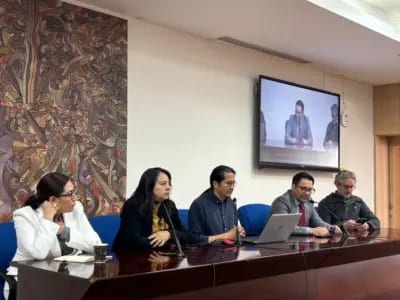
From left to right: Mónica Reinoso (Defensoría del Pueblo), Susana Cadena (Datalat), Carlos E. Flores (Openlab), Marco Insuasti (Mintel) and Rafael Bonifaz (Derechos Digitales). Photo: Openlab Ecuador, used with permission.
This article is part of Global Voices' April 2026 special report on the "Human Perspectives on AI"It has provided insight into how AI is used in countries of the world majority. Among other things, the file examined the impact of the use of AI and its implementation on different communities, what this AI experience could mean for future generations, and much more. To support this project, you can make a donation Here.
A person consults his phone, types a question and gets an answer in seconds. She doesn't know how it works, what data she disclosed, or who's hiding behind that answer. Yet, she continues to use it.
Artificial intelligence is already involved in school duties, professional decisions, and processes that previously required hours. It gives results. It fits in. She's progressing. In Ecuador, there is no coordinated AI policy; Rather, the initiatives are moving in isolation. The ministries, the National Assembly (the Congress), regulatory bodies and the academic community each make their own proposals, with different priorities and timetables. This results in laws, strategies and regulations that do not articulate with one another, or even overlap, without a common guideline.
As the use, limitations and consequences of the technologies are increasingly present in daily life, decisions about their use, limitations and consequences remain far removed from those who use them..
In this context, at the end of 2025, more than 60 people gathered at the FLACSO Ecuador on the theme "Artificial Intelligence and Digital Rights: Different Perspectives for the Common Good", in order to open a debate which, until then, was limited to narrow circles.
This meeting was organised by Openlab, in coordination with Futuroscon.IA and the CTS Lab FLACSO Ecuador, and with the support of a project financed by Probox. This initiative brought together social organisations, academics and public institutions, as well as various actors involved in the debate on artificial intelligence and digital rights, within the same space. The main round table was the Defensoría del Pueblo (the country's national human rights institution), Derechos Digitales, Datalat the Ministry of Telecommunications (MINTEL).
In addition to this round table, the day was also marked by conferences aimed at broadening the debate. by approaching from other angles. Jonathan Finlay of the organisation Free, For example, the discussion in the present: artificial intelligence already influences decisions, without any clear understanding of its effects. For his part, Martha Tudón, of Artículo 19directed the discussion towards monitoring, data use, and rights risks in contexts without clear control mechanisms.
To FLACSO CTS Lab, the issue could be considered in another way thanks to the RAM tool, developed by UNESCO. It was no longer about knowing what artificial intelligence is capable of doing, but whether the country is ready to wear and supervise it. This tool evaluates a country's legislation, institutional capacity, rights protection and level of public understanding to determine whether these AI technologies can be used on a larger scale without losing control over their effects..
During the Open Forum, a collaborative format in which participants collectively define the topics for discussion, this issue was translated into concrete cases. At the privacy table, participants mentioned, for example, the case of an employee of a public hospital who, in order to organise his work, for lack of institutional tools, had entered sensitive medical data on artificial intelligence platforms from a personal account. At present there is no clear directive on this type of use, nor is there an effective control system on how this information is processed or protected.
In the education sector, the problem is manifested differently. Indeed, students now use artificial intelligence tools to carry out their work, write their essays, or even form opinions without fully permeating the content. Practices that undermine the development of independent and critical judgment. At the same time, in the absence of clear tools to integrate these technologies into the learning process or to encourage more thoughtful and responsible use, part of the educational community hesitates between the outright ban and an anti-plagiarism approach.
In terms of gender inclusion and equality, discussions focused on the fact that systems are currently being driven by data that exclude knowledge from indigenous peoples, people of African descent and local communities. This not only reproduces these absences in decision-making processes, but also strengthens a dominant form of knowledge, centred on Western and scientific perspectives, which eventually supplants other ways of understanding and living reality.
From the point of view of governance, conversations have highlighted a fundamental problem: the aspect of artificial intelligence that one wants to regulate is not yet clear. Is there a better interest in its use, development, investment or automated decisions? This lack of clarity is compounded by the adoption of external models without taking into account the local context, and the risk of moving towards excessive control measures for an ecosystem still in formation. In this context, regulation could become too broad, unoperational and difficult to implement in practice.
In addition to the round tables, this debate was already beginning to take shape in the National Assembly. Nevertheless, although spaces for discussion have been opened, they have not necessarily been able to generate wider participation. Throughout the year 2024, the National Assembly received three bills, each focusing on different aspects, from research to the commercialization of artificial intelligence systems through topics such as data protection, transparency, copyright, and the protection of children and adolescents from the use of these technologies.
However, since the merger of these artificial intelligence bills, there has been no visible progress in the debate in recent months. In various circles, we begin to mention the possibility of seeing this initiative closed, without there being for the moment a clear perspective on its future.
While the regulatory debate remains stalled, actors with a real capacity to influence the development and use of these technologies are beginning to gain ground. At the Davos World Economic Forum, Ecuadorian President Daniel Noboa met Alex Karp, CEO of Palantir, one of the most influential companies in the world in the field of large-scale data analysis. Having worked with agencies such as the CIA, the FBI or the US immigration services, this company has developed its expertise in the integration of large volumes of information for security and intelligence purposes..
With the announcement of the opening ofoffice in Ecuador, the possible establishment of Palantir in the country comes at a time when the rules are not yet clearly defined, in an area where the same technology is just as capable of optimising services as of developing forms of surveillance difficult to control..
On 10 March 2026, Ecuadorian government presented the "Strategy for the Promotion of the Development and Ethical Use of Artificial Intelligence in Ecuador" (EFIA-EC), promoted by the Ministry of Telecommunications and the Information Society of the country with the support of IDB and UNESCO. This proposal presents a four-year roadmap, structured around three axes: governance, human and technological capacities, adoption and development. Its objective is explicit: to ensure that artificial intelligence is not confined to a minority, but a tool at the service of citizens, the state and productive development..
In this context, the results of the October meeting, recorded in a report based on these thematic round tableshave started to circulate among the participants, and have been transmitted to the Ministry of Telecommunications, the governing body, as well as to the Defensoría del Pueblo, at a time when these technologies are increasingly part of the debates on digital rights and the protection of human rights.
Between strategy, pending regulation and increasing adoption of these technologies, the country is evolving in a still unstable context, where development is moving faster than defining its limits.