‘Any activity that disrupts ocean health could have downstream consequences…’
Originally published on Global Voices

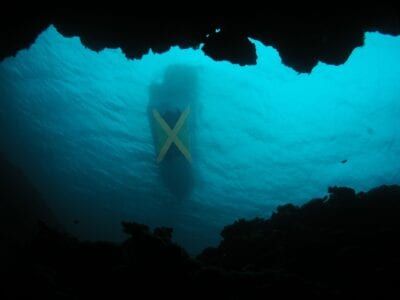
Image of an underwater shot of a vessel with a Jamaican flag on the bottom of its hull, created using Canva Pro elements.
For Jamaica’s fisherfolk, the sea has always been a critical source of food, livelihood, freedom and the future. It’s their pantry, workplace, and cultural centre, but as global companies look to the minerals lying deep below the ocean floor, questions emerge: what will happen to the fishers who rely on these waters when the seabed itself becomes a resource to be exploited?
The way that question is answered could shape the future of Jamaica’s fisheries, and resilience among communities is already bearing the brunt of climate change events. Deep-sea mining may generate sediment plumes, destroy habitats and reduce the biodiversity that cascades through the food chain, placing fisherfolk in the middle of an uncertain ocean economy.
What is deep-sea mining?
The National Oceanographic Centre (NOC) defines deep-sea mining (DSM) as the “process of collecting mineral resources from the ocean floor, usually more than 1,000 metres below the surface.” These resources contain cobalt, copper, manganese, nickel and other rare elements used to make electric vehicle batteries, wind turbines, solar panels and everyday electronics.
Despite being at the heart of the world’s clean-energy drive, the mining of these elements raises serious environmental concerns. For Jamaica’s fisherfolk, the situation may mean that some of the minerals driving climate solutions elsewhere could bring new risks to the waters they depend on.
Global debate, local stakes
Deep-sea mining has emerged as one of the most pressing environmental debates of our time, with wide-ranging implications for countries like Jamaica, whose identity and economy are so closely linked to the ocean. While the industry is not currently being considered in Jamaican waters, the conversations around it raise pressing questions of governance, the impact on livelihoods, and ecological resilience.

Jesse Cleary, geologist, Marine Geospatial Ecology Lab, Duke University. Photo used with permission.
In Kingston, the International Seabed Authority (ISA) — the intergovernmental body responsible for regulating mineral-related activities in the seabed beyond national jurisdiction — continues to debate how, when, and under what conditions mining might proceed. For Jamaica, these unfolding conversations are critical and anything but abstract.
Jesse Cleary, a geographer at Duke University, explains, “We don’t really know what the impacts [of deep-sea mining] could fully be,” adding that the uncertainty around the issue means it has to be watched carefully. According to a 2025 policy brief by UN Special Rapporteurs, DSM risks undermining human rights protections, including food security and cultural rights central to coastal communities.
Diego Alonso Lillo Goffreri, an attorney with the Inter-American Association for Environmental Defence (AIDA), warns, “If we don’t care, those decisions will be taken away and made for us.” He stresses that the absence of civil society benefits governments and companies pushing mining forward without accountability.
Coastal communities at risk
As Alex Simpson, marine protected area manager at the Alligator Head Foundation, explains, “Jamaica’s coastal communities depend heavily on healthy marine ecosystems for food security, livelihoods, tourism, and cultural identity. Any activity that disrupts ocean health — whether through sediment plumes, underwater noise, or ecological disturbances — could have downstream consequences for the people who rely on these ecosystems.”
Even before mining begins, Simpson notes, “The very discussion emphasises the necessity for Jamaica to strengthen ocean governance, invest in scientific research, and ensure that decisions about marine resources are based on sound evidence and meaningful public participation.”
Fishers and livelihoods
“If deep-sea mining were to affect fish populations, migration patterns, spawning areas, or the broader food web,” Simpson emphasises, “these changes could reduce catches and increase uncertainty for fishing communities.”
He also mentions another potential source of stress that could increase their vulnerability: “While efforts are underway to upscale fishers into pelagic fishing, the migration routes of these species might be most affected — potentially nullifying attempts to diversify livelihoods.”
Biodiversity and ecological concerns
There are also other aspects to consider. As Simpson points out, mining could cause habitat destruction, sediment plumes, underwater noise, light pollution, and the release of contaminants. Such disturbances could directly affect deep-sea organisms, and potentially influence ecological connections between deep and shallow marine ecosystems.
Drawing from his own acoustic research on coral reefs, Simpson explains, “Sound affects reef health and fish recruitment. Yet, we have no data on how mining-generated noise might impact coral reef health and fish stocks. From a conservation perspective, Jamaica should avoid irreversible damage until science can fully assess risks.”
Community awareness and engagement
Simpson believes there is significant room for improvement in how communities are informed. “While deep-sea mining is complex,” he says, “and many coastal residents understandably prioritise more immediate challenges, this reality makes accessible, balanced, and science-grounded information even more critical.”
This begins with people on the ground — or rather, in the water. “Local knowledge from fishers often provides insights that scientific methods might overlook,” Simpson emphasises. “Communities should have opportunities to learn about both the potential economic arguments and environmental risks, ask questions, and participate meaningfully in decision-making. Importantly, engagement must happen before major policy decisions advance.”
Role of civil society
Non-governmental organisations (NGOs) and other civil society organisations have a key role to play, Simpson says, as they “can translate complex science into accessible language, facilitate dialogue between stakeholders, and ensure local voices are represented alongside technical experts and policymakers.”
They also have the ability to “identify research gaps, advocate for precautionary decision-making, and encourage policies that prioritise long-term environmental sustainability alongside economic considerations.”
Why Jamaicans should care
Although commercial deep-sea mining discussions are well advanced, the negotiations taking place at the ISA affect whether and under what conditions mining should proceed in the Area — the seabed and ocean floor beyond national jurisdiction.
For Jamaica, which hosts the ISA headquarters and participates in these negotiations, the process feels very close to home. While the areas initially being considered for mining lie largely in the Pacific Ocean, the rules being negotiated in Kingston are intended to govern mineral-related activities throughout the Area, wherever they occur.
This means that what happens in the Pacific is not simply a regional issue. The decisions being made now will help establish the international framework for how deep-sea mining is regulated, what environmental safeguards are required, how benefits are shared and how countries and companies are held accountable.
The Pacific therefore offers Jamaica and the wider Caribbean an important case study. The scientific uncertainties, governance questions and concerns raised by Pacific communities and ocean advocates can help regional nations understand the potential implications of an industry that could eventually extend beyond the Pacific.
For Jamaica, paying attention to these developments is not about assuming that the same impacts will occur in the Caribbean, but about understanding the rules being created, the lessons emerging from Pacific debates, and what they could mean for the region’s own fisherfolk, ocean governance, and future.
From there, the connections only become more complex. Many marine species are highly mobile, moving across national and ocean boundaries during their life cycles, while ocean ecosystems are linked through interconnected food webs. Changes to deep-sea habitats or the organisms that support those webs could therefore have implications beyond the immediate mining area, depending on the species and ecological processes involved.
Understanding these pathways is important for Caribbean countries as they consider what deep-sea mining could mean for their own marine ecosystems and fisheries. Simpson emphasises that “decisions made today about emerging industries such as deep-sea mining could have implications that last for generations.”
Cleary, meanwhile, sees the waters surrounding Caribbean nations “overlapping in
ecological and economic ways.” He says that even though territories make decisions individually, “what their neighbours do really has a big effect.” As such, it only takes one accident or mismanaged project to tarnish the region’s reputation as a pristine tourist destination.
For fisherfolk, the potential risks are less immediate but still worth considering. Cleary points out that nearshore mining activities already compete with them for space and can pollute waters where turtles, sharks and dolphins thrive. If deep-sea mining expands in areas that support interconnected marine ecosystems and fisheries, it could add another layer of uncertainty to already dwindling catches.

Diego Alonso Lillo Goffreri, attorney with the Inter-American Association for Environmental Defence (AIDA). Photo used with permission.
Understanding how — or whether — those impacts could reach Jamaican waters will require more evidence about species movements, food webs and other oceanographic connections. Goffreri frames the issue in terms of rights: “First you have the risk of impact on the country’s livelihood and food security [and] there is a big overlooked issue in Indigenous people’s rights.”
Scientific studies reinforce these concerns. A 2025 peer‑reviewed article in PLOS ONE found that DSM could increase coastal state vulnerability by 13 per cent and raise social risks by eight to 11 percent. These figures form part of the study’s simulation-based analysis comparing scenarios with and without deep-sea mining.
A separate study from the University of Hawai‘i at Mānoa, reported in Nature Communications, showed that DSM sediment plumes could disrupt zooplankton and micronekton, as well as threaten tuna and other commercially important fish.
Governance gaps and community impact
Although DSM is still in the testing phase, Goffreri notes that “governments don’t usually facilitate civil society participation, because it’s an obstacle for them to be held accountable.” He warned, “There are many regulatory mechanisms outside of the Mining Code itself […] environmental thresholds that were supposed to be developed have not really progressed.”
Instead, there is pressure to adopt regulations quickly, risking mining without adequate safeguards. The ISA’s Mining Code is meant to balance priorities like protecting the marine environment, ensuring fair benefit-sharing, and setting clear standards. The Authority also points out that, at present, there is no commercial exploitation of deep‑sea mineral resources in the Area; current activities are limited to exploration and environmental baseline studies.
Goffreri argues, however, that “it is unlikely that countries will be able to have effective control over an activity that is so far away and so deep below the sea. That is basically science fiction.” At the same time, he is concerned that, because benefit-sharing mechanisms are weak, revenues are likely to benefit companies rather than communities.
This suggests that Jamaica’s coastal communities and fishers may bear the environmental costs without seeing any economic boons. Compensation for developing countries whose land-based mining economies could be disrupted has barely been discussed, leaving small nations and their fisherfolk vulnerable to economic shocks.
Missing voices
The perspectives of Jamaica’s fisherfolk and other local deep-sea-related organisations remain absent from the narrative, underscoring a troubling reality: those most likely to be affected by DSM are not really part of the conversation, revealing a gap between decision-making and those most directly affected.
Without stronger efforts to inform, include and empower Jamaica’s coastal communities, fisherfolk risk being excluded from shaping choices that will define their livelihoods and cultural ties to the sea.
For now, DSM remains a looming possibility rather than a lived reality, but as Cleary points out, “We don’t really know what the impacts could fully be.” Goffreri adds, “Only if we show interest in the process and encourage our countries to do the right thing, will they do it.”
Simpson issues a clarion call rooted in Jamaica’s own context: “Healthy oceans are fundamental to healthy communities and resilient economies. Even where scientific uncertainty exists, that doubt should encourage careful consideration rather than complacency. We must adhere to the precautionary principle: when risks are uncertain but potentially severe, we should prioritise protection.
For Jamaica’s fisherfolk, who already face the growing challenges of climate change, having a voice in these decisions is especially important. While the effects of deep-sea mining would depend on where and how activities occur, decisions made today could have implications for marine ecosystems and fisheries beyond the areas where mining takes place. Ensuring that the concerns and knowledge of coastal communities are considered as these rules are developed will be essential.”