"The lactation room was always there. But there was no one to bring me my baby."
Originally published in Global Voices in Spanish

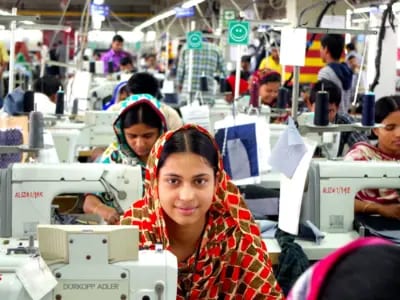
Textile factory workers in Gazipur, Bangladesh. Image of Flickr, courtesy of Solidarity Center (CC BY 2.0).
In April 2026, the Parliament of Bangladesh amended the Labour Law from the country and extended maternity leave from 112 to 120 days, significantly four months, for female eligible workers. However, for many women working in the country's textile factories, the real problem begins when that period ends: who takes care of their babies while they return to shifts that can last between 10 and 14 hours?
The pressure is not limited to workers in the textile sector. Throughout Bangladesh, working mothers often rely on family members or informal care networks, while accessible and quality childcare services remains limited. International Labour Organization (ILO) noted that Bangladesh's traditional family care system is under pressure as work and migration patterns change. For low-income workers with long or unpredictable days, this gap may be even more difficult.
International brands and factories more and more to maternity policies, breastfeeding rooms and day-care centres in the facilities themselves as a sign of progress. The question is whether these spaces have the right staff, whether they are accessible during long days and whether they can really be used.
33-year-old Morsheda Narsingdi, has been working in the textile industry for 15 years, and is currently serving at a factory in Gazipur. Global Voices interviewed her presentially in Gazipur in July 2026 for this article. After four months of maternity leave, he returned to his employment while his five-month-old baby was taken care of the baby's father grandmother.
Before you get to the factory, prepare the food, clean the house and prepare your eldest son to go to school.
"Investors come and talk about different policies and workers' rights. But our day is not short." We continue to work at least 10 hours a day, and with overtime they become 13 or 14 ″, "Morsheda said." Sometimes he worked from 8: 00 to 22: 00. I was exhausted, my breast milk was running away, but I had to clean up and keep working. "
The factory had a lactation roomBut access was another story.
"The lactation room was always there. But there was no one to bring me my baby."
When her eldest son was a baby, Morsheda's mother stayed with her for a while and took the baby to the factory. Later on, he used a nanny not to travel constantly to breastfeed. Now, your five-month-old baby stays with the baby's father's grandmother, and takes him to the factory twice a day.
"I have to meet the production target per hour before I leave; otherwise, the supervisor gets angry," Morsheda said.
Their experience reflects a major problem with child care that has registered in the urban areas of Bangladesh, where alternatives may be limited or inaccessible, and families are managed to organize care according to their working hours. For textile workers, this may mean taking children from one grandmother to another, leaving them with nannies or taking care of older children.
Mina, 38 years old and from Rangpur, has been working in the textile industry for about 20 years and is currently working in Savar. Global Voices interviewed her on the phone in July 2026. When his son, now five, was a baby, he received 56 days of maternity leave.
"When my son was younger, I brought my mother out of town. She took care of my baby about four or five months. Then he returned to the village. Then I left my son with someone else in exchange for money. When I couldn't afford it anymore, I took it to the factory nursery. But there, my son got sick and I had to take him to the hospital. From then on, I stopped taking him to the nursery."
As he was left without options, the responsibility rested with his eldest son.
"I knew this affected my eldest son's studies, but I had no choice," Mina said.
Both women spoke of factories where women account for more than half of the workers, but the space in day-care centres is limited. At the Morsheda factory, where about 3000 people work and almost 2000 are women, the day care centre has capacity for about 12 or 13 children and has two caregivers. Both women also expressed concern about the hygiene and quality of care.
A national industry linked to global fashion
Bangladesh's textile industry generates more than $36 billion in exports and employment of almost 4.5 million workers, of whom more than 57% are women. In 2024, about 40% of clothing exports were to the European Union and another 18% to the United States.
Employment in the textile sector has increased women & apos; s access to paid work, but they still carry most of the unpaid household care tasks. Bangladeshi women spend more than seven times more time than men on unpaid domestic and care work, according to a National Time Use Survey implemented by the ILO. A study supported by ILO revealed that 54 per cent of working parents consider the lack of childcare services to be a major obstacle to women entering the labour market or continuing to work, while 18 per cent claimed to have left employment for responsibilities related to child care.
The Labour Law of Bangladesh requires establishments with 40 or more workers have adequate rooms for their children under the age of six, with trained or experienced caregivers and access to mothers. However, this requirement does not meet the questions raised by Morsheda and Mina about the capacity, staff and possibility of mothers using the facilities during working hours.
Beyond Bangladesh
ILO estimates that the world textile industry Use about 94 million workers, of whom almost 60 per cent are women.
Legal protections vary. Bangladesh now offers 120 days (four months) of maternity leave for women workers who meet the requirements and require breastfeeding rooms in establishments with 40 or more women. Vietnam grants 6 months maternity leave; women who breastfeed a child under 12 months of age are entitled to 60 minutes of paid rest every working day, and employers are required to facilitate access to day-care centres or kindergartens, or to cover part of the costs of child care. Cambodia offers 90 days maternity leavewith half the wage and benefits for women workers at least one year old. During the first year of the child, mothers are entitled to one hour of paid breastfeeding time each working day, while employers with a hundred or more women are required to have a breastfeeding room and a day care centre, or to cover the costs of childcare in certain circumstances.
However, legal legislation does not eliminate the problem of access. In Vietnam, an ILO study revealed women accounted for 74.8% of the labour force in the textile and clothing sector, while 40% of workers in the sector worked more than 49 hours a week in 2023.
VnExpress reported that public day care in industrial areas was scarce, that private care could be costly and that many pre-school centres closed before the end of overtime in the factories.
In Cambodia, a report of the World Bank documented a similar dependency on family care. The textile worker Srun Saren left two children in the care of her 75-year-old grandmother and planned to leave her employment after having a third child because she did not have adequate care services.
Kang Somaly left employment in the textile industryby not finding who would take care of his four-month-old baby and his seven-year-old son.
In Bangladesh, Vietnam and Cambodia, women support textile production while families take much of the care of children, making their employment possible.
From responsible supply to significant support
The idea that support should be extended beyond maternity leave is reflected in existing work programmes. The Mothers @ Work initiative ILO and UNICEF for the Bangladesh textile sector identify seven minimum standards, including paid maternity leave, breastfeeding and child care services, flexible working arrangements, health protection, medical benefits, labour protection and non-discrimination. An ILO assessment of 2022 found improvements in the maternity and nursing policies of factories, while noting that women were leaving and re-entering employment for child care responsibilities.
The findings divert attention from the existence of day care services to how they work in practice, including whether women workers can use them during their long days and while meeting the production objectives.
Neither Morsheda nor Mina identified the international brands that are supplied in their factories, so their experiences cannot be attributed to any particular company. Their stories illustrate how child care responsibilities can be left out of the formal systems of the factories, and they fall into grandmothers, paid caregivers and, in some cases, older children.
The enlargement of the maternity benefits at 120 days In Bangladesh, it has strengthened formal maternity protection for eligible women workers. However, the experiences of Morsheda and Mina, along with the conclusions of the Mothers @ Work qualitative evaluation from ILO, they point to the continuing difficulties in child care after women workers return from maternity leave.