‘Bad Students’ led protests calling for democratic reforms in 2020
Originally published on Global Voices

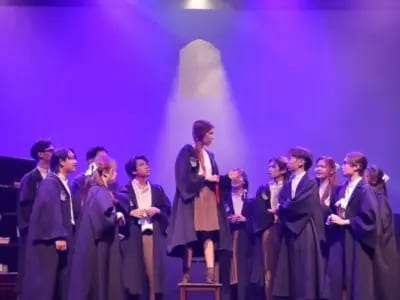
A scene from “Ribbon Club,” the musical. Photo from Hope Theatre. Source: Prachatai, a content partner of Global Voices. Used with permission.
This article by Tara Abhasakun was published by Prachatai, an independent news site in Thailand. An edited version has been republished by Global Voices under a content partnership agreement. It is also part of Global Voices’ September 2026 Spotlight series, “Protest in Democracy.” You can support this coverage by donating here.
This past year, Thailand’s “Bad Student Organization” turned to a new mechanism to question seemingly unbreakable cultural and educational taboos: The theatre.
In 2025, the organization formed Hope Theatre in order to create a dialogue around long-held Thai cultural norms and practices, particularly those involving education and students’ rights. Some of the issues they tackled include corporal punishment, never questioning teachers, mandatory school uniforms, and compliance with haircut regulations.
In September 2025, Hope Theatre delivered its first performance, a musical called “Ribbon Club,” which centered around four students who seek to uncover the truth behind a classmate’s mysterious death at an academy for magic similar to Harry Potter’s Hogwarts. At the behest of Jinny, a top student at the school, students gather to discuss the institution, its rigid rules, how teachers use violence against them, and the identities they are forced to adopt.
As Thamjuthi Thiangtham, 18, who recently completed his freshman year at Chulalongkorn University and works as an editor for the Bad Student Organization, explained, “we started with the question of violence in the context of Thai schools … authoritarianism and violence directed against the lives and freedoms of students.”
He was referring to Thailand’s long-standing use of corporal punishment in schools. It was officially banned in March 2025, but the law has not been strictly enforced. Thamjuthi said that over the past year, his organization received over 200 reports of student rights violations, including corporal punishment, mental abuse, and discrimination against LGBTQ+ students.
Thai teachers still frequently make headlines by imposing physical punishments on students. In June 2025, three months after the ban was implemented, a Bangkok teacher made a student do 200 squats as punishment for late homework. In February 2026, another student was hospitalized after his teacher ordered him to perform 800 squats for failing to submit an assignment.
Raising the issue on stage allowed student actors to address the violence directed again their peers. It also let them magically defend themselves from violent teachers.
Another topic raised during “Ribbon Club,” the musical, is the suppression of classroom questions and debate. In the play, the characters have a special room where they can go for open conversations, similar to the room Harry Potter and his friends secretly gathered in to train against dark magic after a corrupt teacher refused to teach them. It provides a safe space for the students to break free from strict school rules. Inside, they can talk about anything, questioning, challenging, and debating with friends. According to Thamjuthi, it frees them “to openly question the school power structure.”
The room is a plot device which serves to challenge cultural notions of what makes a “good student.” In Thai society, Thamjuthi said, “ideal” students don’t just have academic ability; they obey their teachers and don’t ask questions. “Conversely, a student who is brave enough to ask questions and disagree is considered arrogant … and labeled bad.” However, in the play, when the ‘good’ and ‘bad’ students meet each other and talk in the secret room, they discover there are no differences between them.
In the world of Ribbon Club, it is magic that serves as an indicator of who is a good student. Anything unrelated is deemed useless. Students are expected to use magic every day or — according to an ancient belief — some sort of major disaster will happen. The idea of using magic as a symbol, Thamjuthi said, was meant to help non-Thai audience members who might be less familiar with the context of the Thai education system understand the themes of the play. The audience included members of the Swedish Embassy, as well as some Chinese and American nationals.
According to Thamjuthi, around 80 percent of the audience were young people who already agreed with Hope Theatre’s message and criticisms. The rest were elderly people who agreed with the play’s message but didn’t necessarily support direct protest. Younger audience members thanked the theater group for making them more optimistic and hopeful about change in Thai schools. As for the elderly, although the play “wasn’t polite enough for them,” Hope Theatre’s advocacy drew praise from some, including a very conservative high school principal. Thamjuthi found it impressive that “art has this power to bring people, even those who might not stand on our side, to have more faith in us.”
Hope Theatre’s next performance will likely be staged in late 2026 or early 2027. They haven’t drafted a script yet, but Thamjuthi said it will explore the intense competition to be admitted to Thailand’s top schools. One idea in the works is a reality or game show in which students must fiercely compete to prove their abilities. According to Thamjuthi, “contestants can do anything, no matter if it’s right or wrong, to compete for the prize.”
From the height of Thailand’s youth protests in 2020–2022, the student movement has largely quieted down. In 2020, Bad Student led numerous protests for students’ rights and protections from strict uniform policies, haircut rules, and abusive teachers. Their protests often included costumes and creative expression, such as songs from the Japanese cartoon “Hamtaro.” These protests came amidst a larger protest movement demanding reforms of Thailand’s Article 112, which prohibits criticism of the country’s monarchy. Thamjuthi noted that Bad Student doesn’t engage with national political issues, such as political parties, the constitution, or the justice system. However, regarding the larger protest movement, he remarked that as a result of the government’s ensuing crackdown, “most of our protest leaders had to go overseas … with negative consequences for the movement,” Thamjuthi said.
Thamjuthi remains hopeful for change, despite the election results earlier this year. He notes that “Bad Student” has become a household name throughout the country and no longer carries a negative connotation. “If you’re a bad student in your school, maybe it’s because you’re rebellious. Maybe it’s because you’re brave enough to question your teacher or challenge their power,” he said.
Hope Theatre’s primary challenge, Thamjuthi said, is funding. Last year, the initiative was lucky enough to receive funding from the Swedish International Development Cooperation Agency (SIDA). Now, however, it must find a new source of funding. It is not easy. “To work with students in this society, to work with youth to promote democracy… few funders or businesses are confident enough.”
Hope Theatre is a continuation of the student movement’s focus on art and culture. In the beginning, the organization used dinosaurs to portray conservatives, promoting the slogan “goodbye dinosaurs.” Bad Student has also provided students with cartoon guidebooks to help students understand their rights. Another of their past artistic endeavors involved translating songs from “Matilda” the musical into Thai in order to explain learners’ rights.