‘Students don’t have to be members of a political party to create change,’ says founder of online media platform
Originally published on Global Voices

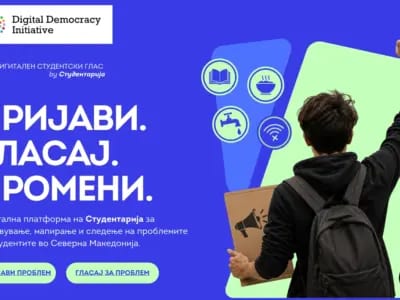
Screenshot from the Digital Democracy Initiative website reads in English: ‘REPORT. VOTE. MAKE A CHANGE. A digital platform by Studentarija for reporting, mapping, and tracking student issues in North Macedonia,’ used with permission.
This interview is part of a series of spotlights on the work of some of the grantees of the Digital Spark granting scheme, as part of the Regional Support Mechanism EECA project, implemented by the Metamorphosis Foundation and TechSoup, in partnership with CIVICUS and under the Digital Democracy Initiative (DDI) that covers the Global South. It is being published on Global Voices as part of a content-sharing agreement.
Students in North Macedonia are not the happiest group: a 2026 survey suggests that over 76 percent of current students are thinking of emigrating. The main reasons for this being cited are “quality of life” and “finding employment suitable to professional qualifications.”
However, what if students themselves could change that? North Macedonia, luckily, has people who decided to take their fate into their own hands and help students achieve a better quality of life, not only for themselves, but for many young people.
At first, Goshe Nikolov, at the time a student himself, founded Instagram-based student media, Studentarija, as an entertainment resource, where students from all over the country shared memes about studies and current events. This outlet now has over 65,000 subscribers, which is a significant number for a country with 53,000 students.
As he comes to the Zoom interview with Global Voices, Nikolov already has nine years of experience running the most successful student media in the country, and with the help of his team of three, has launched a Digital Student Voice, an online platform that enables students across North Macedonia to anonymously report problems related to higher education and student life. They were able to do it with the help of the Digital Democracy Initiative grant.
Nikolov has a wide smile and a confident attitude; he answers questions with the clarity that could only be gained by years of hands-on experience.
We start with the history of Studenjaria.
Global Voices (GV): Could you tell us a little about your student media outlet? How did it start? How did you manage to gain so many followers and so much engagement? Is it only on Instagram?
Goshe Nikolov (GN): Studentarija started in 2017, when I was still a student. I created it from my room in a student dormitory in Skopje. At that time, Instagram was becoming increasingly popular among students in North Macedonia, but there was no Macedonian Instagram page specifically for students. So I decided to create one, and quite spontaneously, in the end it got the name Studentarija, which it still has today. In the beginning, the idea was very simple. It was a place where students could share funny and relatable content. For example, memes, funny videos, everyday posts and situations from student life. So I could never have imagined that one day it would become what it is today. Over time, the audience kept growing, and I think that demonstrated that there was a real need for such a space.
At the beginning of the COVID-19 pandemic, in 2020, I started focusing more on the real problems and challenges faced by students in North Macedonia. Students started coming to us with questions, asking for information and sharing their problems, because they often could not get the information or support they needed elsewhere.
That was when I really understood that Studentarija could play a much bigger role in the lives of students and young people in our country.
So I think the main reasons young people have stayed with us over the years are our openness, transparency, creativity, consistency and, of course, accessibility. Students in North Macedonia know that they can come directly to us, that we listen to them, and that Studentarija is genuinely built around their experiences and their needs.
GV: So do you think it will remain only on Instagram, or are you planning to use other platforms for further development?
GN: At the moment, we exist only on Instagram because Instagram is the main platform where young people and our target audience spend their time. But yes, at the moment we are planning to expand our presence. We are already building our website, and we have already developed a digital platform for students where they can report problems.
GV: Whose idea was it to create such a platform?
GN: I would say that the idea of creating a digital student voice system came naturally from the students themselves. Students began to see Studentarija as a safe space because they came to our DMs and Instagram inbox and told us about problems they were experiencing at universities, in student dormitories, with textbooks, public services and many other aspects of student life. And as a student myself, I couldn’t simply ignore those messages when I saw that something important was happening.
We tried to make these issues public, start conversations, ask universities for answers, or simply give students a place where their voices could be heard.
So, over the years, all these reports were coming into our Instagram inbox. That is one of the main ways we communicate with students daily. But at some point, we realized we needed a much more organized way of collecting, categorizing and following up on students’ problems in North Macedonia. And that is how the idea for Digital Student Voice emerged.
GV: I assume that students’ problems are more or less similar across different countries, but could you give us a few examples of the ones that stand out most in your memory?
GN: Digital Student Voice has existed since April this year, and among the most common problems reported over the last few months, I would say that many were related to delays in state student payments and poor living conditions in student dormitories across the country.
Students have reported, for example, dormitories without hot water and sometimes even without electricity, as well as problems with rodents and insects.
We have also received reports about improper or unfair treatment by professors, problems with grades and examination procedures, and problems with transport in Skopje. So I would say the reports cover a very broad range of issues — from everyday living conditions to much broader questions about the quality of higher education in North Macedonia and the way institutions treat students.
GV: What happens when these problems appear on the platform, when students submit them? What happens to them afterwards? Do we see them being resolved, or not being resolved? Do solutions emerge? Please explain the whole mechanism to us.
GN: I’ll try to explain the process as quickly as possible.
First, we share the link on our Instagram page, because that is our main way of communicating with students.
When students report problems through Digital Student Voice, they first select a category. The problem might be related to discrimination, scholarships or textbooks, student issues, or transport. Then they describe what happened and where it happened, and the report reaches us through a secure anonymous platform.
Every few days, our team checks the reports, organizes and categorizes them, and then looks for patterns. After that, we consider what we can do with them. Depending on the problem, this can mean publishing it on our Instagram page and raising public awareness, contacting the responsible institution, asking for an official response, or drawing attention to a larger problem affecting many students.
Our idea is not simply to collect complaints, but to transform individual students’ experiences into evidence that can be used for advocacy and for creating change. If you want, I can share some examples of what we have done in recent months, if you think that would be useful.
GC: Yes, please do
GN: There is one very interesting example, which demonstrates the potential of this approach. There was a student dormitory in Ohrid. Ohrid is a city in North Macedonia.
Students from Ohrid reported that they had been living without electricity in their dormitory for several days. Imagine being a student, living and studying in a dormitory, and having no electricity for several days.
Without electricity, they didn’t even have hot water, and the food they were receiving was absolutely inadequate. When we learned about this through Digital Student Voice, we started publishing information about the situation and calling for institutional accountability.
After our posts, the story was picked up by major media outlets, television stations, radio stations and online media. That created broad public pressure and eventually led to institutional accountability. Following this case, the director of the student dormitory in Ohrid resigned.
So yes, for me this example shows why it is important to connect students’ individual experiences with media attention and, of course, institutional accountability.
GV: I assume you don’t have many people working on your team. How do you manage to handle all these requests? And have you also tried to influence or engage other democratic institutions, such as political parties or, for example, municipal representatives or something similar?
GN: Yes, regarding the team behind Digital Student Voices, actually, there are currently three of us on the Studentarija team. But yes, we involve institutions, including democratic institutions, when we see that students are experiencing particular problems. We have already contacted various institutions, for example, the Ministry of Education and Science, the National Assembly, Parliament, as well as student dormitory authorities, such as those responsible for the student dormitories in Ohrid.
I would say it is difficult, but we know what we are doing helps a large number of students. That motivates us and keeps us moving forward.
GV: What are your plans for the media outlet and the platform?
GN: Studentarija will continue to exist for students and together with students. At the moment, I am the editor-in-chief of our platform, but we work with students all the time. What it has become today was not built by me alone. It was built together with countless students in North Macedonia over the nine years Studentarija has existed.
At the same time, as I said at the beginning, Instagram is our main platform and, in my opinion, our comfort zone, because it is also the comfort zone of students and of our audience. But we are definitely exploring other formats and spaces where Studentarija can develop both as a media platform and as a way of communicating information and fostering responsible, socially engaged young people.
I have to be honest: since we developed Digital Student Voice, considering the number of reports students have been sending us, I must say that, unfortunately, I have been negatively surprised, because I had not realized that students’ problems in North Macedonia were so much greater than I had assumed.
From what we see every day, from what I read every day, there is a very long road ahead. And of course, we plan to remain here, to push for change and to demand change in the country.
GV: Do you think you are transforming a media organization into a civil society organization: an NGO advocating for students’ rights, or perhaps into a political party?
GN: In terms of the way Studentarija functions today, I think we are a mix of an Instagram platform, a media platform and a civil society organization.
You know, we are not formally registered as a civil society organization, but what we do actually touches on the work of journalists, the work of activists and even the work of institutions.
So, you know, there are different ways in which a young person can be active in society: in a political party, within institutions, as an activist, through a civil society organization, or as a journalist in a media organization. I think we found our voice on Instagram.
You don’t have to be part of a political party to create change in the country. That is something I have learned from my experience so far.
GV: Thank you very much for taking the time to speak with us. All the best to you personally, to your team and to your organization. And to the students in North Macedonia.