"I am very grateful to be here and to be able to rest with dignity at last."
Originally published in Global Voices in Spanish

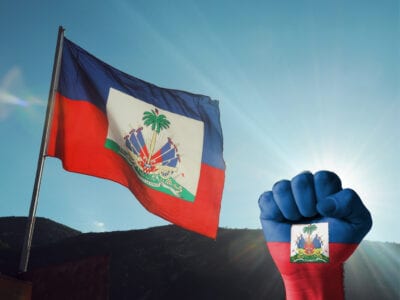
Image of a flag of Haiti and a fist in high in sign of resistance, created with elements of Cova Pro.
The Department of the Centre of Haiti (Central Plateau) is between the departments of the West and the Great North, and covers an area of about 3487 square kilometres (approximately 2166 square miles).
The communes of Sut d'Eau and Mirebalais are famous for their important religious festivities, musical activities and great religious ceremonies. People everywhere visited the local Catholic church. Every July 16, Sut d'Eau celebrates Our Lady of Mount Carmelo (also known as Vyèj Mirak Sodo), with large activities that usually begin in mid-July. Many pilgrims travel to the area to bathe in the waterfall that gives name to the place, pray to the virgin, attend great ceremonies voodoo and enjoy cultural activities.
The department (province) has four communes, or cities, that share the border with the Dominican Republic: The, Thomassique, Sailorand Savanette. The region has a strong agricultural tradition and is known for its important poultry production that includes chickens, turkeys and ducks, as well as cattle, goats and pigs.
The locals raise animals in the open and practice domestic agriculture, poultry can be found in almost all family yards. The Centre's department is the only region in Haiti without a coast, but it shares many rivers and lagoons with the Dominican Republic. In addition, their location at the border facilitates trade between the two countries, although most products come directly from Dominican factories.
Before 2023, this department was characterized as being peaceful and safe especially in comparison with the departments of the West and Beautiful because he had never been attacked by armed gangs. However, this situation began to change on September 25, 2023, when the University Hospital of Mirebalais built by Zanmi Lasante, the country's largest non-governmental health service provider, in collaboration with international partners, suffered its first gang attack. Although the police and local self-defence groups were able to repel the armed groups, it should be noted that before this attempt at incursion, many fleeing violence in the metropolitan area of Port-au-Prince had sought refuge in the department.
The situation got worse 30 March to 3 April 2025, when gangs operating in and around the capital launched a major armed attack on the department of the Centre, with the specific objective of Mirebalais and Sut d'Eau. These gangs were led by Jeff Larose (also known as Jeff Gwo Lwa) Canaan Taliban gangand Wilson Joseph (known as Lanmò Sanjou) of the gang 400 Mawozo. Both groups are part of the criminal coalition known as Viv Ansam ("Living together"). Before burning houses and farms, the attackers systematically looted the property and personal property of the locals. They destroyed police stations, released prisoners, burned down businesses, shot people and looted the hospital.
Many died in these attacks, according to reports No. International Organization for Migration (IOM), United Nations Integrated Office in Haiti (BINUH) and the United Nations Office for the Coordination of Humanitarian Affairs (OCHA). The violence forced thousands of people to flee their homes and seek refuge in other communes in the department, including the cities of Hinche, Sailorand Maissade. According to IOMSome 147,000 displaced persons fled to seek security.
Since then, most of the inhabitants of communes such as Mirebalais and Sut d'Eau have had to move to neighbouring areas and stay in public spaces, such as schools, which they use as shelters. The conditions are very difficult, there is overcrowding and lack of hygiene.
On 5 June 2026, IOM, in collaboration with the civil protection agency in northern Haiti, and with the support of the United States Embassy in Port-au-Prince, initiated a relocation programme which allowed more than 350 displaced families to move from two schools as shelters in Hinche to a new transit centre. Prior to this initiative, these families were housed in classrooms with up to 15 other family units, and they lived together for up to 70 people in the same room.
Now, in addition to having more space and privacy, they also have better access to water, sanitation and hygiene services. The transfer will allow more than a thousand students to return to the classrooms in September, when the new school year begins.
Marie Christiane, a displaced woman, says when she arrived in Hinche, He thought he was going to die."I left my home, where I lived in good condition, and I ended up sleeping in a school, on desks and slate that we put on the ground. That caused me a deep pain. Stalled water was accumulated inside the school and the smell was unbearable. Our children were constantly sick; the mosquitoes were constantly bitten. That is not life [...]; here I can breathe pure air. It is something totally different from school, where it was exposed to serious health risks."
Madelene, who is also a victim of gang violence, expressed satisfaction with the transfer and commented: "I used to sleep in an open corridor, exposed to cold. Coming here marked the beginning of a solution for us. We finally have a comfortable place to sleep. At school, I didn't even have enough room to change my clothes. I had to get down just to get in and out. I am very grateful to be here and finally be able to rest with dignity."
Loukas Garanis, IOM field emergency officer, noted that the new site "consists of 20 hangars, with 14 different and separate rooms. There are eight health modules, each equipped with three latrines and three showers. There is an open space where children can play safely. There are about 80 solar lamps to help reduce protection risks, as well as six large water tanks of a thousand gallons each. There is also a large community kitchen with a cooking area and a safe storage space."
Despite these improvements, part of the department of the Centre remains under the control of armed gangs who continue to extort the population with illegal controls, identity checks, the abduction of cargo trucks, as well as acts of kidnapping, rape and sexual assault against women and girls. They are targeting persons suspected of working with the police as informants, as well as members of self-defence brigades and journalists or influential persons who report their acts of terror. In many cases, when a suspect or someone who violates his rules is captured, he is executed. Sometimes even its own members are not free of this violence.
While these gangs continue to terrorize the population, a combination of armed self-defence groups, the Haitian National Police and members of the Protected Areas Security Brigade and the Haitian Armed Forces occupy important areas of the department; this has so far prevented gangs from taking over the entire region.