And helping to make the goals for EU accession plausible
Originally published on Global Voices

This interview is part of a series of spotlights on the work of some of the grantees of the Digital Spark granting scheme, as part of the Regional Support Mechanism EECA project, implemented by the Metamorphosis Foundation and TechSoup, in partnership with CIVICUS and under the Digital Democracy Initiative (DDI) that covers the Global South. It is being published on Global Voices as part of a content-sharing agreement.
Montenegro is on its way to joining the EU; at the moment, the goal is to do so by 2028. The United Nations Economic Commission for Europe (UNECE) review in 2025 states that the country has made significant progress in aligning its environmental legal and regulatory framework, as well as much of its national legislation, with European Union (EU) directives.
However, some problems remain, including waste management and a very low recycling rate — less than 2 percent, far below the EU’s 50 percent target.
Austrian Member of Parliament Thomas Waitz (Greens/EFA), chair of the delegation to the EU-Montenegro Stabilisation and Association Parliamentary Committee, said in an interview with The New Union Post that there have been “massive improvements” in Montenegro, citing as an example the closure of more than 100 illegal landfills in the last year: “It is a great effort for such a small country. But they have another 500, and if we expected them to have them all cleaned up, it would be impossible.”
While politicians and international agencies discuss how Montenegro could get closer to the target and put its waste management under control, ordinary citizens are making practical steps to improve the situation today.
This Digital Spark spotlight story is about one such organization, EkoGard, and the many people who participate in its efforts and, step by step, try to make Montenegro cleaner.
Global Voices interviewed the organization’s founder and general director, Senad Pepić, about the impact of Digital Spark and its community initiative.
Global Voices (GV): Please tell us about your organization and why you chose to get involved with the Digital Spark project.
Senad Pepić (SP): EkoGard was built through years of work on the ground, not in an office. It grew out of the Očistimo Rožaje initiative, where we spent six years building a strong community of people ready to take action. We started with illegal dumpsites, but our work gradually expanded to other environmental and social issues affecting everyday life.
We organized cleanups, worked with young people, launched campaigns, and encouraged residents to tackle problems that kept coming back.
We joined Digital Spark because we wanted to bring what we learned in the field together with digital tools and data. We hoped to show a fuller picture of the problems and change how people talk about them. EkoMapa grew out of that idea as a natural next step in our work.
GV: What issue or challenge in your community prompted you to undertake this project?
SP: One cleanup in particular made us rethink our approach. We cleared an illegal dumpsite beside a rural road, in an area where residents had no suitable place to dispose of their waste. The nearest legal disposal point was about six kilometers away.
After the cleanup, we asked for a waste container to be installed and were promised that the problem would be addressed. Three years passed; the container was never installed, and the dumpsite returned.
Its return changed how we saw similar sites elsewhere. We had photos, posts, and letters from other areas, but no way to see the full extent of the problem or how it related to gaps in waste collection services.
We wanted to map these places and understand the conditions in each settlement. Doing that gives us a way to show local institutions where waste disposal services are lacking and talk about what needs to change.
GV: What are the key changes or activities that your organization implemented during your participation in the project?
SP: Before this project, EkoGard organized cleanups, worked with young people, held educational activities, ran campaigns, and drew attention to local problems. Through Digital Spark, we began collecting and analysing what we saw in the field more systematically.
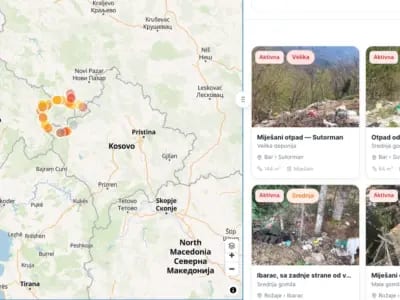
EkoMapa started as a map of illegal dumpsites, but it grew into a tool for understanding environmental conditions across the community. We decided to look at conditions settlement by settlement, so we could connect the problems we found with the services available to residents.
We also developed a model that uses the information we collect to assess environmental risks and gaps in local services in each settlement. It helps us spot patterns, compare needs across settlements, and discuss what the data shows with local institutions.
GV: How did your participation in the project impact your organization’s beneficiaries and the community that you serve? Please provide examples.
SP: Our activists now have a practical tool and a clearer way to document what they find. We can use that information in public campaigns and make a stronger case for change.
For residents, we can now show how the problems they face relate to the services available in their settlements.
Organizations from other towns and countries have also shown interest in using the tool to understand conditions in their own communities and involve residents in finding solutions.
The local waste management company has also recognized that the information could be useful in its work. For now, the clearest changes are in how our activists work and in the conversations we have begun with other organizations and local institutions. Changes on the ground will take longer.
GV: How has your own knowledge, awareness, and experience with digital democracy and civic space changed, thanks to your participation in the project?
SP: Through the project, we learned that giving people a way to report a problem is only a first step. They also need to know why we collect the information, what we will do with it, and how it might lead to change.
The training on how to reach people and communicate more clearly was especially useful. It made us think about the words we use and how to talk about problems without making people feel powerless.
For us, digital democracy means residents can help identify problems and take part in finding solutions. When we collect, check, and present what they tell us clearly, it can inform our campaigns and conversations with institutions. It also helps us ask for clearer answers.
GV: What are the most valuable lessons and experiences you are taking away from this project?
SP: The most valuable lesson is that technology cannot solve a problem on its own. It can help us see what is happening across a community, but it cannot replace fieldwork, talking with residents, or working with institutions.
Finding a problem on a map is just the beginning. We also need to understand why it happened. If we only deal with what we can see, the same problem is likely to return.
When we bring the data together with people’s experiences, we can start to propose solutions that meet their needs. That is what we will take into our future work: listen, look for patterns and causes, and use what we learn to push for change.
GV: What comes next? How will you apply the learning and digital capacity you have built in your future work and within your community?
SP: Our next step is to present our findings to the local government and make the case for better planning of waste collection and other local services. We want to draw attention to settlements that have been overlooked for years and follow up on how institutions respond.
We are already applying what we learned to EkoGard’s wider work, especially our campaigns and how we involve residents. Together with other organizations from Montenegro, we are preparing a campaign to establish a National Eco Line, a nationwide channel for reporting environmental problems and following up on how the responsible authorities respond.
We know the results may take time, so we will keep working with other organizations and local institutions.