For her, a buriato suit is not an exhibition, it's important to see the person
Originally published in Global Voices in Spanish

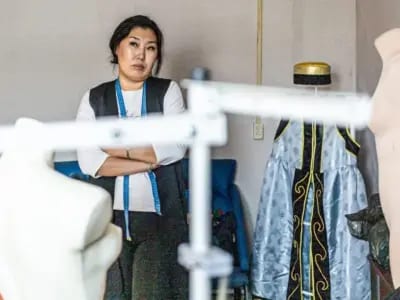
Oksana Alkhunsaeva. Image through Glubina.me. Used with permission.
This article was originally published in Russian in the Russian medium Potok and Novaya Vkladka on May 11, 2026. Global Voices translated it into English, edited it for clarity and reproduces it with permission from Potok and Novaya Vkladka. It is also part of the August Global Voices Spotlight series "Indigenous rights. " You can support this report with adonation.
One night, Oksana had a dream. He dreamed of his late grandmother. In the dream, her grandmother only said one word, "Cose." Currently, the suits made by the costume designer broiates Oksana Alkhunsaeva is charged throughout Russia, from Moscow and St. Petersburg to Yakutsk and Kamchatka.
Oksana was the youngest in the Khunkheev Buriata family. Born in 1984 You-Ordynsky, small town of approximately 15,000 people in the Irkutsk region. She was a very long-awaited daughter, after two men. His parents' family observed traditional rituals and spoke buriato, although it was not usual at that time. Oksana recalls that in her childhood she "saw everything in buriato" and that "everything was made as if that was just the natural way things should be done."
The broiates are a Mongolian people the indigenous region of the Lake Baikal. Historically, they were part of the political and Mongol culturalwhile retaining numerous Mongolic tribal clans and identities. They traditionally constituted the largest subgroup of Mongolic North.
The Russian colonization of these parts of Siberia began about 1620, with the strong military advance of the Russian Army, Cossacks at that time, and its conquest from eastern Siberia. They built strengths, imposed taxes (they forced the buriates to pay taxes regularly to the Russians), and eventually displace existing policies with Mongol rulers. The Buriate Communities resisted repeatedly, attacked Russian positions or fled south to Mongolia before the Russian authorities were established between the late 17th and early 18th century.
Under the Russian Empire and especially during Soviet Union, colonial integration deepened through the distribution of land and economic resources, collectivization, repression of Buddhist institutions and Buriata elites, and increased cultural rusification. The Soviet authorities also eliminated the word "Mongolian" of the name of the republic in 1958.
Today, most buries stay inside. of the Russian Federation, particularly in the Republic of Buriatia. Since Russia's large-scale invasion of Ukraine in 2022, Buriatia has also reported having had mobilization and disproportionately high military casualties. The independent media Ludi Baikala counted 9200 Buriatia and Irkutsk region killed in the Russian invasion of Ukraine from 2022 to 2026.
In the context of this story, the Khunkheev family did not wear the traditional dress on a day-to-day basis, but Oksana's grandmother had gutuls (buries boots) real. Oksana loved clothes and sew since she was a kid. He played with dolls and imagined himself as a fashion designer who created designs and made clothes. I saw the novel "Just Mary", famous at that time, in which a common Mexican girl from a rural and remote province moves to the capital, Mexico City, and becomes a designer. Little Oksana of you-Ordynsky dreamed the same thing.
His adolescence was difficult. In eighth grade, she was transferred to a new school and immediately became an outcast. She was used to her brothers and her father calling her "beautiful." But at school, his companions mocked his fleshly lips, turned his last name into insults and kicked his backpack full of books through the halls. Oksana learned to close emotionally, so far, any conflict detonates what she calls late reaction syndrome. The pain and wounds do not feel immediately, come hours or days later, and it is really difficult to process. He wanted to understand why people behave like this, so then he studied and obtained a university degree in Psychology.

Three generations of the Khunkheev- Alkhunsaev family. Used with permission.
It was because of causality that Oksana came to work at the Centre for Preserving and Developing the Buriato Ethnic Group. When it joined in 2008, the Centre was organizing the Festival Altargana in Irkutsk.
This festival for the Burundian communities was first held in 1994 in Mongolia. Since then, it has become an international and large-scale event, attended by people from all over the world, from Inner Mongolia in China to France. Oksana was completely amazed by the magnitude of the event and what she saw there.
"Before that, I had barely seen our national dress. But at the festival, all the wealth of Buriate traditions were together. I looked and admired him," remember.

You-Ordynsky is Oksana's hometown. Oksana takes measures for young dancers in the cultural center. Used with permission.
The festival is named after the Altargana plant, which with its small leaves and yellow flowers looks humble, but has an incredible and well developed root system. Oksana thought a lot about her own roots and then found out exactly what she wanted to create, but she was still far from it.
After his second maternity leave, Oksana worked in sales and other non-sewing work. It only sew in the nights, when he finished his working day and his children slept, but for her dreams were never something abstract, always paying attention to whatever was presented to him in that way.
He had a sewing machine that he won in a competition, there was a piece of fabric out there, the kids fell asleep at ten and that night he had a little time off. Oksana knew I should sew, but I didn't know how. He made his first suits for his family and loved ones, and he wanted his children, nephews to wear national suits and be interested in their culture.
The results began to look beautiful, but they turned out to be very traditional. With the dress made strictly "according to the canon" there was no place to wear it. He also wanted recognition and visibility, so Oksana tried to participate in different fashion shows. In a parade, a journalist approached and asked for an interview, it was exactly how it happened in "Just Mary."
Although the walkway, bright lights and professional models seemed to be the dream I had imagined as a child, over time Oksana began to see that his greatest aspiration is for people to wear their suits. And he adds that he was named best designer in the Buriato district of Ust- Orda in 2023.
For her, the buriata dress is not just a museum exhibition, it is important to see the person and start the work. First, try to understand what forms and silhouettes the customer likes in his everyday clothes, and that's when he "translates" those preferences to the language of the buriata dress.
Now, Oksana's whole family works together. Her husband is the organizer, her mother helps in fashion parades, iron the clothes and finish sewing urgent jobs, her father makes special knives and takes everyone where they need to go. Her mother-in-law and sister-in-law also help her.
Laughing, Oksana admits that sometimes she would like to go back to calm, to a stable office life, but when they come to her and ask, "Where can I find a suit like yours?," she realizes that every time thoughts about leaving come into her mind, life is in charge of sending her signs deliberately, "it's as if someone wouldn't let me go and keep saying" sew '. "