Climate patterns are intensifying, and Latin America is facing an increasing challenge in food security
Originally published in Global Voices in Spanish

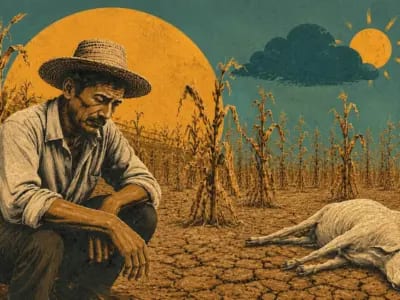
Illustration of Connectas. Used with permission.
East Article of Fabiola Chambi was originally published in CONNECTS 2 September 2026. Global Voices reproduces a version edited under an editorial agreement.
"We are sad, totally desperate, we have lost flames, alpacas, sheep, so far we have not even been able to account for (...) By that we solve ourselves, we make our children study and sell our products to the city." The last strong snow that René Luna remembered surprised him almost 25 years ago, but never like this time. A white mantle covered the landscape and hundreds of animals were buried in its municipality in central Bolivia, now declared a disaster zone.
This situation, according to experts, is a consequence of the phenomenon known scientifically as El Niño-Oscillación del Sur (ENSO), which in Latin America causes extreme temperatures or lack of rainfall in the middle of the rainy season, which also leads to crop losses in rural localities where producers see, with impotence, how their effort of months or even years is plagued.
The sustainability of Latin American families depends on hard work in the field, distribution systems and access. But unfortunately that chain is increasingly vulnerable due to climate events than the change and aggravate the situation in some subregions.
In the 2026 edition of "The State of Food Security and Nutrition in the World," five international agencies indicated in the report that "25.8% of the world's population (about 2100 million people) suffered from moderate or severe food insecurity in 2025, which means that these people were sometimes forced to choose to eat less quality or less food." Paradoxically, the data revealed a decrease in hunger for the third consecutive year, which means that improvements are possible, but remain fragile and uneven.
Lena Savelli, regional director of the World Food Programme (WFP), explains that in order to understand this phenomenon in relation to food security, three factors must be taken into account: one, the conditions of the countryside; two, prices and availability in the market; and three, the purchasing power and the diets of families.
He predicts that "What we will probably see within the next few months is that extreme droughts or rains (...) will reduce yields of key crops such as corn, beans, rice, and even cocoa and coffee, which will shrink their offers and raise prices in markets and shops (...) So, this means eating more expensive and less varied, especially for those who already have low incomes. Families can see that the basic basket of their home becomes more expensive and purchases become more difficult."
However, Latin America and the Caribbean face a paradox, Savellli says: "It is an exporting region, but at the same time it has the highest cost in the world for a healthy diet. Like almost five dollars, $4.91 exactly per person per day. And people in this region don't have that income to feed their families, millions can't afford to eat well. That is why we have a double burden of hunger, but we also have obesity that impacts the economy."
According to the monitoring of WFP, several countries have already emergency response and El Niño is expected to intensify during the second half of the year. For Jhenifer Mojica, a Colombian agricultural expert and former ambassador to the Food and Agriculture Organization (known as FAO), "family agriculture, which includes indigenous peoples and local communities, is at the heart of food supply, but there is little awareness of how we depend on that supply." 80% of our countries' food security depends on these small productions. "
"An individual producer can barely deal with this alone, and what we're going to see is a huge amount of losses, as we're already seeing," adds Mojica. "For example, the forest fires in Spain, predominantly agricultural region where coffee, cocoa, fruit and vegetables are grown. For a family of farmers, a harvest is not just a harvest, it is to lose your family's property. "
The Child turns on the alarms
This phenomenon includes three phases: El Niño, when the surface waters of the equatorial Pacific have an anomalous warming that occurs on average every two to seven years and usually lasts from nine to 12 months. The girl, when those waters cool more than normal. And a third phase characterized by the transition between the two, with average temperatures or in their usual values, and a duration of one to six months.
For Christian Dominguez, a researcher at the Institute of Atmosphere and Climate Change at UNAM, this phenomenon has always existed because it is part of a natural variability and over time has undergone increasingly intense changes
According to the World Meteorological Organization (WMO), climate-risk areas will be the Central American Dry Corridor (a strip that crosses Costa Rica, Nicaragua, Honduras, El Salvador and Guatemala), the Caribbean and northern South America, which will especially face droughts, water deficits and heat waves.
For its part, the Pacific coast of Ecuador and Peru can be affected by extreme rains and floods. And South-East South America will have more than average rainfall and severe storms.
A difficult future
Many governments are moving forward in rapid action to address the emergenciesbut there is still an important way to achieve efficient prevention. Savelli points out about addressing the structural causes: "It is not only about producing more, we have to face challenges such as persistent inequality, low social mobility and unnutritious diets. A number of countries in the region are still struggling with high rates of child malnutrition, and we must strengthen local food systems to ensure that production also reaches markets."
Some good experiences are highlighted in the Dry Corridor of Central America, where they are implementing alerts about when or not to sow, and practical prevention messages. Another alternative is climate insurance to protect individuals, companies and governments from economic losses caused by weather events.
The risks also extend to access to basic services, health (by mosquito proliferation), infrastructure impacts, transport and jobs. According to the report "El Niño 2026-2027 and the world of work in Latin America and the Caribbean"of the ILO, informal, rural workers and those working in the open air are among the most exposed. As the report explains:" El Niño 2026-2027 is first and foremost a test of the institutional resilience of Latin America at a time of accumulation of external impacts "
El Niño returned in June and its effects are already visible from space.
New maps show much lower chlorophyll concentrations than in other years in the equatorial Pacific, a sign of changes in the phytoplankton that supports the marine trophic network. https: / / t.co / vJlP0v0XYQ- NASA in Spanish (@ NASA _ es) August 25, 2026


As Dominguez adds, "We also have to consider that climate change is intensifying phenomena we already know new: droughts, heavy rats, heat waves, even cold waves. These existed long before, but by altering our environment, our atmosphere, we now face the consequences. So how do we live with this? We need to learn to adapt and respond through early-warning systems. "
As Dominguez adds: "We must also take into account that climate change is exacerbating the phenomena we already knew, such as droughts, heavy rains or heat waves, even the gallid waves, but that already existed for a long time, only that we have changed our environment, our environment, the atmosphere and we have consequences and repercussions. Now, how do you live with this? We need to know how to adapt and respond to these events through early warning systems."