Following a national trend, Brasilia concentrates the green spaces in the most prosperous areas
Originally published in Global Voices in Spanish

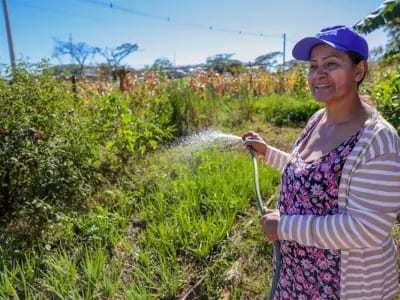
Nasaré Francisca da Silva irrigates crops in Floresta da Nasaré, in Ceilândia, Brazil, where his project of agroforestry from a dump was born. Photo by Fabio Pozzebom / Dialogue Earth, used with permission.
This article by Lobato Felizola was originally published in the Dialogue Earth website 14 July 2026. Global Voices reproduces it with editions under an editorial agreement. It is also part of the work of Dialogue Earth in the project Community Adaptations to City Heat (CATCH) in partnership with Boston University.
Brasilia was named an ecological city. Planting trees was so important when planning the Brazilian capital who described it as city park. This is evident in its central area, with avenues with fresh and aligned trees where neighbors love to walk. The city was built in just 41 tables, and replaced the savannah-type bioma of the Closed with a glowing new capital.
30 kilometres (19 miles) from Pilot Planin the favela Sol Nascente, central area designed as an aircraft, the ecosystem was replaced with concrete. The Pilot Plan notes on average 138 square meters (1485 square feet) of green space per inhabitant, but a study of the Brazilian University of green urban spaces revealed that in some areas of the periphery of Brasilia that figure can be 23 times lower. These surrounding areas are characterized by "limited vegetation and greater distances to green areas," says the study.
Sol Nascente consists of paved streets, with houses stacked on top of each other and narrow sidewalks that can barely accommodate pedestrians, less trees. The heat is a huge problem. "There are times when the whole street is in the sun, and the air does not circulate," says neighbor Francisco Silva.
Health impacts can be severe. "Everything dries, my nose bleeds," says Silva, 34, who suffers from rhinitis and bronchitis, interrupts his sleep. "If I close the window, I can't breathe; if I open it, the dry wind and dust come in."
In the dry season, wash the courtyard every day, put wet towels throughout the house and wear mask. To fight the heat, Silva is renovating his house to leave space to grass and bouts. On the sidewalk has planted the only tree on the street, a Lone lapacho, common species in Latin America.
Valdir Steinke, author of the study of the University of Brasilia, says that the Federal District of Brazil (where Brasilia is) reflects a national pattern of "green spaces concentrated in the most well-off areas, while on the outskirts there is almost nothing." Indeed, the average income for housing in Pilot Plan is 12 times higher than in Sol Nascent. "It is a hard and crude portrait of a pattern of socio-economic segregation in which urban planning is the periphery ignores nature," Steinke says.
These problems are exacerbated as climate change increases temperatures, which increase mortality and morbidity. In response, the local government is planning a tree planting programme, and the neighbors resort to "guerrilla gardening" where urban planning has failed.
Green inequality is a global problem
Sol Nascente emerged in the 1990s on illegally occupied rural lands. Now, more than 70,000 people they live in a territory of nine square kilometres (3.4 square miles). This population density is almost 16 times higher than the Federal District average. With asphalt, low vegetation and population concentration, the favela gives the ideal conditions for the call urban heat island.
"The concrete absorbs and retains the sun's heat more efficiently than vegetation, while the trees refresh more with their shade and moisture," explains Gregory Wellenius, director of the Center for Climate and Health at Boston University in the United States.
What happened in Sol Nascent follows a global pattern. One recent analysis of 199 cities around the world concluded that inequality in access to green spaces is widespread, and the level of inequality in cities in developing countries is twice as high as developed countries.
"Extreme heat maps are much like low-income neighborhood maps," says Jeremy Hoffman, a researcher at Groundwork USA, a network of American organizations working for climate justice. "The heat centers tend to overtake areas characterized by higher poverty, lower educational achievement, higher rates of chronic diseases and less access to green areas."
3-30-300
Cecil Konijnendijk, an expert in urban forests and honorary professor at the University of British Columbia in Canada, proposed the rule "3-30-300"to address green inequality in cities. The rule stipulates that each person should be able to see at least three trees from his window, live in a neighborhood with at least 30% tree coverage, and be no more than 300 meters (984 feet) from a park or green space to ensure visual and physical access to nature and its benefits.
Urban planners around the world have adopted the rule. Now guide policies to plant trees in Belgium, Sweden, the Netherlands, the United States and Canada.
In Brazil, the National Plan of Urban Arborization, submitted at the climate conference United Nations COP30 In 2025, it is inspired by this rule. It recognizes that Brazil's random urbanization has led to landscape fragmentation, deforestation and land sealed under concrete that, combined with climate change, has a negative impact on urban life.
To reverse this situation, the plan sets targets to be achieved by 2045. One is to increase the proportion of inhabitants with at least three trees in their immediate environment, which would give green spaces about 40 million more people.
Some experts question how universal the 3-30-300 rule is. Paulina Achurra, from the educational platformArq.Future, warns that green programs cannot help in communities with "barely sidewalks to plant a tree."
According to Achurra, who spoke at a conference in São Paulo, "although innovative solutions are lacking that incorporate green spaces, they must be able to be implemented in our cities [of developing countries]."
Extreme heat carries extreme risk

Sol Nascente, one of the country's largest favelas, is characterized by paved streets with almost no trees in sight. Photo by Fabio Pozzebom / Dialogue Earth, used with permission.
Larissa Brenda Cordeiro, who presides Daughters of the Earth Institute, socio-environmental justice organization in Sol Nascente, says the afternoon heat can make it impossible for the organization to have meetings or work in its office. With his asthma and fibromyalgia, he also feels the physical effects: muscle and joint pain. "I don't feel well in the cold or during periods of extreme heat."
Patricia Fabian, a heat expert at Boston University, says that those living on urban heat islands are more exposed to the harmful effects of high temperatures: "When there is more heat in the environment, the risk of health impact, including cardiovascular diseases, cognitive problems and respiratory symptoms, and even death, is greater."
During the dry season, the temperature in some parts of central Brasilia can reach 37.8ºC (100ºF), while in Ceilândia, which was incorporated to Sol Nascent in 2019, it reaches 46.6ºC (116ºF).
Protect and grow
One of the few green spaces in Sol Nascente is a remnant of Lagoinha Park, which was gradually defortified by invading settlements. The buriti indicates abundant groundwater, but the waste is accumulate unusually, including the springs that feed the Melchior River and the Descend basin, which provides more than 60% of the water supply Federal District.
In December 2025, the Federal District approved its plan to reduce its "green deficit" in its surrounding areas. In Sol Nascente, the Government told Dialogue Earth that it can't start planting until problems like narrow sidewalks and lack of rain water drainage are solved, because the toilets will not survive. He did not specify whether these work would be done.

Trash spread in one of the few green spaces of Sol Nascente, Lagoinha Park. Photo by Fabio Pozzebom / Dialogue Earth, used with permission.
Now, Lagoinha Park is like a big field with few native trees. Activists like Cordeiro hope that one day it will be a wood area with picnic tables and sports courts: "Our dream is that Lagoinha will become a suitable park for people to enjoy."
They have a model to follow for this project: on the border between Sol Nascente and Ceilândia, a conservation project called Floresta da Nasaré He came out of a dump. In 2009, Nasaré Francisca da Silva, a housewife, undertook the work of cleaning a lot the size of a public-land football court in front of her home. Then he planted seeds. "People were throwing things of all kinds here, from ruse from buildings to dead animals," he recalls. "I saw it from my door and I was sad."
From a seed came the agroforestry system that now has the neighbors, NGOs and researchers of the University of Brasilia. The care given to the land by Da Silva was officially recognized in 2023 by the Federal District Government. Although it does not receive public investment, there is less risk that they will be expropriated by land or that their work will be interrupted without notice.
In the hot days, under the canopy of the trees it continues to make fresh. "Everyone is welcome to come here and refresh themselves from the heat," says da Silva.