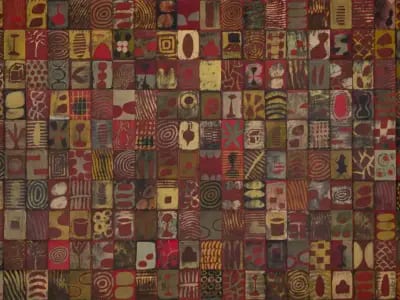
‘[P]ainters cannot escape the state the world is currently in. In my work, I try to seek out another reality …’
Originally published on Global Voices

Jaume Amigó, ‘Papers d’aigua I,’ 2023. Acrylic on paper, 290 x 420 cm (114.2 × 165.4 in). Photo courtesy of the artist.
For Jaume Amigó, painting can be a form of resistance, not by reproducing the violence and disorder of the present, but by creating an alternative space within it. At a moment saturated with immediate and often brutal images, the Catalan artist turns toward silence, contemplation, beauty and the rhythms of nature. “Painting is also a way of taking a position,” he says, through “the creation of another possible space” that, by contrast, “can also become a form of resistance.”
Born in Barcelona in 1963, Amigó studied engraving and printmaking at the Llotja School of Art and Design. Painting remains central to his practice, but he has also worked in sculpture, ceramics, engraving, installation and scenography. Based in l’Alzina de Ribelles, in Catalonia’s La Noguera region, he has exhibited widely in Spain and abroad, including in Japan, Morocco, the Netherlands and Switzerland.

Jaume Amigó at his studio in l’Alzina de Ribelles, Catalonia. Photo courtesy of the artist.
Amigó’s work has the poetic economy of a Japanese haiku: forms, memories and sensations are pared down to their essentials, creating a sense of suspension between presence and absence. His paintings invite a slower kind of looking, where color, gesture and emptiness open space for contemplation. Entre núvols has similarly been described as a “visible haiku” that distills “a poetry of the essentials.”
Travel is central to his visual language. Amigó calls himself “a collector of forms,” absorbing shapes, materials, textures and even smells from Japan and Morocco. Japan, which he has visited for decades, taught him “to say more with less,” while Morocco enters his work through tides, traces and landscapes transformed into memory and abstraction.
In an interview with Global Voices, Amigó speaks about memory, intuition, travel, emptiness, the solitude of the studio, and why silence and beauty can themselves become forms of resistance.
Excerpts from the interview follow:

Jaume Amigó, ‘Between Clouds, Tinglado 2,’ Moll de Costa, Port of Tarragona, 2025. Photo courtesy of the artist.
Omid Memarian (OM): You’ve described the studio as “mobile and permeable” to its surroundings, and your work transforms what you encounter — a rice paddy, clouds, water lilies, or the traces left by tides in Morocco — into abstract forms. What happens between seeing something and painting it?
Jaume Amigó (JA): I normally paint what I've seen outside my studio, drawing on recollection and memory. It’s what remains of that experience, what resists the passage of time, that finally becomes fixed on the canvas or paper.
During this process, many forms disappear, and only those I consider most representative remain. Deciding what should disappear and what should remain is, to a large extent, an exercise in intuition — a synthesis of what memory has preserved. In this way, the act of painting also becomes a form of improvisation, a dialogue between what I remember and what happens in the very act of painting.
Over the years, I’ve worked in numerous studios, spaces where I‘ve been able to carry over and work through the experiences accumulated during my travels and my life. But at the bottom, the studio isn’t so much a physical place as a space that moves with me: it’s wherever I happen to be at any given moment.

Jaume Amigó, ‘Low tide,’ 2023. Acrylic on fabric, 162 x 194 cm (63.8 × 76.4 in). Photo courtesy of the artist.
OM: You trained in printmaking and engraving techniques, which have carried over into your painting, while you also work with handmade paper, ceramics, iron, pigments, and materials like kaolin. How do material and technique shape the work?
JA: Since I was very young, I’ve used pigments to make my own paints. It’s a way to stay in direct contact with the earth and nature, bringing matter from the world around us into the work.
My creative process doesn’t follow any established rule. It’s an act in which intuition plays a fundamental role. In painting, one of the hardest decisions is determining when a work is finished. Usually, the work itself tells you it shouldn’t be touched anymore.
During my working process, many pieces get left abandoned at the back of the studio. Some stay there for months or even years, until I come across them again. When I recover them, they often surprise me in a positive way, and in many cases they need very little intervention to reach completion. Other times, instead, I paint straight over them in white and start again.
I’ve also always felt the need to step outside my comfort zone — painting — and work in three dimensions. Over the years, I’ve found the materials I consider most suitable for each idea or obsession, whether on canvas, on paper, or in sculpture.

Jaume Amigó, ‘Feuilles blanches.’ 2026. Acrylic on canvas. 114 x 146 cm (44.9 × 57.5 in). Photo courtesy of the artist.
OM: Japan has been part of your life for more than 30 years, while Morocco has also become an important place for your practice. Rather than simply appearing through recognizable imagery, these places seem to enter your work through materials, textures, gestures, and ways of observing nature. How has working in different places changed the way you see?
JA: I’ve always considered myself a collector of forms — forms that, over time, I incorporate and transform in my painting. Japan and Morocco have brought a great deal of new material into my work: forms previously unknown to me, new materials, even smells that have sparked some interest and that, one way or another, end up becoming part of my imagery.
I’ve worked many times in Japan and Morocco, and each of those trips has been enriching. But perhaps the most interesting part of traveling is the moment of coming home and returning to my studio. That’s where I can empty out all the sediment I’ve been accumulating during the trip, and somehow put in order what I’ve seen, felt, and gathered.
I always use notebooks for drawings and sketches. I need to give ideas material form, to leave a trace of whatever appears during the process. I think that ideas, if they don't find a form on canvas or paper, eventually expire and disappear.
When I return to my studio, I also start looking at my surroundings differently. After being away, what I already know can take on new forms and meanings.

Jaume Amigó, River I, 2024. Acrylic on fabric, 150 x 150 cm [59.1 × 59.1 inches]. Photo courtesy of the artist.
JA: Japan has always been a very important source of inspiration for my work. Through my travels, I’ve come to discover its aesthetics through its landscapes, its ceramics, and its paintings, but above all through living alongside its people and the friends I’ve made there.
When I read Matsuo Bashō’s The Narrow Road to the Interior, I was quickly fascinated by his ideas and by his way of expressing a concept with extraordinary brevity and, at the same time, sublimity. Almost without realizing it, Bashō became part of how I think and understand painting: how to use emptiness, how to reduce and pare down the use of color, how to say more with less.
In a painting, I believe form and emptiness carry equal weight. It’s a difficult balance to put into practice, but very rewarding when it’s achieved. I’m especially interested in that tension between what is present and what we choose to leave out. I’m also deeply drawn to the concept of impermanence — the idea of something destined to disappear, which precisely for that reason takes on special value. It’s a concept that interests me and that I feel works very naturally within my work.

Jaume Amigó, ‘Between Clouds, Tinglado 2,’ Moll de Costa, Port of Tarragona, 2025. Photo courtesy of the artist.
OM: We are surrounded by immediate, often brutal images of wars, displacement, and human suffering. Your work demands a very different kind of attention: slowness, silence, abstraction, natural cycles, and the traces of what disappears. What can abstraction offer at such a brutally concrete moment?
JA: It’s true that painters cannot escape the state the world is currently in. In my work, I try to seek out another reality, to build a space where beauty, silence, and the cycles of nature help me find my place in a world increasingly saturated with banal, meaningless images.
Painting alone in my studio lets me step away from all that, to forget it for a moment. But that distance doesn’t mean ignoring it. On the contrary, it also lets me become more aware of what’s happening around me and find a way to position myself in relation to it.
For me, painting is also a way of taking a position — not necessarily through a direct representation of reality, but through the creation of another possible space: a place of silence, contemplation, and beauty that, precisely by contrast, can also become a form of resistance.