The light cuts in Cirenaica paralyze the wells and pumps, making an electricity cut into a water crisis.
Originally published in Global Voices in Spanish

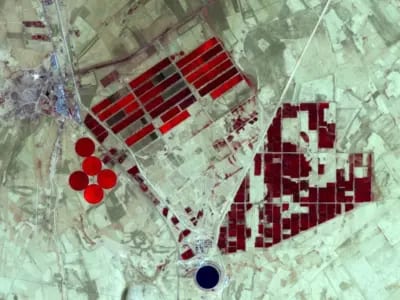
Great Omar Mukhtar reservoir project south of Bengasi. Photo by Jesse Allen, NASA Earth Observatory, who uses data courtesy of NASA / GSFC / METI / ERSDAC / JAROS and the US and Japan ASTER scientific team. Wikimedia Commons. Public domain.
For the population of Cyrenaica in eastern Libya, recent electricity cuts have become inseparable from access to water. On July 18, a blackout throughout the region interrupted the power supply to the Sarir and Tazerbo well fields, and to a Bengasi. Electricity began to be restored gradually from 8: 00 (local time); the supply was recovered first in Sarir and around noon in Tazerbo. The Authority of the Great Artificial River It then began to gradually restore the functioning of the wells and the flow of water as electricity returned.
It wasn't an isolated cut. On 30 May, another widespread blackout stopped all the operating wells in Sarir, Tazerbo and Hasawna before the technicians started a gradual restart, according to a second report from the Libyan News Agency. The same incident affected the water reserves of Ajdabiya and to a pumping station in Suluq.
By July 3, the problem had been repeated so much that the Authority of the Great Artificial River publicly blamed the constant electrical interruptions for disrupting water production. Alwasat reported that a single electrical disturbance had left 41 wells out of service in Sarir and 11 in Tazerbo, while the authority said that repeated outages were affecting daily urban and agricultural water needs.
On July 23, another cut linked to the shutdown of a generating unit at the Sarir gas power plant left 143 off-site wells92 in Sarir and 51 in Tazerbo. Water supply to some cities and areas was reduced for 24 hours to protect the system and preserve levels in the Ajdabiya reservoir. The General Water and Sewage Company then offered tankers for inhabitants, hospitals and care centres, according to Libya Alahrar reported.
Why does the failure of a service become a political issue?
Libya's energy crisis is national, but in Cirenaica service failures have a political significance added by a long history of centralization and regional inequality.
The current Libya formed in 1951 from Cirenaica, Tripolitania and Fezan as a federal kingdom; federalism ended in 1963. Cirenaica is the historic eastern region, with centre in Benghazi; Tripolitania is the western region, with centre in Tripoli; and Fezan is the historic southern region, with centre in Sabha.
Bengasi, the main city and historical political center of Cirenaica, was fundamental in the lifting of 2011 against Muammar Gaddafi. Al Bayda and Tobruk have played important administrative roles; Al Marj and Ajdabiya are important eastern centres. Federalist currents, and separatists later show how services, resources and regional identity intertwined politically. This regional marginalization has a documented political record. An analysis of the Carnegie Foundation In 2012, he recorded the eastern complaints about parliamentary representation, scholarships abroad and diplomatic appointments after 2011.
Oil-rich geography with fragile services
The contradiction is exacerbated when considering Libya's resource map. The United States Energy Information Administration notes that Libya has the largest proven oil reserves in Africa and that about 95 per cent of recoverable reserves are concentrated in the Sirte and Murzuq basins.
Much of Libya's resource base is in the east and south, while the main financial and administrative institutions remain concentrated in the capital, Tripoli.
This does not mean that oil or electricity produced in a region belongs only to that region, or that western Libya is safe from the collapse of infrastructure. The Libyan network is interconnected at the national level. In October 2021, the General Electricity Company announced the reconnection of the east and west wings precisely so that the network could use the generation of the plants throughout the country.
Historical records also show interregional flows. In January 2016, the electric company declared that the cutting of the lines between Ajdabiya, the Wahat area and the west network subtracted 350 MW of the plants of Sarir Oueste and Zueitina, which increased the scheduled cuts in the Great Tripoli and in central and southern Libya.
In May 2025, the flow worked in the opposite direction: energy Western lines to help restart the eastern generation. The evidence supports the existence of a national dual-sense network, not a proven policy of deliberately taking away a fixed "Cirenaica quota" for Tripoli.
This raises a more difficult question: when blackouts persist near major energy and water infrastructure, how are decisions on electricity flows, investment and cargo management distributed among the regions of Libya?
A planning crisis, not a lack of resources
Libya has alternatives: gas, an extensive Mediterranean coast, vast desert areas and great solar potential. However, on July 10, the Sarir- Sirte and Tazerbo- Bengasi water system reached its highest daily production since 2011, although power cuts remained an operational problem.
The data of the World Bank places the population of Libya at about 7.5 million inhabitants by about 1.76 million square kilometres (almost the combined area of France, Spain, Germany, Italy and Belgium). With abundant energy resources, persistent failures in electricity and water point beyond scarcity: they point to planning, governance and responsibilities.
This helps explain the uncomfortable nostalgia of some Libyans. People who consider that the Muammar Gaddafi regime (1969-2011) was authoritarian can still remember that electricity and water were more predictable. This is not a support for the dictatorship; the deterioration of services can make stability gain great weight in collective memory.