The Nepalese protests of September 2025 left physical, emotional and financial scars on many young people
Originally published in Global Voices in Spanish

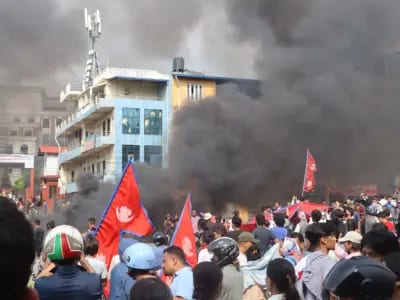
Nepal Z-generation protests against corruption in Bharatpur, central-southern Nepal. Image via Wikipedia Himal Subedi (CC) BY-SA 4.0).
This article is part of the September 2026 Global Voices Spotlight series, "Protest in democracy. "With this series, we seek to explore the various forms of protest, the tactics that States use to de-legitimize and eliminate them, and the complex relationship between protest and democracy. You can support this coverage with a donation Here..
Nepal commemorated its first Generation Z Martyrs Day on 8 September 2026 with a national holiday, when it was exactly one year since young protesters took to the streets and led to a fundamental change throughout the country's social and political system.
In September 2025, Nepal was involved in national demonstrations led mainly by students and members of Generation Z. The movement began when the Government banned several social networksbut quickly transformed, although not have a leadership defined, in a collective expression of frustration about corruption and government inefficiency. For several days, Nepali youth mobilized throughout the country to protest restrictions on online freedom of expression; and too against corruption, the alleged diversion of public funds and the development of wealth by political elites and their families. The demonstrations led to clashes with the security forces that intensified and led to of forceincluding serious violations of human rights human rights.
Liza's frustration
Among the victims of the violence is Liza Adhikari, 21, who received a SLR rifle shot while standing in front of the Parliament Secretariat building. The projectile hit her in the back, went through her body and went out ahead, and left her a wound that is not cured with simple sutures.

Liza Adhikari is taken by stretcher to the National Traumatology Center Hospital in Kathmandu, half an hour after the shot. Image via Liza Adhikari. Used with permission.
Adhikari, a senior student in Business Administration at Kathmandu University, has not been able to return to classes since the incident. In addition to physical damage, he faces a heavy emotional burden.
She asked for financial help through social media and went through various hospitals in Nepal for treatment. In view of the limited local options, he travelled to India, where he recently submitted to a brachial plexus surgery, the nervous net that transmits signals from the spinal cord to the shoulder, arm and hand that allows movement and sensitivity.
In an online interview with the author from a hospital in India, Adhikari explained to Global Voices that the projectile caused severe damage to the bone structure of his arm and that the doctors informed him that the blood vessels ceased to function properly. The chances of a complete recovery remain uncertain; yet, it has not lost its determination.

Liza Adhikari is currently in Mahakali Province (Sudurpaschim), Nepal. Photo taken by his mother. Used with permission.
That same determination was the one that led her to march that day, a fact that she today remembers with deep regret. Although the bullet was removed, the sequelae continue to condition their health and studies.
Liza wasn't the only one on the streets that day.
The story of Shantanu
The survival of Shantanu Dhakal of Itahari, Sunsari district, Koshi province, reflects the impact of a no longer limitedto the capital.
On September 8, 2025, Shantanu was in college without imagining that the protest day would mark a turning point in his life. In the previous days, the call had been reported through social networks.
The 18-year-old, the only child of a middle-class family of Morang districtin eastern Nepal, he joined the march in Itahari with conviction, and carried a banner with slogans made with his friends.
"During the first hour, the streets were quiet. But suddenly, the crowd started marching aggressively, burning objects and throwing stones at public property and the municipal office. It lasted about two hours. Around 1600 hours, bullets and tear gas were fired at the civilian population. When the first shot sounded, the bullet went to the other side; no one knew where. But when they shot a second time, I didn't realize that the hit was me," he said in an online interview.
In a matter of seconds, the manifestation to which he had joined with enthusiasm became a struggle to survive.
He regained knowledge a minute later, after being transferred to a nearby clinic where he was sold the wound. He was then taken on a stretcher to Birat University Hospital. From that journey he remembers that "he had lost his hearing and his sight completely. It is likely that no sensory receiver was working properly at that time."

Shantanu during treatment in Biratnagar. Image via Shantanu. Used with permission.
His first instinct was to run, which probably avoided major injuries. The bullet entered him on the left side of the jaw, fractured the alveolar bone and injured the soft tissues of the mouth cavity before moving towards the chest.
What followed was not only an emergency intervention, but the beginning of a long process of rehabilitation. It was initially performed a tracheotomy and remained intubated to breathe. He then needed grafts as part of his treatment.
While for some a wound ends up becoming a simple physical mark, for Shantanu the scar preserves the memory of the lived. Even ten months later, the trauma reappears. There are days of repentance and painful memories; others of adaptation and acceptance. In the end, life goes on.
However, the sequelae go beyond the skin. The injury limited their physical movements, especially when eating and sleeping, and the impact is even more evident when working in the field. His body has been through two surgical interventions, although none is considered to be of high complexity.

Shantanu standing in front of the Prime Minister's office in Singhadurbar, Kathmandu. Image by Shantanu. Used with permission.
The recovery process also represented a financial burden for his family. Prescription medicines are not always easily achieved and are expensive. Fortunately, most medical care It was covered. the Government of Nepal.
Not all who went out on the streets suffered bodily injuries, but many were marked by fear and trauma.
The story of Riya
The Riya police (protected name) lived a similar experience. In a face-to-face interview with the author, he reported that on 8 September 2025 he was serving in BaneshworKathmandu, along with several colleagues. "The street was calm for the first half hour, but suddenly the situation became violent."
"Some of my colleagues were taken away by the police, while I was struck by several stones, which caused severe contusions on my left foot. They moved me to a nearby hospital and sold me the wound," he said.

Riya receives medical care at a clinic. Image by Riya. Used with permission.
Fear persisted after leaving the medical center. "It was the most terrifying moment. Even at home, that feeling took time to disappear," he recalled.
Just on September 8, 19 people lost their lives during the protests And hundreds were injured. However, the deaths did not silence the claims. Abhijeet Adhikari, a lawyer and political activist, reflects on this day in telephone conversation with Global Voices: "No principle of proportionality was respected," which intensified the public's demand for accountability.
Justice and responsibilities
After the establishment of a interim government As a result of the mobilizations, multiple investigations were initiated to identify responsibilities and promote judicial proceedings. One Commission of Inquiry court headed by Gauri Bahadur Karki recommended Stop the authorities involved, such as the then Prime Minister K. P. Sharma Oli and the Minister of the Interior, Ramesh Lekhakamong others.
However, in July 2026, an independent review panel found that the available evidence was insufficient to charge them with criminal liability. A year later, judicial proceedings face political divisions and the clarification of responsibilities remains uncertain.
In the midst of these indefinitions, Liza, Shantanu and Riya expressed their reflections on the impact of the protests and the aftermath of violence on the anniversary.
For Liza, those days remain linked to repentance and the consequences of a decision that I would like to change. "Perhaps, if I had listened to my parents that day, this would not have happened to me," he said.
Riya chose not to get caught in the past. "What happened, happened. It was already left behind," he said, although he keeps his reservations about the country's course.
For his part, Shantanu is facing the scar on his face without allowing him to define his future. Newly graduated from high school, advances to its pace and prepares to enter the Engineering career. Looking at him, his smile says everything.
Maybe that's the strength that defines every survivor as him.