"Any activity that changes the health of the oceans could have long-term consequences..."
Originally published in Global Voices in Spanish

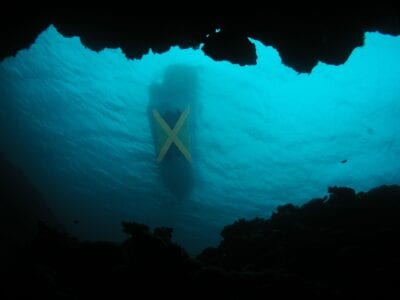
Take from below the water of a boat with a Jamaican flag in the lower art of the hull. Image created with elements of Cova Pro.
For the Jamaican fishing community, the sea has always been the main source of food, sustenance, freedom and future. It is their pantry, their workplace and their cultural space, but as multinational companies They put their eyes on the minerals which are well below the bottom of the ocean, the questions ariseWhat will happen to those who live from fishing in these waters when the sea bed itself becomes a resource to exploit?
The answer to that question could be decisive for the the future of Jamaica's fishing activityand the effects of climate change anda weigh on community resilience. Deep-water mining generates sediment penachos, destroys habitats and reduces biodiversity, which affects the food chain and leaves fishermen in the face of an uncertain marine economy.
What is high seas mining?
The National Oceanographic Centre defines deep-water mining as the "process by which mineral resources are extracted from the sea bed, usually more than a thousand meters deep." These resources consist of cobalt, copper, manganese, nickel and other rare elements used to manufacture batteries of electric vehicles, air turbines, solar panels and electronic devices for daily use.
Despite being key to promoting clean energy the mining of these elements causes serious concern for the environment. For those living from fishing in Jamaica, the situation is that some of the minerals that provide climate solutions elsewhere could pose new risks to the waters on which their subsistence depends.
A global debate with local risks
Deep-water mining has become one of the more critical environmental discussions of our time, which means a wide range of consequences for a country like Jamaica, where identity and economy are so closely linked to the sea. Although this industry is not currently being seen in Jamaican waters, the discussions on the subject They raise critical issues of governance, the impact on livelihoods and ecological resilience.

Geographer Jesse Cleary, Duke University's Geospatial Marine Ecology Laboratory. Photo used with permission.
In Kingston, the International Seabed Authority (ISA), an intergovernmental body responsible for regulating the activity related to the marine bed mineral resources beyond national jurisdictions, continues to discuss how, where and under what conditions mining could be carried out. These developing talks are critical and not abstract for Jamaica.
Jesse Cleary, geographer of the University of Duke, he explains: "We do not know for certain what impacts [deep-water mining] would have," and he added that the uncertainty surrounding the issue requires that it be observed in detail. A policy document of the United Nations Special Rapporteur of 2025 notes that deep-sea mining represents a potential threat to the protection of human rights, in particular the rights to food and cultural security, which are at the centre of coastal communities.
Diego Alonso Lillo Goffrieri, lawyer member of the Inter-American Association for the Defence of the Environment (AIDA), warns: "If we neglect, others will make the decisions for us." He stressed that the absence of civil society benefits Governments and companies that promote mining without accountability.
The risk to coastal communities
Alex Simpson, director of marine protected areas of the Alligator Head Foundationexplains: "The food security, livelihoods, tourism and cultural identity of Jamaica's coastal communities depend entirely on a healthy marine ecosystem. Any activity that disrupts ocean health, whether through sediment penachos, underwater noise or ecological alterations, could have consequences for populations dependent on those ecosystems."
Simpson points out that, even before mining begins, "the mere fact that it is mentioned raises the need for Jamaica to strengthen governance over its ocean, invest in scientific research and ensure that decisions on marine resources are based on sound evidence and effective citizen participation."
Fisheries and livelihood
"If deep-sea mining alters the population of marine species, their migratory patterns, spawning areas or the food network in general," Simpson emphasizes, "these changes could reduce catches and increase uncertainty among fishing communities."
It also mentions another possible factor of tension that would increase their vulnerability: "While measures are being taken to move to pelagic fishing, the migration routes of these species could be the most affected, and that would nullify efforts to diversify livelihoods."
Concern about biodiversity and ecology
There are other aspects to be considered. Simpson stresses that mining would cause habitat destruction, sediment penachos, underwater noise and the release of polluting agents. Such changes would directly affect deep sea organisms and therefore change the ecological relationship between deep and surface ecosystems.
From his own acoustic studies on coral reefs, Simpson explains: "The sound has an impact on the health of the reef and the recruitment of fish, but we do not have data on the possible impact of the noise generated by mining on the reefs and the fish population. From a conservationist perspective, Jamaica should avoid any irreversible damage until science can reliably evaluate the irrigation."
Community knowledge and participation
Simpson believes that it is possible to improve the information received by communities: "While deep-water mining is complex, and many coastal populations, as can be understood, prioritize the most immediate problems, this reality makes information accessible, balanced and scientifically sustained more essential."
It must start with people on the ground, or rather in the water. "Local knowledge of the fishing community offers perspectives that escape the scientific method," Simpson emphasizes. "Communities must have the opportunity to learn about potential economic arguments as well as environmental irrigation, ask questions and participate actively in decision-making. Most importantly, such participation must take place before moving forward with political decisions."
The role of civil society
Simpson believes that non-governmental organizations and other civil society entities play a key role, as they "can convey the complexities of science in accessible language, facilitate dialogue among stakeholders and ensure that local voices are represented in the same way as technical and political staff."
These organizations can also "identify research failures, promote prudent decision-making and promote policies that give priority to long-term environmental sustainability along with economic considerations."
Why should Jamaicans care?
Although the discussions on deep-sea commercial mining are well advancedthe ongoing negotiations in the International Seabed Authority affect the conditions under which it should proceed in the Zonethe sea bed and ocean soil beyond national jurisdiction.
For Jamaica, where the headquarters of the International Seabed Authority and participating in these negotiations, the process is very close. Although the areas initially considered for mining are largely in the Pacific Ocean, the rules that are negotiated in Kingston are made to govern mineral-related activities throughout the Area, wherever they occur.
This means that what happens in the Pacific is not simply a regional issue. The decisions now taken will help to establish the international framework for how deep-sea mining will be regulated, what environmental safeguards are needed, how benefits are divided and how countries and companies assume their responsibility.
The Pacific therefore offers Jamaica and the Caribbean in general an important case of study. Scientific uncertainties, questions about governance and concerns by the Pacific communities and ocean defenders can help countries in the region understand the possible consequences of a heading that could extend beyond the Pacific.
For Jamaica, attention to these developments is not about assuming that the same impacts will take place in the Caribbean, but about understanding the rules that are created, lessons learned from the Pacific debates, and what it would mean for fishermen, ocean governance and the future of the region.
From there, the connections only become more complex. Many marine species move much across national and ocean boundaries in their life cycles, while ocean ecosystems are linked by interconnected food networks. Changes to deep-water habitats or the organisms that support these networks could have consequences beyond the immediate mining areas, depending on the species and ecological processes involved.
Understanding these paths is important for Caribbean countries, as they consider what deep-sea mining can mean for their own marine ecosystems and fisheries. Simpson emphasizes that "the decisions made today on emerging industries, such as deep-water mining, could have consequences that last for generations."
On the other hand, Cleary sees that the waters surrounding the Caribbean countries "overlap in an ecological and economic way." He says that although the territories make individual decisions, "what their neighbours do has a great effect." Thus, only an accident or a poorly managed project is needed to eclipse the region's reputation as an excellent tourist destination.
For fishermen, the potential risks are less immediate, but it is worth considering. Cleary points out that mining activities near the coast already compete with space and can contaminate the waters where turtles, sharks and dolphins live. If deep-sea mining expands to areas that support interconnected marine ecosystems and fisheries, it could add another layer of uncertainty to already reduced fish.

Diego Alonso Lillo Goffrieri, lawyer of the Inter-American Environmental Defense Agency (AIDA). Photo used with permission.
Understanding how these impacts reach, if they reach, Jamaican waters need more evidence about movements, food networks and other oceanographic connections of species. Goffrieri outlines the issue in terms of rights: "First, you have the risk of impact on the country's livelihoods and food security [and] there is a big issue that is overlooked in the rights of indigenous peoples."
There are scientific studies that reinforce these problems. One 2025 peer-reviewed article of PLOS ONE revealed that deep-sea mining could increase by 13% and raise social risks by 8 to 11%. These figures are part of a simulation analysis of the study that was done with deep-water mining and without deep-water mining.
Another study of the University of Hawaii at Mānoa that published in Communications, showed that deep-water mining sediment columns could affect zooplankton and micronekton, and threaten tuna and other commercially important fish.
Governance gaps and community impact
Although deep-water mining is still on the test stage, Gofferi points out that "Governments often do not facilitate the participation of civil society, because it is an obstacle to their taking on responsibilities." He warned "there are many regulatory mechanisms outside the Mining Code... the environmental threshold to be developed has not progressed."
Instead, there are pressure to pass regulations quickly, which puts mining at risk without proper security measures. The International Seabed Authority Mining Code has the objective of balancing priorities such as protecting the marine environment, ensuring a fair distribution of benefits and setting clear parameters. The Authority also points that there is currently no commercial exploitation of deep-sea mineral resources in the Area; current activities are limited to basic environmental exploration and studies.
However, Gofferi argues that "countries are unlikely to have effective control in an activity that is so far and so deep at sea. This is basically science fiction." At the same time, the Committee is concerned that, since the mechanisms for sharing benefits are weak, income is likely to benefit businesses rather than communities.
This suggests that Jamaica's coastal and fisheries communities can bear environmental costs without seeing economic returns. Compensation for developing countries whose land mining economies could be altered has hardly been discussed, leaving small nations and their fishermen vulnerable to economic impact.
Voices missing
The fishing prospects of Jamaica and other deep-water-related organizations do not participate in the narrative, which highlights a complicated reality: those likely to be most affected by deep-water mining They're not part of the conversation., which reveals a gap between decision-making and those most directly affected.
Without more determined initiatives to inform, include and strengthen Jamaica's coastal communities, fishermen risk being excluded from decision-making that will define their livelihoods and cultural links to the sea.
For now, deep-water mining remains an imminent possibility rather than a living reality, but as Cleary points out, "We don't really know what the impact could be in all its magnitude." Gofferi adds: "Only if we show interest in the process and encourage our countries to do the right thing, so will they."
Simpson makes a strong call on Jamaica's specific context: "Healthy oceans are fundamental to healthy communities and resilient economies. Although there is scientific uncertainty, that doubt should encourage careful consideration and not complacency. We must adhere to the precautionary principle: when the risks are uncertain but potentially serious, we must prioritize protection."
For Jamaican fishermen, who are already facing the growing challenges of climate change, having a voice in these decisions is particularly important. While the effects of deep-sea mining would depend on where and how activities are carried out, the decisions that are made today could have implications for marine ecosystems and fisheries beyond the mining areas. It will be essential to ensure that the concerns and knowledge of coastal communities are taken into account as these standards develop. "