International law recognizes the right to adequate housing
Originally published in Global Voices in Spanish

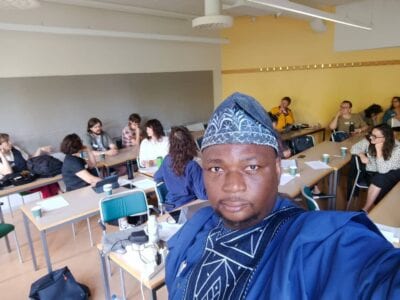
Kehinde Adegboyega, co-founder and executive director of Human Rights Journalists Network in the conference on the right to housing. Photo used with permission.
In different African cities, urban growth often has a cost that especially affects the most vulnerable sectors: forced evictionsinformal settlements demolished to give way to urban renewal projects and land use decisions made with little or no consultation to those living there. In Lakes, Cape Townand other cities These patterns raise a question that transcends urban planning: who decides the future of a city and the knowledge of who is taken into account in making those decisions?
The question was present at the Common City conference, held in Uppsala, Sweden, where academics, activists and grass-roots organizations met to discuss housing, urban justice and the right to the city. He was among them. Kehinde Adengboyega, co-founder and executive director of Human Rights Journalists Network Nigeria (HRJN), invited as an organizer and exhibitor of the panel "Resist authoritarian urbanism in sub-Saharan Africa: Alternative knowledge and common property of housing in Lagos and Cape Town."
The session discussed how communities in Nigeria and South Africa respond to forced evictions, dispossession and unequal urban development. It also addressed how the knowledge generated by these same communities, often relegated in public policy discussions, can become tools for accountability, rather than being reduced to raw materials for external researchers.
Global Voices spoke presentially with Adengboyega about their participation in Uppsala and the links between the conference discussions and the reality of the displaced communities of Lagos. They also spoke about how this experience can contribute to their work in documenting human rights violations in Nigeria.
Jean Sovan (JS): You were in Sweden to participate in an international meeting focused on the right to housing. What led you to participate there and what do you expect to get from this experience?
Kehinde Adegboyega (KA): I am in Uppsala, Sweden, participating in the Common City Conference at Uppsala University, which brings together scholars, activists, researchers and grassroots organizations working on housing, urban justice, and the right to the city.
I was invited as a panel organizer and presenter for a session titled 'Resisting Authentic Urbanism in Sub-Saharan Africa: Counter-Knowledge and the Housing Commons in Lagos and Cape Town.' The session brings together experiences from Nigeria and South Africa to examine how communities and civil society actors respond to displacement, dispossession and unequal urban development.
For me, the conference is an opportunity to bring experiences from Nigeria into a global conversation while also learning from housing justice movements and researchers working in very different contexts.
I am particularly interested in taking away practical approaches to community organizing, documentation, and knowledge production that can strengthen how we support communities facing displacement and housing insecurity in Nigeria.
Kehinde Adegboyega (KA): I am in Uppsala, Sweden, participating in the Common City conference at Uppsala University, which brings together academics, activists, researchers and grassroots organizations working on housing, urban justice and the right to the city.
I was invited as an organizer and exhibitor of a panel entitled "Resist authoritarian urbanism in sub-Saharan Africa: alternative knowledge and common housing goods in Lagos and Cape Town." The session brings together experiences from Nigeria and South Africa to discuss how communities and civil society actors respond to displacement, dispossession and unequal urban development.
For me, the conference represents an opportunity to incorporate Nigeria's experiences into a global conversation and, at the same time, to learn from the housing justice movements and from researchers working in very different contexts.
I am particularly interested in taking me with me practical tools for community organization, documentation and knowledge production that can strengthen our support to communities facing displacement and difficulties in accessing housing in Nigeria.
JS: Housing is often mainly addressed as a social or economic issue. What new perspectives did the conference talks on housing bring to you as a fundamental human right?
KA: One of the strongest lessons for me is that housing is not simply about having a physical structure over one's head. It is connected to dignity, security, livelihood, family life, community, participation, and the ability to belong to a city.
When people are forcibly evicted from their homes without meaningful consultation, adequate protection, or access to remedy, the issue goes beyond property or economics. It raises fundamental questions about human rights and the relationship between citizens and the state.
The discussions here have reinforced my understanding that we need to look at housing through a broader human rights framework. The right to adequate housing is recognized in international human rights law, including Article 11 of the International Covenant on Economic, Social and Cultural Rights, and it is closely connected to other rights.
This perspective is particularly important in context where urban development can prioritize investment and infrastructure projects while treating low-income communities as obstacles to development.
KA: One of the most important teachings for me is that housing is not just having a roof. It is linked to dignity, security, sustenance, family life, community, participation and the possibility of belonging to a city.
When people are forcibly evicted from their homes without being adequately consulted, without adequate protection or access to redress mechanisms, the problem goes far beyond property or economy. It also raises fundamental human rights issues and the relationship between citizenship and the State.
The talks here have reinforced my conviction that we must address housing from a human rights perspective. The right to adequate housing is recognized by international human rights law, including article 11 of the International Covenant on Economic, Social and Cultural Rights, and is closely linked to other rights.
This is particularly important in contexts where urban development can prioritize investment and infrastructure projects while considering low-income communities as obstacles to development.
JS: In Nigeria, inequality, forced displacement and vulnerability of certain communities remain major challenges. What links do you find between the discussions in Sweden and the realities in Nigeria?
KA:There are significant connections. Although the political, economic and urban contexts are different, we see similar questions around who has the right to the city, who gets to make decisions about urban development, and whose knowledge counts.
In Lagos, for example, informal and low-income communities can face eviction, displacement, and reform pressures. These communities are often described through statistics or development narratives, but their own experiences and knowledge are not always adequately represented in policy discussions.
That is where the idea of counter-knowledge becomes important. Communities are not simply victims or beneficiaries of urban policy; they possess knowledge about their neighbours, history, housing systems, and survival strategies.
Our work in Nigeria is therefore not only about documenting violations. It is also about ensuring that communities can document, narrate, and advocate for their own experiences.
KA: There are important links. Although the political, economic and urban contexts are different, we find similar questions about who is entitled to the city, who makes decisions about urban development and what knowledge is considered valid.
In Lagos, for example, informal and low-income communities can face evictions, displacement and pressures from urban renewal projects. They are often described through statistics or development speeches, but their own experiences and knowledge are not always adequately represented in public policy discussions.
That is where it is important to recognize the knowledge that arises from the communities themselves. Communities are not simply victims or beneficiaries of urban policies; they have a deep knowledge of their neighbourhoods, their stories, their ways of accessing housing and their strategies to move forward.
That is why our work in Nigeria is not just documenting violations. We also seek to enable communities themselves to document, count and defend their experiences.

Kehinde Adengboyega. Photo used with permission.
JS: Was there any idea, perspective or experience that has been discussed during the meeting that you consider could be adapted to the Nigerian context?
KA:Yes. One important idea is the use of community-generated knowledge as a tool for advocacy and policy change.
Too often, research about vulnerable communities is produced externally, while communities themselves have limited control over how their experiences are documented and represented. Approaches that involve residents directly in documentation, mapping, photography, storage, and evidence production offer a different model. This has strong potential in Nigeria.
For example, journalists, researchers, human rights organizations, and affected communities could work together to create community-owned documentation of evictions, housing conditions, access to basic services, and changes in neighbours. This could combine journalism, participatory research, digital tools and legal advocacy.
The important principle is that technology and documentation should not simply be used to document communities, but to give communities greater capacity to document themselves and influence decisions affecting them.
KA: Yes. An important idea is to use the knowledge generated by communities themselves as a tool to defend rights and change policies.
Too often, research on vulnerable communities is carried out from the outside, while its members have little control over how their experiences are documented and represented. The perspectives that directly incorporate locals in documenting, mapping, photographing, narrating stories and collecting evidence offer a different model. This has enormous potential in Nigeria.
For example, journalists, researchers, human rights organizations and affected communities could work together to create community-run records on evictions, housing conditions, access to basic services and slum change. This would allow for the combination of journalism, participatory research, digital tools and legal actions.
The fundamental principle is that technology and documentation should not be used simply to register communities, but to give them greater tools to document their own reality and influence decisions that affect them.
JS: International meetings often generate valuable conversations, but their real impact is measured by what happens next. What do you take from this experience and how can you strengthen your work on human rights in Nigeria?
KA: I want to take three things: knowledge, networks and methodology.
First, the conference expanded my understanding of housing justice as a human rights issue that goes through different dimensions of social life.
Secondly, it provided links between the experiences of Nigeria and other African countries and the housing justice movements and research groups working in other parts of the world. These relationships can contribute to future research, impact actions and knowledge exchanges.
Thirdly, I want to strengthen our approach to documentation. In Human Rights Journalists Network Nigeria, we work with journalists and human rights defenders to document violations and give greater visibility to the voices of marginalized communities. I see an opportunity to more explicitly incorporate housing rights into this work.
This could include more rigorous documentation of forced evictions and displacement, training for journalists on housing rights, support for the collection of evidence by communities themselves and the production of stories that link specific cases to broader issues of urban governance and inequality.
JS: As a journalist and human rights defender, how can these international exchanges help journalists and civil society organizations in Nigeria to document and defend the right to housing and other fundamental rights?
KA: International exchanges provide something very valuable: The ability to see local problems through comparative perspectives.
A journalist covering an eviction in Lagos may initially see it as an isolated local story. But when you engage with people working on similar issues in Cape Town, Dublin, Marseille, or elsewhere, you begin to see common patterns around land, property, displacement, urban governance, and power. That comparative understanding can improve journalism.
It can help journalists ask better questions: Who benefits from redevelopment? Who is being displaced? Were affected communities consulted? What alternatives were considered? What legal protections exist? Where is public money going? Whose voices are missing from the development narrative?
It can also help civil society organizations build stronger evidence for advocacy and litigation, while creating connections with organizations facing similar challenges elsewhere.
For me, international exchange is therefore not simply about attending conferences. It is about bringing new methods, relationships and perspectives back into local practice.
KA: International exchanges offer something very valuable: the possibility of observing local problems from a comparative perspective.
A journalist who covers an eviction in Lagos can initially see it as a local and isolated case. But when you come into contact with people working on similar issues in Cape Town, Dublin, Marseille or elsewhere, you begin to recognize common patterns related to land, property, displacement, city management and power. That comparative look can improve journalism.
It can help journalists ask better questions: who benefits from the renewal? Who are you moving to? Were the affected communities consulted? What alternatives were considered? What legal protections exist? Where's the public money going? What voices are left out of the development discourse?
It can also help civil society organizations to gather stronger evidence for their advocacy and litigation actions, as well as generate links with organizations that face similar challenges elsewhere.
For me, therefore, an international exchange is not simply to attend conferences. The aim is to bring new methodologies, relationships and prospects back to local practice.
JS: After these exchanges in Sweden, what is the message or new perspective that you would like to take most to Nigeria and why do you think it could make a difference to vulnerable communities?
KA:The message I would bring back is simple: The people who live in our cities must have a meaningful say in how those cities are raped.
Development should not mean that communities have to survive their homes, histories, livelihoods and social networks without meaningful participation, protection and remedy.
We need to move beyond seeing vulnerable communities only as people who need to be protected. They are also knowledge holders, rights holders and active participants in shaping the future of their cities.
If we can strengthen community participation, documentation and access to information, we can change the balance of power between communities and institutions making decisions about land and urban development.
For me, that is the real value of housing justice: Not simply ensuring that people have houses, but ensuring that people have dignity, security, a voice, and a meaningful place in the future of the city.
KA: The message I would take is simple: those who live in our cities must have a real participation in how these cities are transformed.
Development should not mean that communities have to deliver their homes, stories, livelihoods and social networks without effective participation, protection and redress mechanisms.
We must stop considering vulnerable communities only as people in need of protection. They are also knowledge depositaries, rights holders and active participants in building the future of their cities.
If we can strengthen community participation, documentation and access to information, we can change the balance of power between communities and institutions that make decisions on land and urban development.
For me, that is the true value of justice in housing: it is not just a question of ensuring that people have a housing, but of ensuring that they have dignity, security, voice and a real place in the future of the city.