It's easy to take citizenship for granted when you get it automatically and you never have to defend it.
Originally published in Global Voices in Spanish

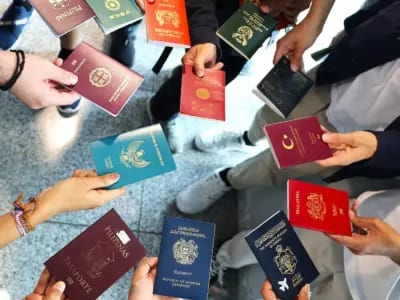
Group of people with their passports at Wikimania meeting held in 2024. Image by Ahmad Ali Karim, CC0 through Wikimedia Commons.
This article is part of Global Voices' July 2026 Spotlight series, "Statelessness. "This series provides a detailed view of the problem of statelessness and how it limits freedom of movement, educational opportunities, political access, and more. You can support this report with a donation.
I have been aware for years that statelessness is a problem of vital importance and very little is spoken of; I first wrote about it in 2017. In large part, I am fascinated by its almost invisibility: as many of our articles of this month point out, it is easy to take citizenship for granted when it is automatically obtained at birth and never must be defended.
Despite my interest, it was when Global Voices began to work closely with the Global Movement against Statelessness (GMAS), our partner in the "Spotlight" series on "Statelessness"of July 2026, that I began to understand a wide variety of ways in which people become stateless, and the various effects it has. I associated statelessness with refugee status, with groups that, usually because of intolerance, were not welcome in their countries of origin. That is certainly one of the causes of statelessness, and we can see some of its many forms in the" Spotlight "series, as in this story about an artist from Myanmar who struggle to redo his life in France, or in this one about a trans woman who fled Russia.
By talking to GMAS members and attending some of their events, I discovered other ways in which people can be left in statelessness, often because of the banality of a bureaucracy reluctant to deal with limited cases. These administrative traps are very often also an inherent intolerance: for example, the case of Japanese-Filipino children born in Japanor the fact that, countries, women cannot transmit their nationality to their children.
For others, it is the country that has changed, like when the USSR broke down. Or, there are groups that have never had their own State and have never been allowed to fully integrate into the country where they live, as explained in this collaborative article on Roma in Ukraine and Tatars in Russia. A similar dynamic also applies to the Roma of the former Yugoslavia.
Perhaps the most frightening thing is when the threat of statelessness is used to impose oppression and authoritarianism, as in the case of the new law allowing Cambodia to revoke citizenship for certain offences. The narrative analysis column Undertones August examines how these threats are justified in the context of Nicaragua, which enacted a similar law in 2023.
However, some of the texts that have touched me most in August have been the essays of people who felt away from their homeland or their country: a Venezuelan exile who could not return from Mexico to help after the earthquake because his irregular situation does not allow him to travel; a Cantonese opera that reminded someone who fled Hong Kong everything that's changed.
There are also articles that remind us of the precariousness and uncertainty of the administrative documentation on which all our nationalities are based. In India, for example, a number of recent headlines have reminded the population that passport is not proof of citizenship. Especially in a country where citizenship requirements have recently changed, that means that demonstrating citizenship can be a complicated process, as the article explains: "A birth certificate... is usually enough if it was born before 1987. Those born between 1987 and 2003 must show that at least one of their parents is an Indian citizen, and those born after 2003 must check that both parents are citizens or at least live legally in India." This is complex, and impossible for many, as "even on a date as recent as 2019, almost 40 per cent of children under five years of age had no birth certificate. "
Citizenship can escape from us, and States do not always fulfil their obligation to carefully examine the complex and often arbitrary evidence they require.
Statelessness is important in itself, because of the devastating consequences it can have on people's lives. It also serves to remind us of those who do not normally think about that we should never take citizenship for granted. That means not only assessing what we have, but also questioning why it is so. Citizenship is not automatic, inevitable or uniform in all countries; its functioning is the result of a number of decisions. This approach to statelessness reveals how these decisions unnecessarily harm millions of people.