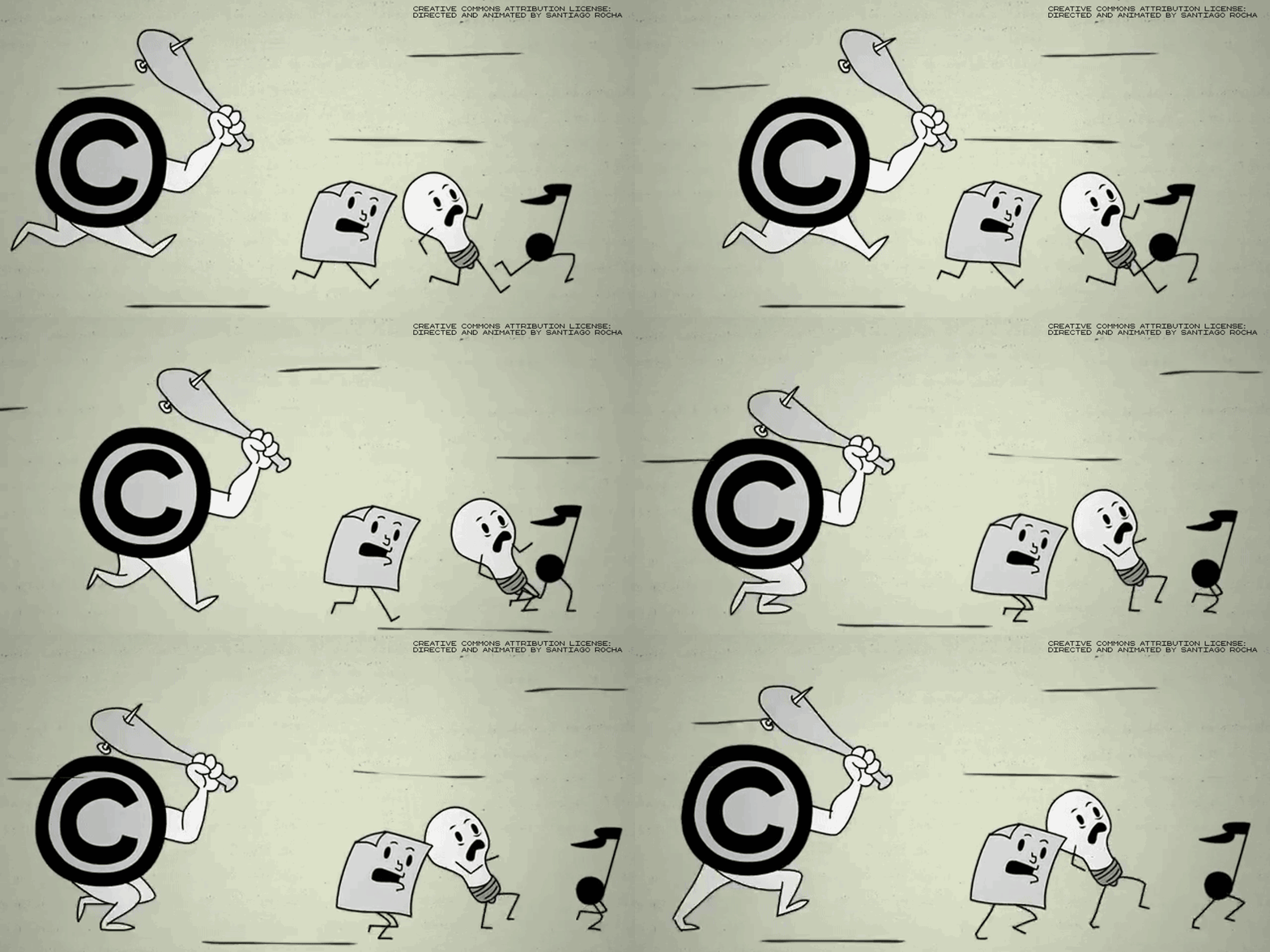
The Caribbean has long been exploited on the world stage, and copyright law is no exception
Originally published in Global Voices in Spanish

Intellectual rights as the persecutor of ef.org. legitimate use.
For Alexis Hancock
"Oh, Bob Marley, right?" Jamaican culture has been popularized in traditional media, and as Jamaican-American, I usually have a look at how others have consumed it and from what point of view. I wouldn't say I'm a burning follower of Marley, but I know what kind of people are the most likely to be linked to his music outside of Jamaica. For example, a countercultural student potential of the 1970s at UCLA found connection to its resistance messages.
My personal fascination with Jamaican music is the "riddim" - the way to write "rhythm" in Jamaican Creole- instrumental rhythm or melody not made for a single artist, but for use by the collective of time, and to enjoy and criticize the creators of Jamaican art culture: the disadvantaged masses.
As a technologist of public interest and a defender of digital rights, I see the "riddim" with an open source vision. It helped to protect Jamaican culture, especially from Western constructs that are deeply embedded in existing power dynamics, such as rigid intellectual property laws and the corporate commercialization of music.
Riddims
The interactive and collaborative nature of the dance does not treat a work as isolated or as something "finished." Repeal is a part of the creative process that is decided in the next function or party. In "Gross citizenship, "Larisa Kingston Mann summarizes how he wrote about intellectual property at a time when many on the island were considered property under slavery, which creates - from the beginning - a conflicting relationship with those who have the wealth of society. Intellectual property was for those who had extensive resources to dictate what could be protected and who would benefit.
The exchange of rhythms directly faces the individualistic and neo-colonial definition of intellectual property in terms of property and originality. Traditional intellectual property promotes the monopoly on expression, imposed by severe legal mechanisms (such as compensation for damages established by law) which make intertextuality, reuse and artistic experimentation legally risky. Even Sean Paul, one of the most successful dance artists in the world, attributed the success of his theme "Get Busy" in the general public Diwali Riddim. If it were not for this collective creativity and shared use, we would not see how dancehall music evolves and spreads throughout the world as it has spread.
Collective exchange was not limited to music alone; it was often also learned to dance in a group. I was watching videos of "passa passa"in high school and college, only to learn and keep up with the last dances that were in Jamaica and New York in the early 2000's. These parties were the nightmare of those who took respectability seriously. The clothes were extravagant, the" rude "manners, the queens of the dance hall were authentic acrobats and the parties could last until 6: 00 in the morning.
But it was also the time when new artists could get a space, vendors could earn some money and producers could collaborate with artists and get public consensus on what worked before investing money in a study.
Caribbean economy

Library of Congress - banana farm in Jamaica. legitimate use.
The Caribbean has long been exploited on the world scene in many ways, and intellectual property law is no exception.
A Jamaica is usually put aside in less than favourable international trade agreements that did not consider the interests of the Jamaican masses. Very often, there was a strict, single structure, dictated by the International Monetary Fund (IMF) and the World Bank: harmful lending structures, unilateral trade agreements, monetary devaluation and exploitative labour patterns.
In 1992, the IMF created terms that profoundly impacted Jamaica's economy. This served as a background to Jamaica's intellectual property law of 1993, when Jamaica reformulated its laws to participate in global trade. More rigid terms forced artists to start register "Riddims," and although these laws were aimed at protecting artists, less-resourced and independent artists, they had difficulty making claims against large producers. This also killed the "verbal agreements" that many artists and producers made before 1993.
Modern Dancehall and more

Dancehall party flyer. Photo courtesy of OpenView. Public domain.
This has not prevented Dancehall creators from organizing alternative circuits of trade and action, social privacy and community participation. Even today, the continuous nature of the dance works still causes friction how intellectual property works.
In 2026, a monumental case of intellectual property was annulled by an American federal judge who named many famous artists on a list of 150, and affected about 2000 songs. The plaintiffs, Cleveland "Clevie" Browne and the Wycliffe heirs "Steely" Johnson, They claimed that the Riddim Fish Market (also known as the Riddim Pocoman Jam) was the basis and source of the percussion pattern that runs the reggaeton, now billionaire gender musical with origins in the Spanish reggae of Panama carried by Afro-Japanese migrants, and then expanded by Puerto Rican artists.
However, the logic was denied. As U.S. District Judge André Birotte Jr. said, "The plaintiffs have not clearly identified what intellectual property work is contained in the alleged selection to protect and the arrangement they seek to apply."
The demand failed to take all the above-mentioned selections and arrangements and link them to a single work. Rather, he referred to a collection of works that reflected parts over time: "This principle is particularly significant in this case." Skidmore warned that a plaintiff cannot "reconstitute the work of intellectual property as a combination of unprotected elements" and then claim that these elements are substantially similar because they appear in an accused work, even when the elements are presented in "a different aesthetic context."
In this case, the nature of the riddims is a double-edged weapon. Browne and Johnson were deprived of the opportunity to participate in the gains derived from their creativity, which laid the foundation for a completely new musical genre. If this trial had come out in his favour, that logic could have forced any new reggaeton artist to meet that profit-sharing parameter, which would possibly have led to conditions that only well-supported artists, such as Bad Bunny, could meet. This result could have created an unfavourable dynamic for new artists. A power structure that the Riddims fought from the beginning.
We can easily hear the main impact of Puerto Rican and Dominican dembow, but the intellectual property ears are selectively biased against rhythm, usually prefers money, the artist's desire to give credit where it is due, and when the songs were created in the career of the most popular artist. In fact, to the black artists often they are given credit long after by one work that defines gender and after clearer-skinned artists have earned their money.
Although the dominant current is moving away from collective processes, the dance hall continues to evolve. What "makes Jamaicans great" are the layers of meaning that arise from what we spread. Intellectual property leaves a mark in time: a fragment of the "great" that the dominant current can freeze and sell. However, the truly great develops along with the collective and remains protected by that shared meaning.