The state-owned company is accused of abetting crimes against humanity
Originally published on Global Voices

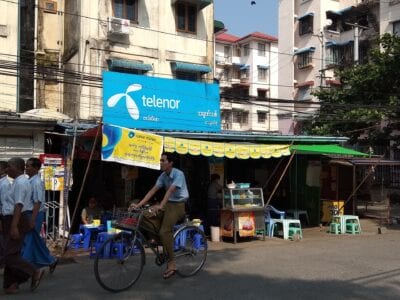
Telenor telecom operated in Myanmar from 2014 to 2022. Photo by Bjoertvedt. Source: Wikipedia. CC BY-SA 4.0
This post is part of Global Voices’ October 2026 Spotlight series, “Big Tech and Authoritarianism.” In this Spotlight, we explore how Big Tech facilitates and hinders authoritarian governments and practices, and how these choices influence the Global South. You can support this coverage by donating here.
The Norway-based multinational telecom company Telenor is facing charges for its role in turning over sensitive customer data to the military government of Myanmar.
If successful, the case would be the first ever to hold a telecom company accountable for failing to protect user data from being misused by an authoritarian regime.
Telenor operated in Myanmar from 2014 to 2022 with 18 million subscribers. After the February 2021 coup, Telenor faced pressure after the junta demanded compliance with its surveillance and content blocking directives. Telenor decided to leave Myanmar, but civil society groups raised strong objections that its local operations would be sold to a company with links to the junta.
In December 2024, activist group Justice For Myanmar filed a complaint against Telenor in Norway for breach of the Sanctions Act. Norway rejected it, but the complaint was refiled in October 2025 with an additional charge of aiding and abetting crimes against humanity.
The Norwegian state has a 54-percent stake in Telenor. In December 2025, the Norwegian Parliament initiated an investigation into the operations of Telenor in Myanmar. The leader of the disciplinary committee of the Parliament said: “We must uncover how a state-owned company could cooperate with a brutal military regime (by handing over) customer information about the opposition [in Myanmar].”
In April 2026, a civil class action lawsuit was filed against Telenor in Norway by Myanmar citizens for sharing their sensitive personal data with the junta. The complaint alleged that Telenor shared at least 1,253 phone numbers with the regime. The data also included call logs and location data, names, addresses, ID numbers, Facebook, and bank accounts linked to mobile numbers.
Among the complainants is Tha Zin, the widow of rapper and lawmaker Phyo Zeya Thaw, who was arrested based on a trumped-up charge, convicted, and later executed by the junta. Tha Zin said her husband was arrested right after his account information was accessed by the junta.
I lost my husband. It is not just a wife losing her husband. It is also a loss to the movement. It is also a loss to democracy because my husband was committed to democracy and a youth leader. Losing him means a loss to the country.
Lawyer Jan Magne Langseth summed up the content of the complaint.
Telenor ASA in Norway clearly contributed to the practice of handing over user data, despite the inherent risks for its customers in Myanmar. We have evidence of cases where the team at HQ expressly recommended the data to be handed over.
In September 2026, Norway’s National Criminal Investigation Service and the interior security service searched the office of Telenor related to the charges filed against the company.
Justice for Myanmar spokesperson Yadanar Maung welcomed the decision of Norway authorities to investigate Telenor.
Telenor’s transfer of spyware to a military-linked company and sharing of sensitive data with the military junta was extensively documented
We hope this will finally lead to accountability for the harms Telenor has caused Myanmar people through its conduct and its dangerous divestment.
In several statements sent to the media, Telenor said it is cooperating with authorities with regard to the ongoing investigation. It added that it needed to defend its employees in Myanmar.
In Myanmar, refusing requests from the military authorities could, in the worst case, have led to imprisonment, torture or the death penalty.
Telenor Myanmar had no real options. We could not play Russian roulette with the lives of our employees.
Telenor media relations director David Fidjeland reiterated the same point.
Our employees risked imprisonment, torture or the death penalty if the military authorities’ orders were not complied with. We found that we had no real choice and that we could not put our employees’ lives at risk.
Telenor acknowledged the brutality of the junta, but it asserted that the welfare of its employees should not be endangered.
Telenor acknowledges that human rights due diligence must consider all rights-holders. However, when faced with the brutal force of the military, Telenor maintains that an employer cannot give instructions that put employees’ lives at direct risk.
Civil society groups said the investigation is a step forward in fighting impunity. Civicus said companies should not enable human rights abuses.
The Telenor case has the potential to challenge impunity. It should refocus the minds of democratic states and companies headquartered in them, offering a warning that they can be exposed for complicity in the junta’s atrocities. It should give fresh impetus to civil society’s efforts to hold states and companies to account.
Faiz Naeem, Asia Pacific policy analyst at Access Now, added that Telenor’s case is a reminder for companies that their obligation to users does not end when leaving a country under an autocratic regime.
The decision to investigate Telenor for crimes against humanity should be a wake-up call for every technology and telecom company operating in a high-risk environment: leaving a market does not mean leaving your human rights responsibilities behind.
The civil class action lawsuit is seeking damages of EUR 9,000 (roughly USD 10,500) per customer.