All Togolese people are being affected by the country’s economic and political crisis
Originally published on Global Voices

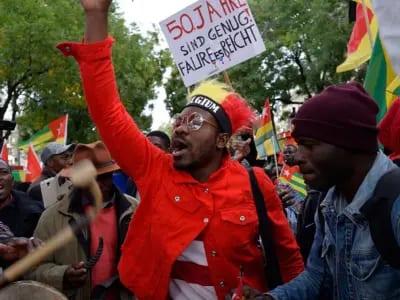
Protest against Faure Gnassingbé in Belgium in October 2017. Since the 2025 Gen Z protests, the Togolese state has cracked down on protesters and civil society. Image via Wikimedia Commons. CC BY-SA 2.0
This post is part of Global Voices’ September 2026 Spotlight series, “Protest in Democracy.” With this Spotlight, we seek to explore the many forms of protest, the tactics states use to delegitimize and suppress them, and the complex relationship between protest and democracy. You can support this coverage by donating here.
In Togo, demonstrations and opportunities for civil disobedience are drying up as the government cracks down on civil society and tightens restrictions on freedom of expression amid an ongoing political crisis. However, this does not spell the end of protest, as citizens find other avenues to make their voices heard.
As in-person gatherings have become difficult to organize or too risky for citizens, online protest has become an increasingly common form of political dissent in Togo.
A contested constitution
To understand what is at stake today, it’s important to understand the reforms that reshaped Togo’s institutions. On March 25, 2024, the National Assembly adopted a new Constitution that shifted the country from a presidential to a parliamentary system. Under the restructuring, the President of the Republic, now elected by members of parliament rather than by direct universal suffrage, became largely ceremonial. Most of the power passes to the President of the Council, a position with no term limits. Faure Gnassingbé has held the position since May 2025 after twenty years as head of state.
The ruling government claimed the reform would promote stability and collaborative governance, while the opposition disagreed. El Hadj Madi Djabakaté, a political scientist and president of the Center for Democratic Governance and Crisis Prevention, summed up this shift by noting that the reform has “enshrined the concentration of power in the constitution” rather than creating a new balance of power.
This controversial change and the backlash that ensued sparked the June 2025 protests — one of the largest in Togo since 2017, according to CIVICUS Lens. The protests were triggered by the arrest of Togolese rapper Aamron, who had spoken out online about declining living conditions and political corruption. The protesters’ demands were primarily economic and social in nature, with protesters asking for a minimum wage of CFA francs 52,500 per month (approximately USD 93) — one of the lowest in the subregion — and for the government to limit power outages to a maximum of four to six hours a day, according to the same source.
Police forces violently suppressed the protests, killing at least seven people and arresting over 140 throughout the month.
Former Defense Minister Essossimna Marguerite Gnakadé publicly condemned the violence. Three months later, on September 17, 2025, she was arrested for inciting rebellion, according to Amnesty International’s 2026 annual report. Aamron, for his part, was arrested again on September 19, 2025, on the same charges, before being released on probation.
The M66 collective (June 6 Movement), formed in the wake of these events, illustrates the shift in the country’s organizational structures. With no official spokesperson or recognized legal status, it was unable to legally register a demonstration — which complicated matters for authorities seeking a target, but also deprived protesters of the protection normally afforded by an authorized demonstration, explains Ahouefa Sossou, a lawyer and human rights defender at the Center for Documentation and Training on Human Rights (CDFDH), in an interview with CIVICUS Lens. In December 2025, the movement called for another demonstration, this time to coincide with the opening of the 9th Pan-African Congress in Lomé.
Digital technology: The second front line
Since the protests began on June 26, 2025, Togolese authorities implemented a nationwide internet shutdown. More than 15,000 data points collected between June 25 and 27 revealed systematic disruptions on both landline and mobile networks. The disruptions, which primarily affected Facebook, TikTok, and YouTube, continued well beyond the three days of protests: They were still being reported in late August 2025, forcing some internet users to rely on VPNs to continue working or communicating.
The shift became evident in the fall. On October 3, 2025, Mawama Talaka, the Togolese public prosecutor, publicly denounced the “abusive and anarchic” use of social media and warned that any post or comment deemed outside the legal framework would expose its author to prosecution, including for what he termed “complicity by approval.” That same day, a midwife and human rights activist, Grâce Koumayi Biyoki, was arrested at her home over a video posted online, according to Article 19, which described the period from August to October 2025 as an “alarming narrowing” of Togolese civic space. In November 2025, a decree further expanded the scope of prosecution to include simple online interactions, such as “liking” a post.
The consequences of self-censorship
According to Ahouefa Sossou, this “silent shrinking of the space for expression” is more concerning than the arrests themselves, because it leaves no measurable trace. In her view, people who spoke out freely two years ago are now forced to remain silent. Sossou highlights a specific gender-based risk: Women human rights defenders who are forced to scale back or stop their online activism under pressure from harassment and their families.
The cost of speaking out publicly is also measured by those who have chosen to leave. Rodrigue Ahégo, national coordinator of the pro-democracy movement Tournons La Page-Togo, was arrested in September 2024.
“It’s not easy; it’s difficult,” he confides, describing the threats and intimidation that drove him to leave the country, in an Icilome report.
The same source documents two cases of journalists forced to delete their footage under police pressure: Flore Monteau, a TV5 Monde correspondent, on June 6, 2025, in Lomé, and Albert Agbéko on April 8 in Tsévié.
The resistance goes digital
On social media, some young people are trying to defy the ban by taking a stand against the status quo. They are neither political nor career activists, but are driven by a desire to see change in their country. A young man named Brice says:
La situation de mon pays me fait mal. Je n’ai pas besoin d’être affilié à un parti politique ou militant quelconque pour constater la mauvaise gouvernance dans le pays. J’ai participé à plusieurs manifestations et parce que, comme tout togolais, je ne suis pas épargné par les conséquences de la vie chère.
The situation in my country pains me. I don’t need to be affiliated with any political party or activist group to see the poor governance in the country. I have participated in several protests because, like every Togolese, I am not spared from the consequences of the high cost of living.
In early September 2026, civil resistance took the form of a call to action against rising fuel prices, issued by a journalist sounding the alarm from exile via social media, and by artists announcing sit-ins scheduled for October.
On September 12, 2026, four Togolese opposition groups, namely Dynamique Monseigneur Kpodzro (DMK-Originale), Dynamique pour la Majorité du Peuple (DMP), Lumière pour le Développement dans la Paix (LDP), and the Front Touche Pas À Ma Constitution, issued a joint statement opposing the latest increase in the price per liter of unleaded premium gasoline. Gas prices rose more than 20 percent over four months in Togo, hitting CFA francs 817 (USD 1.44) in September 2026, while the monthly median salary is around CFA francs 100,000 (USD 176). The statement calls on the public to prepare for a “peaceful general mobilization.”
Eleven days earlier, on September 1, a completely different kind of protest was dominating social media: Investigative journalist Ferdinand Ayité live-streamed via Facebook to reveal that he was once again receiving death threats, even as he sits in exile in France.
The Ayité case illustrates another phenomenon. Repression has certainly changed the landscape of Togolese protest and driven some activists out of the country — but it has not, however, silenced them. Forced into exile in 2023 after he faced a prison sentence for a report on corruption, Ferdinand Ayité continues to influence Togolese public debate from France. In early September 2026, a coalition of opposition parties and civil society organizations expressed support for him and extended it to other activists in exile, including blogger Zaga Bambo, who also hosts live streams and panel discussions from abroad.

Ferdinand Ayité on a Facebook live stream. Screenshot via Facebook. Fair use.
What has become of the protests one year later?
A year after the June protests, it is no longer just rappers and connected urban youth who are driving the movement. A broad coalition of political parties, artists, and public figures in exile have joined the cause and are continuing to speak out from abroad.
On September 10, 2026, the Togolese Music Federation announced a series of sit-ins for October to demand the activation of the National Fund for Cultural Promotion and the resignation of Isaac Tchiakpé, Minister of Culture. The initiative is not presented as an anti-regime movement; however, publicly mobilizing an entire profession — even on a sector-specific issue — remains, in the current Togolese context, a political act in its own right.
It remains to be seen how this mix of in-person and online mobilization might influence and sway the government. But based on activists’ responses, one thing remains clear: The people of Togo will not remain silent.