‘No independent body regularly monitored developments in prisons and communicat’d this information to the public using data.
Originally published on Global Voices

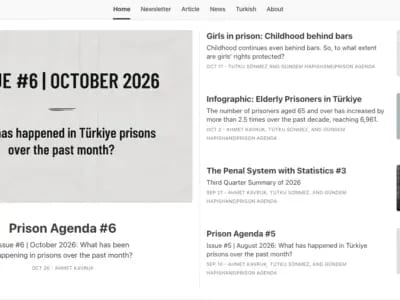
Screenshot from Prison Agenda‘s Substack page, used with permission.
This interview is part of a series of spotlights on the work of some of the grantees of the Digital Spark granting scheme, as part of the Regional Support Mechanism EECA project, implemented by the Metamorphosis Foundation and TechSoup, in partnership with CIVICUS and under the Digital Democracy Initiative (DDI) that covers the Global South. It is being published on Global Voices as part of a content-sharing agreement.
In Turkey, a team of two journalists and human rights activists launched a digital publication, Prison Agenda, to report on what is happening inside the country’s prisons and prison system, information that is often hidden from the Turkish public and the world.
As the Nordic Monitor noted in 2025, Turkey’s prison population has reached an unprecedented level. Citing figures from the Directorate General of Prisons and Houses of Detention, the website states that as of September 1, 2025, Turkish prisons hold 419,194 individuals. This includes 356,710 convicted prisoners and 62,484 people in pretrial detention. The figure exceeds the official capacity of 295,000 and places immense strain on the country’s penal system.
Le Monde also wrote in 2026 that a commissioned report on prison conditions among Council of Europe member states showed that France and Turkey each had 131 inmates for every 100 places, making them the two most overcrowded prison systems.
For the relatives of people in prison, as well as for national and international human rights organizations and agencies, the information provided by the Prison Agenda publication can be vital. A similar organization — Russia Behind Bars — used to work in Russia. While it did not function exclusively as a publication, it received letters from prisoners and their relatives, published news about torture or other human rights violations, and reported how the prison population had been drafted, in the hundreds of thousands, to fight Russia’s war with Ukraine. Unfortunately, it had to shut down its work within Russia because of the regime’s prosecution, but it continues to inform from abroad.
Civil society organizations, such as the publication about Prisons and Prisoners, are vital to the country and the world; they need to continue their important work within one of the most opaque systems in the world.
Global Voices interviewed one of Prison Agenda’s founder, Ahmet Kavruk, by email.
GV: Please tell us about your organization, and why you chose to get involved with the Digital Spark project?
Ahmet Kavruk (AK): Prison Agenda is a digital publication that covers data on Turkey’s prisons, legislative changes relating to prisons, and human rights violations within them. It is guided by an independent, rights-focused approach to journalism.
We launched in January 2026. Our aim is to make the often complicated and scattered information about prisons more accessible to the public by presenting it in a clear and understandable way, and to highlight the human stories behind the statistics.
Shortly after launching in January, we reached a crossroads. We could either continue as a passion project, publishing solely in Turkish, which would be easier to sustain, but would not fulfil our potential, or evolve into a publishing model that would require more intensive work, but enable us to reach a wider audience.
It was precisely at this decision-making stage that we came across the Digital Spark call for proposals. It was one of the few support programmes capable of creating space for initiatives working in specific and often overlooked fields, such as prisons. We, therefore, drew up a plan and, should we be accepted into Digital Sparks, began to focus on the question, ‘How can we grow the Prison Agenda?’
We were particularly impressed by Digital Spark’s approach, which focuses on amplifying the voices of marginalized groups and strengthening civic participation. The fact that the project’s core objectives aligned so closely with our own area of work was a decisive factor in our decision to join the programme.
GV: What issue/challenge in your community prompted you to undertake this project?
AK: We are currently a team of two. We are both individuals with over 10 years’ experience working and producing within the prison sector in various capacities. We were aware of the growing problems in Turkey’s prisons. Through our voluntary work, professional lives and social networks, we have been trying to raise awareness of these issues.
However, our work in this field revealed not only these problems, but also a significant shortcoming. No independent body regularly monitored developments in prisons and communicated this information to the public using data. The data was scattered, technical and often difficult to access. Meanwhile, media interest tended to intensify only when there was new legislation or a high-profile incident.
Drawing on our background in journalism and our experience in human rights monitoring, we believed we could address this gap. We, therefore, launched Prison Agenda, aiming to present existing information to the public in a clear, accessible, rights-focused manner.
GV: What are the key changes/activities that your organization implemented during your participation in the project?
AK: The most significant change for us during this project was launching our bilingual publications. By switching to English, we were able to reach beyond our existing Turkish audience and connect with a very different group of readers. The feedback from this new audience further strengthened our belief in the project’s potential.
While we initially had just one e-newsletter, we diversified our publications over time, increasing our regular e-newsletters to three. Today, Prison Agenda has evolved from a publication that shares news into a comprehensive digital media organisation that produces investigative reports, data analyses, data visualisations, thematic content, and opinion pieces.
This transformation aligns with our initial project goals of bilingual publishing and data-driven content production. In the first six months, our Turkish and English newsletters reached a total of 435 subscribers.
AK: How did your participation in the project impact your organization’s beneficiaries and the community that you serve? Please provide examples.
AK: While our Turkish-language publications are mainly followed by the press, legislators and civil society, we have noticed that our English-language publications are attracting the attention of diplomatic missions from various countries and international-level bureaucrats. This was a significant development for us as it created an opportunity to raise awareness of prison issues in Turkey within a wider international network.
Throughout the project, we received collaboration proposals from different organisations and groups. The number of news articles citing our data and content increased, raising Prison Agenda's profile. Additionally, we started providing advice on data, sources and content to journalists reporting on prisons.
This has ensured that the information we produce is not limited to our own readers, but is made available within a wider ecosystem. We hope the network of readers and stakeholders established by Prison Agenda will help to raise awareness of prisoners’ rights and the need for humane prison conditions. The project’s aim was, indeed, to strengthen civil oversight and accountability by making information more accessible.
GV: How has your own knowledge, awareness, and experience with digital democracy and civic space changed, thanks to your participation in the project?
AK: Prisons are, by their very nature, a rather closed field of work, with limited overlap with many other areas of rights. For this reason, we are not always able to collaborate with other civil society organisations.
One of the most significant opportunities that Digital Sparks has created for us is the chance to share a space with different civil society organisations and learn about their work first-hand. We have met groups working on issues outside our own field, developing different methods, and those who are just starting out. These encounters have enabled us to share knowledge and view our own work from an outside perspective.
One of the most significant realisations for us during this process was that civil society is much larger and broader than we had previously realised. Because Prison Agenda works in a very specific field, we realised that we were sometimes limited to our immediate circle. However, Digital Sparks showed us that this field is much broader and that there are far more areas where different struggles can intersect.
GV: What are the most valuable lessons and experiences you are taking away from this project?
AK: Digital Spark was the first support we received. Although we had previously been involved in various projects as part of a team, this was the first time we had been part of a project where the full responsibility rested directly with us. For this reason, it was also a new learning experience for us.
This was actually the part that challenged us the most. We learnt that a project is not limited to simply producing content and activities; it also requires managing its budget, administrative processes, reporting and responsibilities.
One of the most tangible things we learnt during this process was financial reporting. While our previous experience in this area was limited, carrying out the reporting processes required by the project provided us with valuable practical experience.
Consequently, Digital Sparks was not merely a project through which we developed Prison Agenda’s publishing capacity; it was also a significant experience in a small team transforming into a structure capable of standing on its own two feet, managing its responsibilities, and planning for the future.
GV: What comes next? How will you apply the learning and digital capacity you have built in your future work and within your community?
AK: Although we’re a very new organisation, we’re just as eager and enthusiastic. We have many options before us that could take us in different directions, as well as ideas that we’re keen to develop.
For example, we’re currently refining a public prison database project, and we’re also preparing to run a training course on prison journalism in the new year. We have a wide variety of datasets at our disposal that we want to make accessible to a wider audience. In the long term, we also plan to increase the number of areas we cover and deepen the content we produce in these fields.
We believe that we have not yet reached our natural limits. The digital capacity we have developed through Digital Sparks has opened up significant scope for us to expand these limits. In the near future, we intend to use the knowledge and experience we have gained to prioritise our readers, understand their requirements, and integrate their feedback into our editorial strategy.
Our aim is to transform the Prison Agenda into a structure that produces more content and enables more people to access information on prisons, bringing together different stakeholders in the process.


