Their petition to the authorities has already gathered over 500 signatures
Originally published on Global Voices

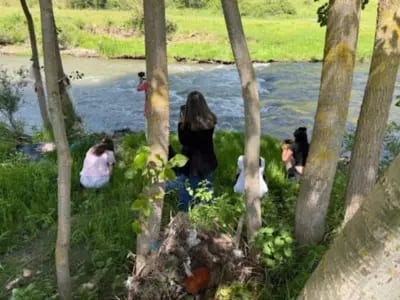
DigiAction picnic held in Lozhan village, Albania. Photo by Qendra KAZUS. Used with permission.
This interview is part of a series of spotlights on the work of some of the grantees of the Digital Spark granting scheme, as part of the Regional Support Mechanism EECA project, implemented by the Metamorphosis Foundation and TechSoup, in partnership with CIVICUS and under the Digital Democracy Initiative (DDI) that covers the Global South. It is being published on Global Voices as part of a content-sharing agreement.
In rural parts of Albania, youth are seldom mobilized to help solve local environmental and other problems in their communities, although they, too, are affected by them. This has been the case in the eastern Korce region as well, which was hit by heavy rainfall and subsequent devastating floods in November 2025.
In the Maliq municipality, one of the affected areas, the situation was worsened by improper disposal of waste that blocked drainage channels, including the Devoll River, which flows through the area. Illegal waste disposal has obstructed the river’s infrastructure and contributed to widespread flooding. Despite efforts by the authorities to improve waste management and clean up the river, the situation has remained dire.

Waste accumulated at the Devoll River Bridge in Maliq, Albania. Photo from November 21, 2025 by Qendra KAZUS. Used with permission.
In 2026, a local non-governmental organization (NGO), Qendra KAZUS, recruited and trained local youth to help solve this long-standing issue by turning them into environmental advocates. Global Voices conducted an email interview with Dhorjela Cela, the group’s executive director, to learn about how Qendra KAZUS implemented a project that brought together youth, digital democracy, environmental challenges, and advocacy. The interview has been edited for clarity and brevity.
Global Voices (GV): Please tell us about your organization and why you chose to get involved with the Digital Sparks project.
Dhorjela Cule (DC): Qendra KAZUS was founded in 2024 and focuses on young people’s activism and engagement. Our team brings together journalists, photojournalists, and education specialists with years of experience in media, law, and mentoring.
Our mission is to strengthen democracy and the rule of law through youth advocacy and to raise awareness around preserving cultural heritage, protecting the environment, and building capacity in ICT and media. As a young organization, our work relied mainly on small activities and projects.
Digital Sparks gave us the opportunity to prioritize digital advocacy. We saw a chance to give young people in rural areas and cities tools they use every day — their phones and social media — and turn them into instruments of civic participation and accountability.
GV: What issue/challenge in your community prompted you to undertake this project?
DC: The Devoll River in the eastern Korça region is facing a serious environmental situation. Plastic pollution, inert waste, agricultural waste, and other debris accumulate along the riverbanks. During winter floods, high river flows expose and spread this waste, blocking drainage canals, and water overflows from the riverbed into agricultural land and residential areas, damaging soil health, livelihoods, and the local ecosystem.
In the villages of Lozhan and Pojan, the waste is considerable, and local authorities seem to have their hands tied in finding a solution.
What worried us most was that young people from rural areas, whose families depend on agriculture and are directly affected, were excluded from the search for solutions. They had phones and strong opinions, but no channel to turn them into public pressure.
We wanted to show that the right to a clean environment is something young people can demand with evidence and a collective voice.

Waste on the banks of the Devoll River in Pojan from May 2026. Photo by Qendra KAZUS. Used with permission.
GV: What are the key changes/activities that your organization implemented during your participation in the project?
DC: We implemented three phases of the project. First, we recruited and trained 44 young people from Maliq municipality in MoJo, aiming to turn mobile storytelling, video editing for reels, and graphic design in Canva into a powerful advocacy tool.
Second, we organized two Digital Picnics along the Devoll River and the affected farmland, piloting two locations in the villages of Pojan and Lozhan, where participants filmed and photographed the accumulation of waste, creating a “visual pollution map”. Thirty materials produced by the young people were published on social media to raise public awareness.
Finally, we launched an online petition, through which we will ask the Maliq municipality to step up cleaning actions, with the joint commitment of the municipality and the community, as well as community education and awareness.
The petition was hosted on Change.org to reach a wider audience and has collected 506 signatures so far, exceeding our target.

Participants of the DigiAction Picnic in Pojan, Albania. Photo by Qendra KAZUS. Used with permission.
GV: How did your participation in the project impact your organization’s beneficiaries and the community that you serve? Please provide examples.
DC: For the young participants, the project turned social media from an entertainment tool into a tool for action. Forty-four young people learned to document environmental problems and communicate them publicly.
“I had never seen the use of social media from this perspective. Now, I have a different approach to the posts I can make,” said Igli, one of the young people who joined the training and field activity.
For the community, the Digital Picnics made the pollution visible: everyone had the chance to see the waste accumulated along the river in videos and posts, and hundreds of people engaged with our content online.
The petition gave residents and supporters a simple way to take a stand, and 506 people signed it online. The materials now form a public archive of evidence that the community can use in future discussions with local authorities.
GV: How has your own knowledge, awareness, and experience with digital democracy and civic space changed, thanks to your participation in the project?
DC: Through Digital Sparks, we came to understand digital democracy more broadly: using technology to document facts, mobilize people, and demand accountability from institutions.
We learned how evidence, whether a video, a poster, or a signature, gives citizens credibility when they address public authorities.
We also gained practical experience in campaign planning, content strategy, moderating online comments, using Instagram and TikTok analytics, and digital safety and ethics, including the protection of young participants and personal data.
As a team, this project taught us how to turn this knowledge into youth-led digital civic action.
GV: What are the most valuable lessons and experiences you are taking away from this project?
DC: One of the most valuable lessons is that in the digital era, young people need little technical equipment, but much more mentoring and guidance to lead them towards becoming responsible citizens who make demands and engage in concrete action to be part of decision-making. Their phones and creativity are enough when they have a clear purpose and guidance.
Second, an informal and enjoyable format like the Digital Picnic lowers barriers to participation and attracts young people, including girls and those from marginalized groups or low-income families.
Images and facts are more persuasive to institutions than complaints, but this experience taught us that flexibility is essential. Choosing Change.org instead of Google Forms for the petition taught us to adapt tools to the audience.
Finally, institutional change and engagement take time, and follow-up is as important as mobilization.
GV: What comes next? How will you apply the learning and digital capacity you have built in your future work and within your community?
DC: Qendra KAZUS has started implementing another project in which part of the knowledge gained is being applied. The use of social media by young people as a powerful mechanism to raise their voice and demand more engagement and responsibility from institutions is this time focused on cultural heritage.
What remains essential for us is identifying a completely different approach to young people, through the channels and platforms where they spend a considerable part of their time and focus their communication.
It is worth stressing that finding a meeting point with young people, through a method that is interesting to them, is of particular importance. We have managed to involve them by showing that social media can also be used as a healthy mechanism that achieves results for their demands.


