Explore Webb
  1. Ciencia
  2. Telescopio Espacial James Webb (JWST)
  3. Webb Captures de la NASA...
  • Sinopsis
  • ¿Quién es James Webb?
  • Hoja informativa
  • Impactos+beneficios
  • FAQ
  • Webb Timeline
  • Ciencia
  • Early Universe
  • Galaxias con el tiempo
  • Star Lifecycle
  • Otros mundos
  • Explicantes de ciencia/ingeniería
  • Observatorio
  • Lanzamiento
  • Despliegue
  • Orbit
  • Espejos
  • Sunshield
  • Módulo ISIM
  • Instrumento: NIRCam
  • Instrumento: MIRI
  • Instrumento: NIRSpec
  • Instrumento: FGS/NIRISS
  • Elemento óptico del telescopio
  • Backplane
  • Spacecraft Bus
  • Webb vs Hubble - título
  • Multimedia
  • Imágenes
  • Videos
  • Productos y actividades
  • Podcasts
  • Sonificaciones de imagen Webb
  • ¿Qué es la observación de Webb?
  • Webb en 3d Sistema Solar
  • Primeras imágenes de Webb
  • Equipo
  • Personas de Webb
  • Más
  • Para los científicos
  • For Educators
  • Para Diversión / Aprender
  •  
    5 Min Read
    NASA’s Webb Captures Commotion From Nebula’s Stellar Jets
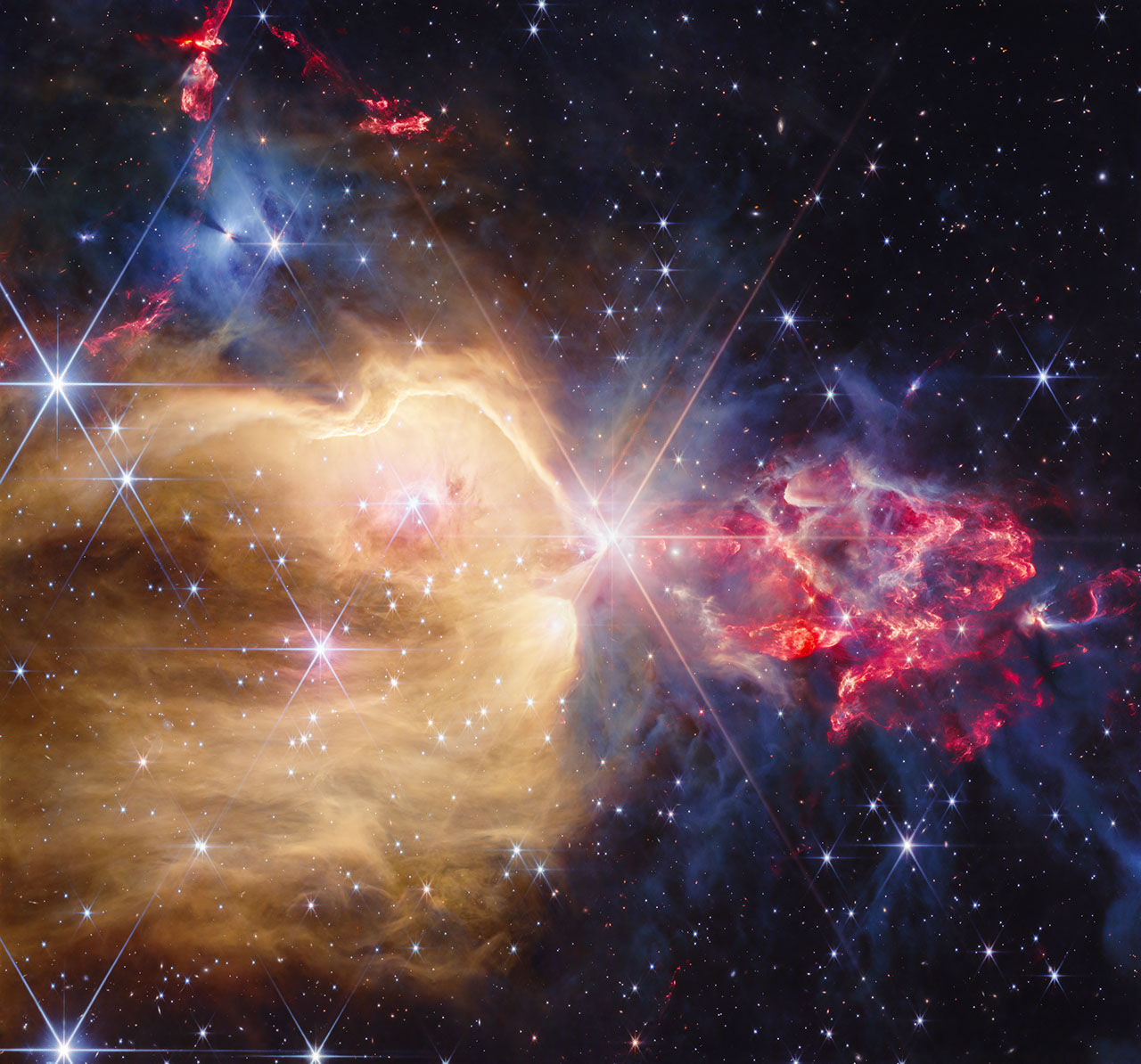
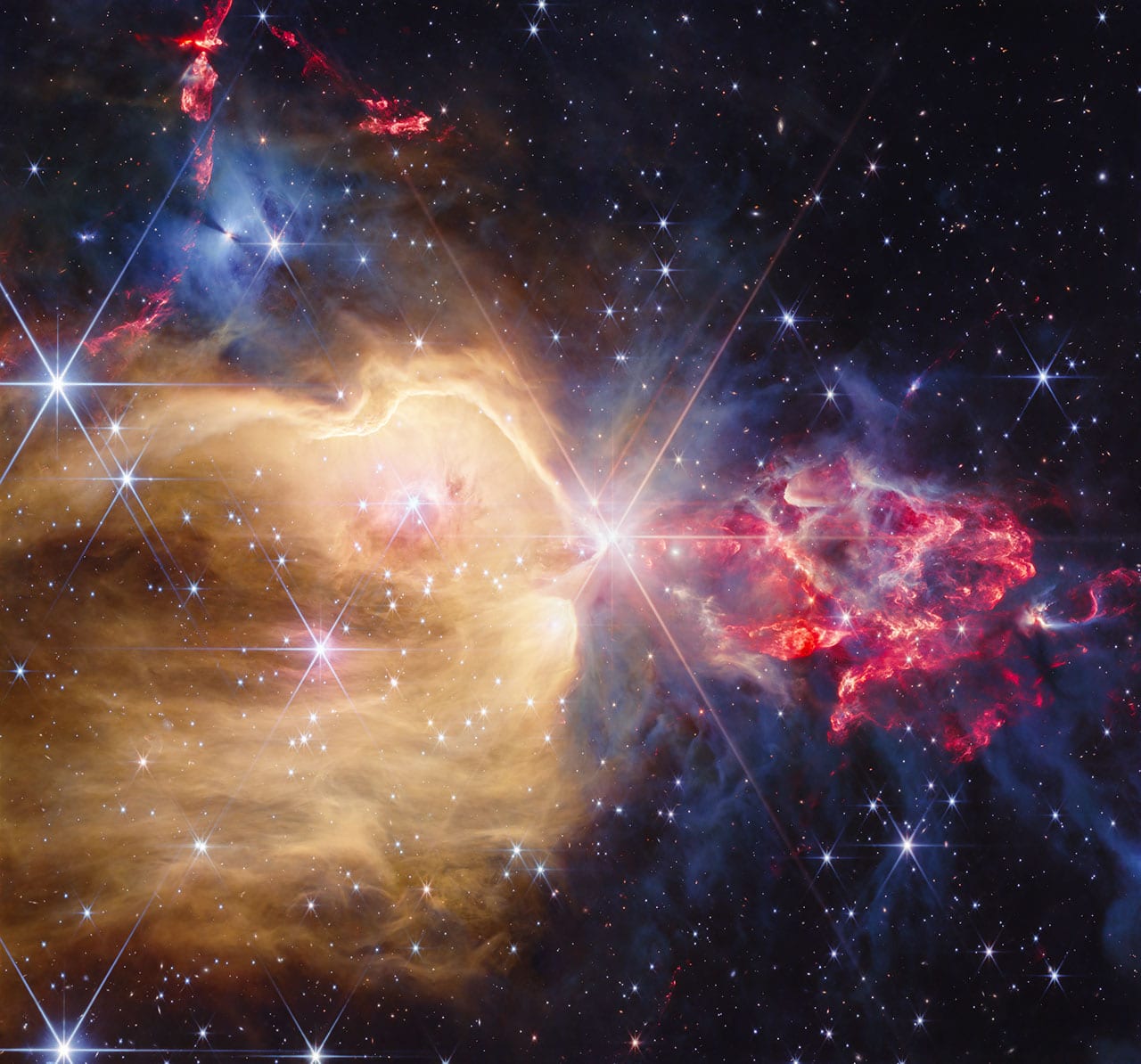
    A young star cluster filled with many stars that display Webb’s unique eight-pronged diffraction pattern. At its center is a yellow star that sports the largest diffraction pattern. To its left, there is a region filled with yellow dust and gas that extends from the star to the left and the bottom, covering about two-thirds of the frame. The yellow region has several embedded blue stars of different sizes. The top third, which lies outside the yellow region, has a few bright protostars, within dense gray gas. These stars illuminate the gas, making it appear blue. A few red outflows from other protostars are visible above this grayish-blue region. To the right of the central star, there is a clumpy, flame-like plume of red dust and gas with protostars that emit a soft white light within. The plume is surrounded by more dense gray gas and dust. It is about one third the size of the yellow region. There are several background galaxies strewn throughout.
    El telescopio espacial James Webb de la NASA ha revelado muchas protoestrellas y estrellas dentro de los gases brillantes de NGC 7129. El gas de hidrógeno caliente y atómica se muestra aquí en la región dorada, mientras que el gas de hidrógeno molecular más fresco, impactado por protoestrellas incrustadas, está representado en rojo.
    Credits:
    Image: NASA, ESA, CSA, STScI; Image Processing: Alyssa Pagan (STScI)

    Un caldero de creación cósmica se está revelando en una nueva imagen del telescopio espacial James Webb de la NASA. Webb ha revelado numerosas estrellas antes escondidas por nubes de polvo en una guardería estelar conocida como NGC 7129, que reside alrededor de 3.300 años luz de la Tierra.

    Publicidad

    Estrellas, motores de creación elemental, tienen ciclos de vida que comienzan con su nacimiento en nubes moleculares – regiones frías y densas de polvo y gas. Debido a estos capullos polvorientos, las estrellas jóvenes son a menudo imposibles de ver por muchos telescopios, especialmente aquellos incapaces de capturar luz infrarroja. Webb, sin embargo, tiene un alto grado de sensibilidad infrarroja, permitiendo a los astrónomos a mirar a través de ese polvo y estudiar el comienzo del ciclo de vida estrella.

    Imagen: NGC 7129 (NIRCam Imagen)

    A young star cluster filled with many stars that display Webb’s unique eight-pronged diffraction pattern. At its center is a yellow star that sports the largest diffraction pattern. To its left, there is a region filled with yellow dust and gas that extends from the star to the left and the bottom, covering about two-thirds of the frame. The yellow region has several embedded blue stars of different sizes. The top third, which lies outside the yellow region, has a few bright protostars, within dense gray gas. These stars illuminate the gas, making it appear blue. A few red outflows from other protostars are visible above this grayish-blue region. To the right of the central star, there is a clumpy, flame-like plume of red dust and gas with protostars that emit a soft white light within. The plume is surrounded by more dense gray gas and dust. It is about one third the size of the yellow region. There are several background galaxies strewn throughout.
    El telescopio espacial James Webb de la NASA ha revelado muchas protoestrellas y estrellas dentro de los gases brillantes de NGC 7129. El gas de hidrógeno caliente y atómica se muestra aquí en la región dorada, mientras que el gas de hidrógeno molecular más fresco, impactado por protoestrellas incrustadas, está representado en rojo.
    Imagen: NASA, ESA, CSA, STScI; Procesamiento de imágenes: Alyssa Pagan (STScI)

    Las estrellas de este grupo están en diferentes etapas de su desarrollo, ya que las estrellas más masivas forman y evolucionan más rápido. El más masivo (y el más maduro) es la estrella central luminosa de la región, LkH(alpha) 234 (pronunciada Lick-H-alpha). Esta estrella, que destina la imagen más prominente patrón de difusión, es una estrella pre-principal que pesa alrededor de 5 a 8 veces la masa de nuestro Sol. Las estrellas pre-principales como éstas han terminado de reunir masa y están contrayendo bajo la fuerza de la gravedad, causando que sus temperaturas aumenten. Con el tiempo, esta estrella fusionará su propio hidrógeno como nuestro Sol.

    La cavidad a su izquierda, que aparece en oro y abarca alrededor de 3.5 años luz, es la mayor demostración del impacto de la estrella central. Las salidas de una etapa anterior del ciclo de vida de la estrella se extienden hacia la densa nube molecular de hidrógeno. Tanto las salidas como la luz de la estrella energizan el gas, lo que la hace brillar. Mientras que gran parte de este gas de hidrógeno es volado, una gran cantidad también se comprime, creando las condiciones para que se formen aún más estrellas.

    Interactivo: Las nubes coloridas del NGC 7129

    Unable to render the provided source
    Explore los detalles de NGC 7129 para descubrir las características y actividades ocultas dentro de las nubes de esta joven región formadora de estrellas. En este interactivo, aventure a puntos de interés individuales o siga visitas guiadas a través de lugares e historias relacionados. Inicie en pantalla completa para la experiencia interactiva completa —o visualice directamente en su navegador.
    NASA y STScI

    Algunas de estas estrellas son visibles dentro de la cavidad. Varios de ellos también son pre-principal secuencia y emiten vientos estelares. Cerca shocks de arco, el gas comprimido curvado que aparece cerca de las estrellas, se crean a medida que esos vientos empujan hacia el gas energético y crean sus propias cavidades más pequeñas.

    Juntos, las estrellas centrales e incrustadas también crean la cumbre de la cavidad dorada. Su luz genera un ambiente caliente que empuja contra el gas molecular más frío y denso fuera de la cavidad, y crea un límite conocido como un región de fotodisociación. En esta región, las moléculas de hidrógeno se descomponen en átomos. Al influir en la temperatura y química de la región, esta colección de estrellas ofrece una visión de cómo estas nubes moleculares se erosionarán gradualmente a lo largo de millones de años.

    Publicidad

    La región a la derecha de la estrella central narra un relato diferente, pero igualmente caótico. Esta materia gruñida representada en rojo esconde objetos mucho más jóvenes que los de la izquierda: protostars. La etapa protostar es anterior a la etapa pre-manente-sequence y se produce después de que las nubes moleculares de gas y polvo compren y fragmentan inicialmente.

    Mientras las protoestrellas acumulan materia y aumentan su masa, ellos eject outflows de material supercalentado. Estas salidas interactúan con la materia densa, gris, translúcida en la que se envuelven las protoestrellas, creando shocks que causa una apariencia textura. El resplandor rojo es también el resultado de la interacción. Múltiples salidas de múltiples estrellas se superponen desde nuestro punto de vista, llevando a la mirada caótica de la escena.

    Imagen: NGC 7129 Side-by-Side (Spitzer y Webb Image)
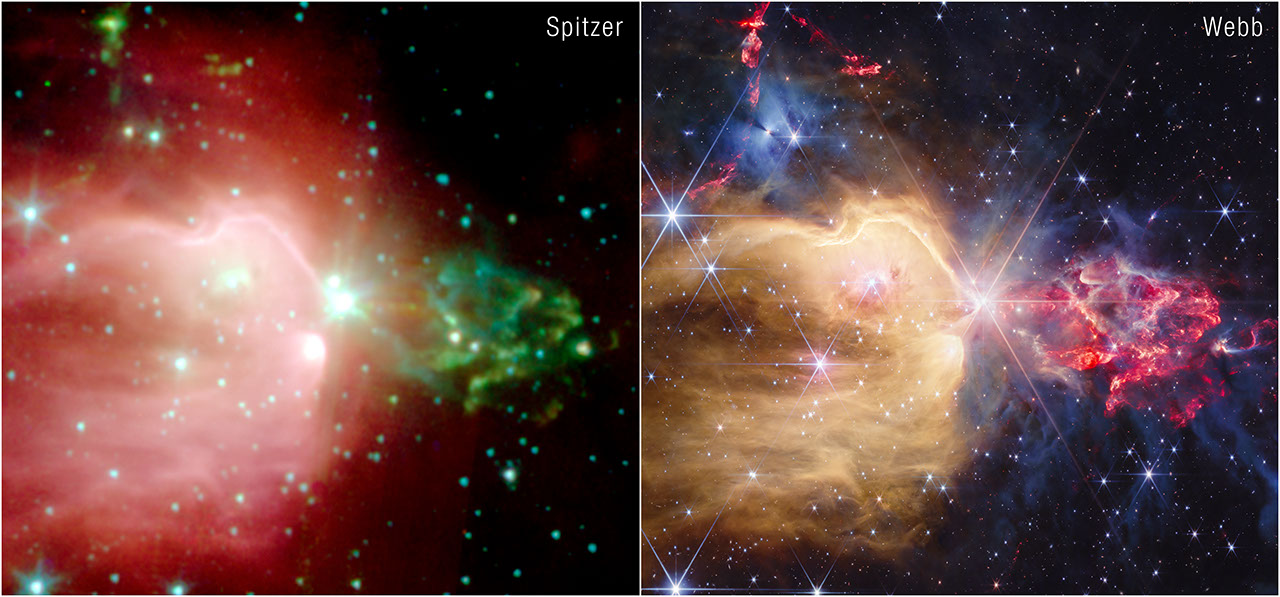
    Two images appear side by side. The left is labeled “Spitzer” and the right “Webb.” The Spitzer image, which is fuzzier and less detailed, shows two regions separated by a bright central object, a star. To the left of the star, there is a region filled with red dust and gas that extends from the star to the left border of the image. The red region extends from the bottom, covering about two-thirds of the image. To the right of the star is a large, irregular green blob. The Webb image shows the same two regions at both sides of a central star, but at a higher resolution. The left region is filled with stars and yellow dust and gas that extends from the star to the left border of the image. This yellow region extends from the bottom, covering about two-thirds of the image. The top left of the image holds a few bright protostars, within dense gray gas. To the right of the central star, there is a clumpy plume of red dust and gas, which is surrounded by more dense gray gas and dust.
    El Telescopio Espacial Spitzer retirado de la NASA observó el gas y el polvo dentro de NGC 7129; sin embargo, la mejor resolución del telescopio espacial James Webb de la NASA muestra filamentos más detallados de gas y polvo, junto con muchas galaxias de fondo.
    Imagen: NASA, ESA, CSA, STScI, NASA-JPL; Procesamiento de imagen: Alyssa Pagan (STScI)

    Más de estos flujos protostelanos se pueden ver en la parte superior izquierda de la imagen, cerca de una nebulosa de color azul. El centro de esta región azul alberga un protostar rodeado de un disco en forma de donut de material. Este disco arroja una sombra contra la nebulosa circundante, reminiscencia de una estructura similar conocida como la “Bat Shadow” que fue observado por el Telescopio Espacial Hubble de la NASA.

    La alta resolución espacial de Webb revela muchas estructuras ricas en el gas de la región, basándose en investigación realizada anteriormente por el telescopio espacial Spitzer retirado de la NASA. Los astrónomos seguirán utilizando estos datos de Webb para estudiar cómo las estrellas y protoestrellas de esta región influyen en el gas y el polvo circundante.

    El telescopio espacial James Webb es el principal observatorio mundial de ciencias espaciales. Webb está resolviendo misterios en nuestro sistema solar, mirando más allá de mundos distantes alrededor de otras estrellas, y probando las misteriosas estructuras y orígenes de nuestro universo y nuestro lugar en él. Webb es un programa internacional dirigido por la NASA con sus socios, ESA (Agencia Espacial Europea) y CSA (Agencia Espacial Canadiense).

    Para obtener más información sobre Webb, visite:

    https://science.NASA.gov/webb

    Descargas " Información relacionada

    Las siguientes secciones contienen enlaces para descargar imágenes y vídeos de este artículo en todas las resoluciones disponibles seguidas de enlaces de información relacionados, contactos de medios, y si está disponible, papel de investigación y enlaces de traducción español.

    Imágenes relacionadas & Videos

    A young star cluster filled with many stars that display Webb’s unique eight-pronged diffraction pattern. At its center is a yellow star that sports the largest diffraction pattern. To its left, there is a region filled with yellow dust and gas that extends from the star to the left and the bottom, covering about two-thirds of the frame. The yellow region has several embedded blue stars of different sizes. The top third, which lies outside the yellow region, has a few bright protostars, within dense gray gas. These stars illuminate the gas, making it appear blue. A few red outflows from other protostars are visible above this grayish-blue region. To the right of the central star, there is a clumpy, flame-like plume of red dust and gas with protostars that emit a soft white light within. The plume is surrounded by more dense gray gas and dust. It is about one third the size of the yellow region. There are several background galaxies strewn throughout.

    NGC 7129 (NIRCam Image)

    El telescopio espacial James Webb de la NASA ha revelado muchas protoestrellas y estrellas dentro de los gases brillantes de NGC 7129. El gas de hidrógeno caliente y atómica se muestra aquí en la región dorada, mientras que el gas de hidrógeno molecular más fresco, impactado por protoestrellas incrustadas, está representado en rojo.

    Two images appear side by side. The left is labeled “Spitzer” and the right “Webb.” The Spitzer image, which is fuzzier and less detailed, shows two regions separated by a bright central object, a star. To the left of the star, there is a region filled with red dust and gas that extends from the star to the left border of the image. The red region extends from the bottom, covering about two-thirds of the image. To the right of the star is a large, irregular green blob. The Webb image shows the same two regions at both sides of a central star, but at a higher resolution. The left region is filled with stars and yellow dust and gas that extends from the star to the left border of the image. This yellow region extends from the bottom, covering about two-thirds of the image. The top left of the image holds a few bright protostars, within dense gray gas. To the right of the central star, there is a clumpy plume of red dust and gas, which is surrounded by more dense gray gas and dust.

    NGC 7129 Side-by-Side (Spitzer y Webb Image)

    El Telescopio Espacial Spitzer retirado de la NASA observó el gas y el polvo dentro de NGC 7129; sin embargo, la mejor resolución del telescopio espacial James Webb de la NASA muestra filamentos más detallados de gas y polvo, junto con muchas galaxias de fondo.

    Enlaces relacionados

    Leer más: Los descubrimientos de formación estelar de Webb

    Explore más: Tour de imagen: Herbig-Haro 46/47

    Mira: Herbig-Haro 49/50 Stellar Jets Visualization

    Explore más: Formación estelar en la Nebula del Águila

    Mira: Salvadores Celestiales: Jets Estelares en HH24

    Más Webb: Noticias Silencio Imágenes Silencio Ciencia Silencio Página

    Compartir


    Detalles

    Last Updated
    Oct 06, 2026
    Contact
    Media

    Laura Betz
    Centro de Vuelo Espacial Goddard de la NASA
    Greenbelt, Maryland
    laura.e.betz@NASA.gov

    Matthew Brown
    Space Telescope Science Institute
    Baltimore, Maryland
    Hannah Braun
    Space Telescope Science Institute
    Baltimore, Maryland