When communities are included, when solutions are discussed, understood, and locally relevant, collaboration and participation follow
Originally published on Global Voices

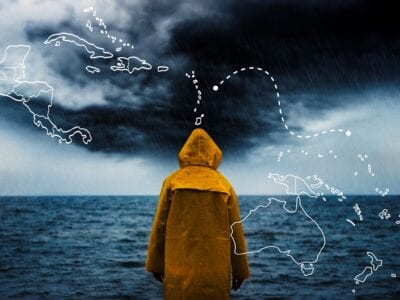
Maps of Oceania and the Caribbean superimposed over the image of a young person looking at a storm brewing on the horizon. Feature image created by Janine Mendes-Franco using Canva Pro elements.
By Adele Roeder, Orit Novak, Chelsea Adams and Zahiris P. Francisco
This article was originally published by Future Forward Australia on May 10, 2026. An edited version is published here with permission.
Young people are no strangers to seeing the impacts of climate change. In Australia alone, the catastrophic Black Summer bushfires of 2019–20, record-breaking floods across northern parts of the country in 2026, and most recently, the severe tropical cyclone Narelle, which badly affected three states, have all left their mark.
The livelihoods of Australian farmers are being severely undermined by prolonged droughts and a growing homeless population, more than 23 percent of whom are under the age of 25. Indigenous Australians, who have acted as environmental stewards for millennia, are seeing their knowledge, leadership, and deep cultural connection to the land undermined by practices like the desecration of sacred ceremonial sites by resource-extractive industries.
News headlines are often juxtaposed, highlighting these issues while simultaneously politicising a sustainable future through Australia’s reliance on coal, iron ore and natural gas. Even as the Great Barrier Reef bleaches, and Australian students skip school to strike for climate, the climate agenda is being quashed by political parties whose priorities are swayed by mining-magnate lobbyists.
Yet, young people living in Australia’s major cities have the privilege of being comparatively shielded from the worst impacts of climate change. In contrast, across Oceania and the Caribbean, Small Island Developing States (SIDS) are already experiencing the climate crisis as an everyday reality, despite contributing less than one percent of global greenhouse gas emissions.
What the climate crisis looks like across SIDS
While statistics help us understand the scale of the climate crisis across SIDS, they often fail to capture what this reality looks like. John Whippy, a community leader and climate activist based in Suva, Fiji, paints a different picture — one that moves beyond projections and into daily life. In coastal and low-lying communities, climate change is an immediate threat. Rising sea levels regularly push water into homes, forcing families to constantly adapt their living conditions. “When the water comes in,” he explains, “people have to move everything — put it higher, try to protect what they can.”
For many, relocation is not a viable option. Instead, communities are adapting in place. Homes are being rebuilt on higher foundations, using raised wooden structures in an attempt to stay above incoming water levels. These responses are practical and necessary, but they are also temporary and shaped by limited resources rather than long-term security.
Equally apparent is that the challenge is both environmental and social. Despite the presence of some external support — whether from governments, international organisations or limited local interventions — many communities are hesitant to seek assistance. Feelings of shame, exposure, or fear of becoming the subject of external attention can act as barriers to accessing help. As a result, communities often rely on their own means to cope.
‘Incomplete action’
Where external interventions do occur, they are not always sustained. Examples include development projects that began with intent but were never completed, infrastructure left unfinished, roads partially built, and drainage systems started and abandoned. In such cases, the issue is not simply ineffective aid, but the consequences of incomplete action. “If it’s not finished,” Whippy adds, “the water still comes. The problem just continues.”
These gaps highlight a broader issue within climate response efforts: a lack of continuity and accountability. With projects that are initiated but not fulfilled, responsibility is often left with the community, without the resources to complete what was started, raising critical questions about how climate solutions are designed, implemented, and evaluated.
From the perspective of those experiencing these impacts, there is a need for greater oversight — not just in funding, but in ensuring that initiatives are fully realised and genuinely beneficial — because there is a strong willingness within communities to engage. “If people come and talk to the community first,” Whippy notes, “everyone will help.” Collaboration, rather than imposition, emerges as a key principle. When communities are included in decision-making processes, when solutions are discussed, understood, and locally relevant, collaboration and participation follow.
Zahiris Priscila Francisco Martínez, a climate activist and journalist based in Santo Domingo, sees a similar situation unfolding across the Caribbean. “It’s heartbreaking to witness how every hurricane season becomes more severe,” she laments. “The lack of strong and consistent climate policy means that every year, families lose loved ones, homes, and entire livelihoods because of climate-related disasters. When heavy rains hit, children can’t go to school, adults can’t go to work, and the government is often forced to declare a national state of emergency.”
Read more: SIDS nations grapple with the climate crisis
The Dominican Republic, like many SIDS, remains highly vulnerable to climate extremes. Rising temperatures and warming ocean waters are intensifying storms across the Atlantic, increasing both rainfall and hurricane strength by the time they reach the Caribbean archipelago. Recent scientific analysis has shown that climate change is making hurricanes in the region more destructive, with stronger winds, heavier rainfall, and more rapid intensification.
For coastal and low-income communities in the Dominican Republic, these impacts are especially devastating. Flooding repeatedly affects families living near rivers, informal settlements, and vulnerable coastal zones, many of whom lack the resources to relocate or rebuild safely. Studies on Caribbean SIDS warn that rising sea levels, stronger tropical cyclones, and increasingly erratic rainfall patterns are placing enormous pressure on already fragile infrastructure, food systems, and public health networks.
‘When the water comes in, people can lose absolutely everything overnight’
“There is still so much more that could be done,” Francisco Martínez adds. “We need stronger prevention policies, resilient infrastructure, and more shelters for families living in high-risk areas. Here, just as in Fiji, when the water comes in, people can lose absolutely everything overnight.”
Francisco Martínez points to the growing number of tragedies linked to floods and infrastructure collapse across the region, where children and vulnerable families are frequently among the most affected. “For many people, even staying inside their homes during extreme weather becomes dangerous. It feels like being trapped between two impossible choices.”
Across the wider Caribbean, these challenges continue to intensify. According to UNICEF, the number of people internally displaced by storms and floods in Caribbean SIDS has increased sixfold in recent years, with children and young people among the most affected populations. Meanwhile, researchers confirm that over 65 percent of Caribbean SIDS populations live in low-elevation coastal zones, making entire communities increasingly exposed to sea-level rise, storm surges, disease outbreaks, food insecurity, and forced displacement.
“We have already seen tragic cases where children have lost their lives and infrastructure collapses have killed people in the streets,” Francisco Martínez says. “For families living in vulnerable areas, even staying inside their homes during extreme weather can become dangerous. It feels like being trapped between two impossible choices.”
Beyond physical destruction, climate change is also creating a growing emotional burden for Caribbean youth. Young people across the region are increasingly experiencing climate anxiety, fear, uncertainty, and ecological grief as they witness repeated disasters affecting their communities and futures. For many Caribbean youth activists, journalists, and community leaders, climate advocacy has therefore become not only an environmental issue, but a fight for survival, dignity, and justice.
Two sides of ‘voluntourism’
Responding to challenges of this scale requires more than short-term interventions or symbolic inclusion. The disconnect in the perception of the climate crisis is exemplified by the proliferation of “voluntourism,” where unskilled volunteers from high-income countries can seemingly “fix” climate issues in the Global South without community consultation, inherently promoting neocolonial notions.
Voluntourism involves combining travel with volunteer work which, while beneficial in certain contexts, frequently replaces place-based, community-informed and lasting change with feel-good, short-term input. Additionally, most programmes only involve short stays of up to three weeks — not nearly long enough to offset the emissions associated with participants’ travel.
With an estimated 10 million people partaking in voluntourism annually, it is clear that people want to help communities outside of their own. However, many voluntourism organisations continue to expand the climate divide by inhibiting sustainable development in the communities they work in through displacing local labour, excluding community input, and being culturally insensitive, not to mention exposing communities to additional issues like child safety risks and infrastructure strain.
Lasting solutions
This situation further emphasises the importance of prioritising locally informed and locally led solutions, and listening rather than assuming what kind of support vulnerable nations actually require from high-income countries.
Collaborative youth networks like the Oceania Caribbean Climate Alliance (OCCA) provide a more just and lasting solution. Such groups exemplify how young people from across regions, with different lived experiences of the climate crisis, can inform policy through local perspectives and push for equitable climate action.
A collaboration between the Global Shapers hubs of Brisbane and Castries, OCCA will host its Youth Climate Conference in Saint Lucia in December 2027, after rescheduling the event from 2026. The conference will fund young leaders from every Oceania and Caribbean nation for a two-and-a-half-day workshop on scaling climate projects from local to inter-regional, culminating in a Youth Climate Statement for decision-makers across both regions.
In July, OCCA also organised a North–South Ocean Dialogue in The Hague connecting young leaders from the Pacific and the Caribbean. These youth leaders are driving localised action with a global perspective, and supporting their cross-regional peers to effect change through shared resources, knowledge and community-building.
The Caribbean and Oceania are on the frontlines of climate change, but they are also home to the young people already shaping solutions with clarity and courage. For them, the task is not to step in briefly and step out unchanged, but to engage with care, humility, and long-term commitment.
If the goal is a fairer climate future, then how we show up matters just as much as what we do: impact means backing local leadership, not overshadowing it.


