More than 500 people have already signed their appeal to the authorities.
First published Global Voices

DG is an adventure organized in the village of Lojan, Albania. Photo: Center Kazus. Used with permission.
This appointment Digital Flash Funding ProgramThis post is part of our special coverage Global Development 2011. The program is part of the IECA project, which is based on Global South. The project is jointizing Interactives Foundation Ooh. Techps( See opening picture.) With the Help Cevus And Digital Democracy Initiative( See opening picture.) The interview is being published on Global Voices under the content agreement.
In Albania, young people are very young to solve the local environment and other problems Not sorted( See opening picture.) But these problems have a bearing on their lives. The image is not unique in the eastern Corcha region of the country. Strong in November 2025 Rain The region was hit by severe flooding in G us.
The situation is more than one owner of the damaged areas. When I got sick, Because of waste failure. The garbage dumps get stuck. That was the beginning of the 20th century. River DevollHe's no exception. Rivers were blocked and flooded by illegal waste. The situation hasn't improved since the administration's efforts to clean up waste management and the rivers.

Landing near the Devoll River Bridge in Albania. Photo of November 21, 25th. Photo: Center Kazus. Used with permission.
Local non-governmental organization in 2026 Center Workus This is the long term training of young people in the region. The goal of this initiative was to actively add them to the protection of the environment. To learn how youth participation, digital democracy, environmental crisis, and public interest are going ahead, Global Voices executive director Dorjezla Clell has spoken to the agency's executive director, Dorjela. The interview was short and edited for the benefit of reading.
Global Voices Why did you decide to be involved in the digital shines project?
Dorojela Sela (Ros. She: The establishment of Cazus in 2024. Our main goal is to promote youth activism and social activities. We have journalists, photographers and academic experts. Their long experience in press, law, and counsel.
We want to strengthen democracy and rule of law by promoting public interest in youth. We also work to preserve cultural heritage, protect environmental protection, and develop skills in information and communication technology and media. As a new organization, our work was mainly limited to small initiatives and projects.
Digital flashs allow us to give special importance to public interest through digital media. We understand that mobile phones are also available to young people in rural and city Citizen participation and accountability are possible on social media.
Govo: What challenges or challenges in your area motivated you to take up this project?
Shit. He's. The Devoll River is now facing serious environmental crisis in the Eastern Cocha region. There are plastic, construction, agricultural waste and much of the garbage on the side of the river. As the river rises in winter during the flood, the waste spread and the unreasoned Khals are stuck. The rivers flow through agricultural lands and homes. The soil damages health, human livelihood, and local housing.
Lozon Ooh. Puan The waste in the village is particularly great. The local administration is also virtually helpless to solve the problem.
Most of the concerns were that young people in rural areas were not being formed to solve this problem. But many of their families depend on farming and are directly victims of the problem. Young people had mobile phones, they had their own opinions. But they don't have any way to express their opinions openly.
We wanted to show that young people can express evidence of information and collective voices about the right to live in clean surroundings.

In May 2026, waste on the banks of the Pwane Devoll. Photo: Center Kazus. Used with permission.
Govo: What has your organization done, or has been effective in participating in the project?
Shit. He's. We have implemented the project at three levels.
First, I trained Mojo or Mobile Journalism by the owner. It was our intention to use the skills of sharing stories on mobile phones, editing videos for Rells, and making graphic design as a public interest tool.
Second, Devoll River. We organize two digital vendors to the affected agricultural lands. The event was experimented in two areas of Puan and Lojan. The participants took photos and videos of the dumping by rivers. They are brought together with a "A map of visual pollution" map. 30 material made by young people are published on social media so that the problem is more people's attention.
Finally we launched an online petition. This will also require strengthening the cleanup of the owner. In addition, the joint initiative of Viva and the local people will also focus more on cleanliness, public education, and awareness.
The petition was published on Change.org to reach more people. Up until now, 506 signed it, beyond our targets.

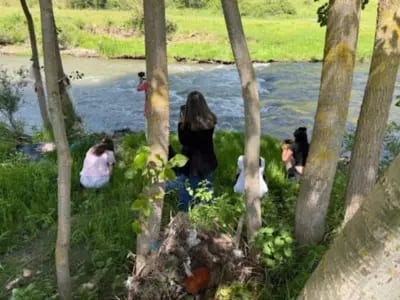
Participants at the Digé Djio adventure in Panan, Albania. Used with permission.
Govo: What impact did participation in this project have on your zeal and local community? Would you like to share some examples?
Shit. He's. The project has changed the idea of using social media to young people. What was previously a entertainment medium, now it's about the problems they're facing. You learned to view action as a tool. 44 young men learned how to document and highlight environmental problems.
In the words of Igli, a young man who participated in training and grassroots activity, I never thought of such a way. My thoughts have changed now about what kind of posting can be. [ Map on page 16]
The images of pollution are more evident to local people. The photos and videos of the dump in the river are all available through digital adventure. Hundreds of people have responded to our content online.
Local residents and supporters can easily protest. 506 signed online. This photograph, videos and other information is now part of an open archive. In the future, people in the region will be able to use them while discussing with local administration.
Govo: To participate in the project, what has changed to your own knowledge, awareness, and experience about digital democracy and citizen space?
Shit. He's. The concept of digital democracy is even more evident to us through digital flashs. Using technology is part of digital democracy to collect and document information, gather people and demand answers from different organizations.
We learned that a video, posters, or signatures can make people's demands more reliable. This kind of information is also evidenced by the public authorities.
In addition, the campaign's strategy to create content, to manage online commentary, to use Instagram and Tktk's Analytics, and to experience digital security and ethics. Among them were the protection of young participants and the protection of their personal information.
The group has taught us how to use this knowledge to build digital citizen initiatives led by young people.
Govo: What are the most valuable lessons and experiences from this project?
Shit. He's. One of the most important lessons, young people in digital age do not need much technical equipment. Rather, they need to be responsible citizens, to demand and participate in the process of making decisions. Their mobile phone and creativity are enough to get specific goals and needs.
Second, an informal and pleasant event like digital adventure will reduce youth participation. Young people from marginalized communities, and low-income families can join these initiatives.
Photo too for complaint. The evidence can have a greater impact on the organization. However, this experience also taught us that it is important to change strategy. The decision to use Google form instead of Google.org to create a petition is to choose weapons according to their advantage.
Finally, it takes time to change the level and ensure their active participation. It is also important to follow the progress of the initiative as well as to unite people.
Govo: What next? Learn From This Project How do you use digital skills in the future and in improving your community?
Shit. He's. One more project has already started. There's a part of knowledge from the previous project. This time, cultural heritage. On the other hand, we are taking a look at how young people can help promote their own demands and demand more accountability and participation from different organizations.
The most important thing for us is finding new and different methods to reach young people. They have to use communication tools to share their time with media and platforms.
It is important for young people to connect with them through a better approach. We are able to add these initiatives to understanding that not only spend time on social media but also a practical way to bring real change to ourselves.