The power outages are stopped in the wells and pumps, transforming the electrical holidays of a water crisis.
Originally published Global Voices Global

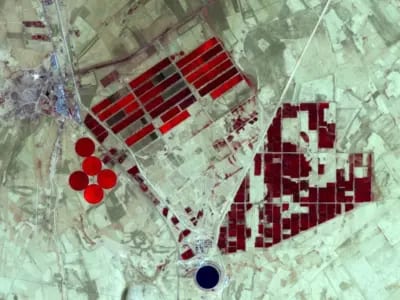
Omar Al-Mokhtar ' s Grand Reservoir Project South Benghazi. Photos. Jesse Allen, NASA Earth Observatory, data used from NASA/GSFC/METI/ERSDAC/JAROS and ASTER Science American/Japan Group. Wikimdia Komnes.I'm sorry. Public property.
Access to water is closely linked to the power cuts in the... Awesome. In eastern Libya. On July 18th, Area-wide power outage By cutting the current from the fields of bed wells, Tazerbo and a pumping station. Benghazi.I'm sorry. The electric current gradually returned from 8:00 a.m., depending on local timing, to bed first and then Tazerbo by noon. She's back. The Great Industrial River. The wells are gradually running and water flows as electricity returns.
It wasn't an isolated vacation. Report of the Libyan news agencyThe technicians began work on gradually recovering the current after another large-scale break, on 30 May, all the wells working in Tazerbo and Al-Hasrah beds were stopped. The same incident affected the water tank in Ancestors. And the pump station. Slug.I'm sorry.
By July 3, the recurrence of the problem prompted the Great Industrial River Authority to blame the recurring power disruptions in disrupting water production. Middle gate. One electrical holiday stopped 41 wells in bed and 11 wells in Tazerbo, while the Authority reported that frequent breaks affected the daily needs of water in agricultural and urban areas.
After that, on July 23rd, another power outage was released, linked to the closure of a generator unit at the gas bed station to generate electricity, 143 wells of service — 92 wells in bed and 51 wells in Tazerbo. Water supplies for some areas and cities have been reduced for 24 hours to protect the network and maintain water levels in the garments of ancestrals. The free Libyan channel. The State Water and Sanitation Company subsequently provided water carriers to the population, hospitals and care centres.
Why is the failure to serve a political cause?
Libya ' s electric power crisis is national, but the failure to serve in the Brigats has additional political meaning due to a longer history of centralization and inequality between regions.
Founded. Libya ' s newest federal kingdom in 1951, from Barakah, Tripoli and Zahn, ended in 1963. Historical Eastern Province and its capital Benghazi; Western Tripoli Region, its capital, Tripoli, the historic South Zan region and its capital, Sabha.
Benghazi, the main city and historic political status of the Berqah region, played a major role in A revolution. 2011 v. Qadhafi's Sheriff.I'm sorry. Both White and Metropolitan cities also played important management roles while the coral and judiciary cities were basic eastern centres. The federal and separatist currents, which followed, demonstrated the political overlap of services, resources and regional identity. This regional marginalization has a documented political history. Records. Analysis of the Carnegie Foundation In 2012, complaints from the eastern regions about parliamentary representation, external scholarships and diplomatic appointments after 2011.
A rich oil geography, but weak services.
This discrepancy is further exacerbated when taking into account Libya ' s resource map. She's... Department of American Energy Information Libya has the largest confirmed oil reserves in Africa, and about 95% of the extractable reserves are concentrated in the Sart and Merzek basins.
Most of Libya ' s resource base is concentrated in the east and south, while key financial and administrative institutions remain concentrated in the capital, Tripoli.
This does not mean that the region has the oil and electricity it produces or that western Libya is free from infrastructure failures. Libyan electrical network is interconnected at the national level. In October 2021, Declared. The General Electricity Company reconnects the east and west wings in particular to enable the network to use power generated from stations throughout the country.
Historical records show cross-regional energy flows. In January 2016, Reporting Electricity Company that the interruption of lines between Ajadbia, the Wahat area and the West Network has lost 350 megawatts to the West and Zowet bed stations, which has resulted in electricity technification in Grand Tripoli, Central and Southern Libya.
In May 2025, the flow was reversed: Zod. Western lines are powered to contribute to the reboot of the eastern stations. The guide supports a national network with a bilateral orientation, not a proven policy that deliberately cuts a fixed share of a hammer to Tripoli.
That raises a more difficult question: how will decisions to manage loads, investments and power flows be distributed in the context of its ongoing disruption near the main water and energy infrastructure?
Planning crisis; no shortage of resources
Libya has alternatives that include gas, long coasts on the Mediterranean, large desert areas and enormous solar power potential. However, on 10 July, a bed-water system, Sirte, Tazerbo and Benghazi, registered its highest daily production rate since 2011, while power outages continued to pose an operational challenge.
She's... Data The World Bank has a population of approximately 7.5 million people distributed over an area of approximately 1.76 million square kilometres, close to France, Germany, Italy and Belgium combined. However, despite the abundance of energy resources, the ongoing disruptions in electricity and water services indicate failures in planning, governance and accountability, which are just beyond scarcity.
That explains the unsatisfactory humor of some Libyans. It may be remembered who considered the rule of the Qadhafi colony (1969-2011) as a waste of how much water and electricity were more stable in his time. This does not mean support for dictatorship; however, the deterioration of services may make stability a prominent place in public memory.