Death does not annul the sentence, nor the responsibility of officials who turn a condemned war criminal into a hero
Originally published in Global Voices in Spanish

Bardhyl Jashari, Executive Director, Metamorphosis Foundation. Photo of a private file, used with permission.
East Article of Bardhyl Jashari was first published in Albanian Portalb 31 August 2026. Global Voices reproduces a version edited under an agreement to share content with Metamorphosis Foundation.
Death does not erase the sentence. When government officials put a war criminal on a pedestal, the dignity of the victims was affected, the rule of law was weakened, the idea of North Macedonia itself was damaged as a multi-ethnic society, and the European vision of the country was compromised. In the year in which North Macedonia 35 years of independence We should have already understood that a State is not built by glorifying war criminals.
The death of Ratko Mladić, former commander of the Serb forces in the Bosnian war between 1992 and 1995He was not a hero or a victim of The Hague, but a criminal sentenced to life imprisonment for genocide and other serious crimes. Mladić died on August 27 when serving a life sentence. In 2017, he was found guilty of genocide, crimes against humanity and war crimes, and the sentence was raided after an appeal in 2021. The allegations they were the result of genocide in Srebrenica, persecution, extermination, murder, deportation and forced transfer, terrorism and illegal attacks against civilians in Sarajevo, and of taking United Nations workers hostage. His crimes were monstrous, and that's why he was nicknamed "Butcher of the Balkans. "They are not merely political or emotional descriptions, and their guilt is not a matter of personal opinion. The responsibility for genocide and war crimes was established in a Judgment of the International Residual Mechanism of Criminal Tribunals (IRMCT) in The Hague.

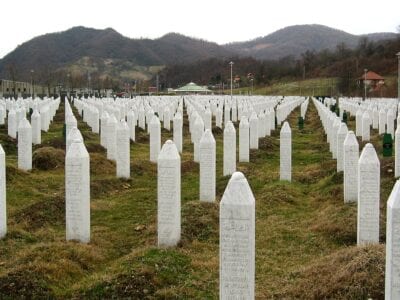
Tombs in Srebrenica Genocide Monument to commemorate 8372 Muslim Bosniacs of the massacre committed by Serbian forces under Ratko Mladić's command in 1995. Photo by Michael Büker, via Wikimedia Commons (CC BY-SA 3.0).
That is why it is unacceptable how some media reported his death to the public as well. Write that he died in The Hague, list your diseases and calls for your freedomwithout explain clearly why he was there. It's not neutral reporting. It creates a false biography in which the uniform and military grade remain, while the victims and the crimes disappear.
It is more worrying that glorification was not limited to citizens' comments. The Serbian Democratic Party in Macedonia, led by the Minister of Local Self-Government, Ivan Stoilković, described a Mladić as a general who served the Army and the people, and suggested that many would remember it "not for The Hague."

Screenshot of a publication in Instagram by Dalibor Kitanović, director of the Agency for the Exercise of the Rights of Communities of the Republic of North Macedonia, which highlights the sentenced war criminal Ratko Mladić and the Second World War criminal and Nazi collaborator Draža Mihailović, who was whose rehabilitation was controversial in 2015with historic Serbian military leaders and the text: "For the Honorable Cross and Golden Freedom: General of the Celestial Army," published on August 28 and later deleted.
On the other hand, Dalibor Kitanovic, Director of the Agency for the Exercise of the Rights of the Communities, published a photomontage that puts Mladić among the "generals of the heavenly Army." These are not neutral expressions of regret. Raise a war criminal sentenced to the status of a national hero.
When an ordinary citizen does something like this, one could say that we have a social problem and that we lack empathy, the crime of genocide, that there is inter-ethnic intolerance and hatred, and more, is minimized and relativized. But when a public official does, it becomes an institutional and political scandal, because the message comes from representatives of the State. It is particularly disturbing that this should be done by the head of an institution whose mission, by definition, should be to ensure equal access, respect differences and promote the rights of all communities.
Several ethnic and religious communities live together in Macedonia. For Bosnian citizens living there, Srebrenica It's not a distant historical event. To glorify a man convicted of genocide against Bosniacs sends a message that his pain and dignity matter less. That is a direct blow to inter-ethnic trust and social cohesion, which remains fragile even without such provocations.
It should also be emphasized that condemning Mladić does not represent a position against the Serbs. On the contrary, it is a rejection of the attempt to identify an entire people with the crimes of a person and the ideology that caused them. Criminal responsibility is individual, and the respect of victims must be universal.
To glorify, deny or minimize genocide and war crimes is not only morally unacceptable, it can also constitute a crime under the law. The Article 407A of the Criminal Code establishes criminal responsibility for publicly denying, ostensibly minimizing or justifying genocide, crimes against humanity and war crimes, even through information systems. The prosecution and the courts must determine whether publications comply with all elements of a crime. They are the institutions that have an obligation to examine the case and determine whether there are grounds for criminal responsibility, and not simply ignore it. However, political and moral responsibility is a separate matter and should not be expected to be completed. The resignation or dismissal of a public official may be requested as soon as his or her conduct is considered incompatible with the public offices they hold, regardless of whether criminal responsibility is subsequently established.
Many political parties, such as the Democratic Social Union of Macedonia, Democratic Union for Integration, the Democratic Action of Macedonia and the party Liberal Democratic They condemned glorification and asked for responsibility.
The VLEN coalition, one of the main ethnic Albanian political blocs in North Macedonia and partner of the VMRO-DPMNE government, as well reacted. However, their response must be assessed in another way because VLEN is part of the Government and shares power with political entities and officials that glorified the war criminal. Although in principle I condemn the glorification of Ratko Mladić and asked for "immediate responsibility," he does not mention either Dalibor Kitanović or the Agency for the Exercise of the Rights of the Communities, which he leads. Nor did he directly address the statement of the Serbian Democratic Party in Macedonia, led by Minister Ivan Stoilković, VLEN's partner in the ruling coalition. A conviction that does not clearly identify who should assume responsibility is incomplete and allows governing partners to hide behind general statements
At first, the ruling party VMRO-DPMNE was silent. August 30 said that the Government's position is based on internationally established legal acts and that officials who supported Mladić should either withdraw their words or leave their posts. However, this reaction is also warm: those responsible are not mentioned, their dismissal is not called for, and the responsibility of Minister Stoilković and the party he leads, which is part of the government, is not directly addressed. For its part, Kitanović was given the opportunity to delete or withdraw its publication and continue to run the agency. But to delete a publication does not erase the opinions expressed or the disconcertation and damage they caused.
On July 16, just one and a half months before these events, North Macedonia officially supported the European Union declaration at the OSCEwhich states that there is no place in Europe to deny genocide, review or glorify convicted war criminals.
It is understandable that the publications of some officials do not stop or hinder the process of North Macedonia's integration into the European Union. However, to tolerate these views of government representatives undermines the credibility of the candidate country and shows that European values are adopted in declarations, but not necessarily in practice. Macedonia cannot condemn glorifying war criminals in international forums while tolerating the same conduct of its own officials in the country.
Ratko Mladić is dead. But the ideology that makes a war criminal a hero is still alive every time that glorification is tolerated for various party or other interests. The Government must clearly demonstrate that it is on the side of the victims, that it respects the law and that it protects our shared future, even if this requires that its own officials and coalition partners be held accountable. Without respect for the dignity of citizens, there can be no social cohesion. Without accepting the truth, there can be no reconciliation. And a state that tolerates the glorification of war criminals cannot claim that it is building a European future.