Machado returns to a nation full of hope, but cautious
Originally published in Global Voices in Spanish

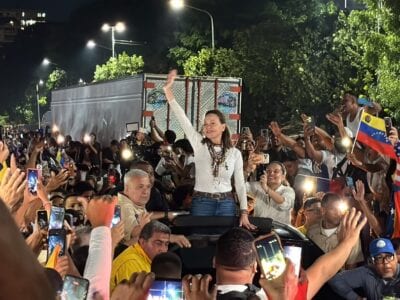
Maria Corina Machado arrives in Caracas after months of being hidden in exile. Photo by Oscar Calles, 2026. Used with permission.
Thousands gathered on Valle Car Road in Caracas to welcome the opposition leader and Nobel Peace Prize winner Maria Corina Machadowho returned to Venezuela after 16 months in hiding and ten months in exile. The mass congregation celebrated, but their compatriots were also full of doubts about what was coming.
After more than a year in the shadows, forced to hide behind her abduction - allegedly by government paramilitaries - in his last public protest of 2025, Machado left the country quietly. He appeared on the world scene that year to to receive the Nobel Peace Prize in tribute to his social organization campaign during the presidential elections of Venezuela in 2024, that in the end Nicolás Maduro won with fraud. From capture of the Venezuelan former On January 3, 2026, Machado had tried - without it - to enter the country at least seven times, he said because the management established by US President Donald Trump did not allow it.
However, on the morning of October 25, Machado was seen in the city of Barquisimetowhere he visited the church of Santa Rosaand at 22: 25, his caravan went through Santa Monicaalong the main route leading to the capital of Venezuela:
I'm here. With you
- Maria Corina Machado (@ MariaCorinaYA) October 25, 2026
The excited drivers made their horn sound. A crowd of about 3000 people began to chew slogans. From the state of Lara, the caravan of Machado crossed Yaracuy, Carabobo and Aragua as it approached Caracas, a journey of more than 300 kilometres that took him About 11 hours.
A different country
After the US operation of January 3 in which captured Nicolás Madurowhose reelection in 2024 was questioned inside and outside Venezuela, then Vice President Delcy Rodríguez took power as Acting President.
Since August, interim management has been negotiating with Dinorah Figuera, President of the National Assembly elected in 2015, in a Washington-led dialogue process. Despite promoting participation in the 2024 presidential elections, the Machado party, Vente Venezuela, was not represented in those negotiations.

The crowd waited for hours for the arrival of Maria Corina Machado to the capital. Photo by Oscar Calles, 2026. Used with permission.
United States Secretary of State, Marco Rubio, attributed Machado's safe return to these talks, which he said had already authorized the release of hundreds of political prisoners and the return of hundreds of opposition figures in exile. Blonde called all political actors to support them because they represent the "best opportunity Venezuela has had in 30 years."
In the face of political demobilization, Venezuelans are used to seeing protests in which most of the participants are activists, leaders and members of civil society organizations, well-informed people because that's their job, but Machado's meeting was different. There were people without T-shirts or party hats; only a combination of families, friends and civilians who seemed motivated by return and with hope for their country.
People started to gather on the road around 15: 00. After hours of waiting, the meeting became a party, the kind of celebration many did not dare to have after January 3.
Read more: Venezuela's struggle for democracy
Machado almost didn't talk, he didn't have a megaphone and he was in the back of a van safely around him. He gave no statements to the media, but he heard and greeted the crowd, embraced the people, touched their hands and let himself be seen. On this occasion, they had not gone to listen to their proposals, they had only gone to see it.
In a moment, two patrols of the General Directorate of Military Counterintelligence They went through there. Those who were closer to the highway lane began to shout "go, go!" but no one blocked their way or touched doors or windows, and the patrols followed their ways. The Directorate-General is known as the political police of Venezuela, and is one of the entities identified by the repressive measures of 2024 after the elections, in which there were more than 2300 detainees.
New uncertainties
When asked about possible consequences of Machado's return, the participants of the caravan had different perspectives. The veterinarian Marianna Torres had no doubt about the order of things: Venezuela must have presidential elections and soon, but not with the same electoral institutions that allowed electoral fraud. For her, all branches of power are corrupt and must be cleaned before any choice.
He also urged those who see Venezuela from outside to stop listening only to politicians and to pay attention to what the "day-to-day Venezuelans" are saying, which they know there are still political prisoners, human rights violations and authoritarian government control.
Gabriela Santander, publicist and activist of the Encuentro Ciudadano party, thinks almost the opposite with regard to chronology. He stressed that he had been waiting for months, since before Machado left, and believed that voting now, without an independent electoral arbitrator or an impartial Supreme Court, would be a trap. Its chronology is concrete: if a new National Electoral Centre is not established by the end of the first quarter of 2027, the time will come to put pressure.
Santander suspects that after the return of Machado, who believes that it would not have happened without Washington's approval, there are agreements that no one has revealed, especially because Rubio confirmed that his government had negotiated his return with the interim government "many weeks before." What Santander pointed out on the night of the caravan was more important: people were waiting on the highway for more than four hours, and the authorities didn't try to stop anyone.
Lawyer Joyffer Briceño had a pragmatic opinion of the situation. Although he sees Machado as the leader of those who want to restore the country's institutions, he does not confuse emotion with change. "Those who have power are the same as those who were part of the crisis for years," he explained. "I want something less abstract than a figure of economic growth, I want the improvement to sit in every Venezuelan's pockets."
For José Gregorio Rodríguez Cham, the arrival of Machado has a different weight. His father. Julio Rodríguez Salazar is a political prisoner, so he went to the congregation with other relatives to continue demanding the release of 322 political prisoners who, according to the Criminal ForumThey're still in detention. He believes that new elections would be different, because US supervision, but does not deny that the repressive apparatus in Venezuela is still intact, and that it will take time to disarm it. What you expect in the next few years is elections and freedom, starting with that of your family.

Photo by Oscar Calles, 2026. Used with permission.
Raquel Bugallo, a Caracas merchant, suspects foreign aid. He believes that the international humanitarian aid that Venezuela expected was overshadowed by economic interests, and that oil has been Venezuela's greatest wealth and also its "worst curse." Although he did not reject the call of Blonde of understanding from all sectors, I express a condition: to find common ground, to the extent that the country can move forward. His message to the international community was the shortest of the night: "If you are not going to help us, do not stand in the way."
The day after Machado's return, Delcy Rodríguez He was kidding. that the "show could have been avoided." For its part, the Inter-American Commission on Human Rights recalled the Venezuelan State of its obligation to guarantee the life, integrity and political rights of the leader. From 11 to 15 November, the dialogue table He'll meet again. for the first time with Machado in the country.
Meanwhile, Venezuelans can taste the feeling of having spent hours in the streets without the well-known fear of repression. On October 25, 2026, although there were repressive entities that were patrolling through the crowd while Machado was waving from the back of a van, people were watching the patrols and telling them to leave, and that must have felt like progress.