Hong Kong ranks 24th in rule of law index and is trending down
Originally published on Global Voices

Screenshot from the World Justice Project's Rule of Law Index. Fair use.
This post is part of Global Voices’ November 2026 Spotlight series, “Justice as infrastructure.” In this Spotlight, Global Voices is partnering with The Hague Institute for Innovation of Law (HiiL) to highlight the ways justice functions as critical infrastructure for any society. You can support this coverage by donating here.
The Hong Kong anti-graft body, the Independent Commission Against Corruption (ICAC), flaunted on X in early October that the city ranked in the top 10 globally and third in Asia in the “Absence of Corruption” category on the “Rule of Law Index 2026” published by the World Justice Project (WJP).
However, the “Absence of Corruption” merely captures whether or not public officials from the administration, police force, and judiciary use their offices for private gain; this single factor does not mean a society is free from corruption, as institutional favoritism, such as political nepotism, legal discrimination, and cronyism, are equally dangerous abuses of power that create systematic injustice. That’s why the WJP includes eight major factors in its index, and Hong Kong ranks 24th and scored 0.71 in the overall index among 143 countries, falling behind Australia (12), Singapore (14), Japan (15), and South Korea (20) in Asia and the Pacific. Between 2016 and 2020, Hong Kong consistently ranked 16th overall in the index.
The eight factors considered in the Rule of Law Index are “constraints on government power,” “absence of corruption,” “open government,” “fundamental rights,” “order and security,” “regulatory enforcement,” “civil justice,” and “criminal justice.”
Best performance: “order and security” and “absence of corruption”
Hong Kong performs best in “order and security” (ranked seventh with a 0.92 score), “absence of corruption” (ranked 10th with a 0.83 score), and “regulatory enforcement (ranked 16th with a 0.79 score). Among the subfactors of “order and security,” the city indeed has a relatively low crime rate (ranked eighth), and near-zero violent expression of grievance (ranked ninth).
In fact, the city has had hardly any protests since 2021, following the enactment of the National Security Law on June 30, 2020, and a heavy-handed crackdown on unauthorized protests. However, civic conflict remains high (ranked 40th), as people resort to street fights to express their frustrations.
The average Hongkonger will likely disagree with the relatively high ranking of “regulatory enforcement,” particularly after the recent release of the Taipo Deadly Fire investigation report, which revealed that multiple Hong Kong government authorities, including the Housing Bureau, the Labor Department, the Fire Service Department, and the Buildings Department, had not effectively enforced related regulations, which could have prevented the death of 168 individuals on November 25, 2025.
Moreover, while Hongkongers have complained about tender rigging in building renovations for over a decade, it was only after the high-profile Taipo fire that the authorities vowed to actively investigate the construction sector. Some fire victims also criticized the government’s buy-back plan as disrespectful of their private property rights. Both effectiveness of regulatory enforcement and respecting property rights are subfactors of “regulatory enforcement” in the Index.
Worst performance: “constraints in government's power” and “fundamental rights”
Hong Kong’s worst performance among the eight categories is “constraints in government’s power” (ranked 63rd with a 0.54 score) and “fundamental rights” (ranked 69th with a 0.55 score).
Hong Kong ranked 25th in “constraints in government’s power” in 2016, fell to 31st in 2020, then plummeted to 54th in 2022, and further tumbled to 63rd in 2025 and 2026. The enactment of the National Security Law in Hong Kong on June 30, 2020, which empowered the Hong Kong government to shut down independent media outlets and NGOs, was the main driving force in the recent plunges. Other factors included officials’ decision to rewrite electoral laws under the guiding principle of “patriots administering Hong Kong” in May 2021, the 2023 district council reform to restrict district councilors’ power and exclude oppositional figures, and the passage of domestic security law in March 2024 to outlaw acts including treason, espionage that harms the city, and incitement that provokes hatred. Rights groups say all of these provisions have chilled civil society activity and encroached on citizens’ fundamental rights.
The report described the “constraints in government’s power” performance as moderately to alarmingly risky, with constraints from the legislature ranking 84, judiciary 64, independent auditing and review bodies 61, non-government organizations 105, and the law 90 — the law refers to the legal framework that protects procedural justice and integrity regarding the appointment of officials and the electoral process. As for the subfactor “official sanctioned for misconduct,” which has a fair 22 ranking, some Hongkongers may consider the score too generous given that only one official has taken responsibility and resigned over the preventable Taipo Fire disaster.
A similar downward trend appears in the “fundamental rights” category, which ranked 29th in 2015, slipped to 38th in 2020, plummeted to 54th in 2021, and fell to 69th in 2026. The at-risk subfactors include security of suspects and dissidents (73), freedom of opinion and expression (105), privacy protection (86), freedom of assembly and association (115), and labor rights (66).
Hong Kong saw the shutdown of Apple Daily News and Stand News in 2021 upon the enactment of the National Security Law in 2020. The domestic Article 23 security law was enacted in March 2024 to further clamp down on “soft resistance” with the newly introduced sedition crime. Privacy rights have declined, as implementation rules for national security laws have empowered police to conduct physical searches of private property and digital devices without court warrants during national security investigations. Since 2020, NGOs, independent media outlets, and activist groups have vanished en masse amid a tightening political environment and shrinking civic space for organizational activities.
The fairly ranked subfactors are freedom from discrimination (29), rights of the accused and convicted (32), and freedom of religion (31).
Poor performance on “fundamental rights” also drags down the “open government” factor's rank (29), with its subfactor “civic participation” ranking 87 in an at-risk level.
Downgraded “civil justice” and “criminal justice”
Although Hong Kong's overall performance in civil and criminal justice remains fair, both factors have fallen from their historical high ranks of 11th and 7th to the current 20th and 23rd.
The main subfactors driving the decline in civil justice are discrimination (48) and improper government influence (56).
After the passage of Legal Aid Reforms in 2021, the number of applications to fund judicial review that challenge the government’s policy and decisions received by the Legal Aid Department dropped 60 percent from around 275 in 2016 to 110 in 2025. Of those 110 requests, the department approved only 2 cases. The overall number of judicial review cases fell from a peak of 3,899 in 2019 to 1,545 in 2022. Because most cases involve non-refoulement claims for refugee status, the government, in addition to the administrative Unified Screening Mechanism (USM) launched in 2014, introduced a special scheme in March 2025 to appoint eligible private practitioners as Deputy Judges of the Court of First Instance to handle these cases exclusively. The mechanism disposed of more than 3700 claims in 2025. Both reforms, driven by the government administration's political considerations, have negatively affected the poor and the non-citizen's access to judicial justice in Hong Kong.
The major subfactor contributing to the fall of criminal justice ranking is “government or political influence on the criminal justice system” (61).
Hong Kong’s criminal justice ranking first plunged in 2017, from 8th to 16th, after the government labeled the civil unrest in Mong Kok, dubbed the Fishball Revolution, as a riot and reactivated the colonial-era Public Order Ordinance to prosecute protesters en masse. Then, in 2021 and 2022, the ranking dropped again amid a series of speech-related prosecutions against 47 pro-democracy activists for participating in the primaries of the election of the legislature for conspiracy to subvert, Apple Daily senior executives for foreign collusion, and Stand News editors for conspiracy to publish seditious content. The recent convictions and heavy sentencing of Apple Daily’s executives, including Jimmy Lai, and former leaders over collusion, Albert Ho Chun-yan, Lee Chuek-yan and Chow Hang-tung, of the now-disbanded organizer of the June 4th candlelight vigil, Hong Kong Alliance in Support of Patriotic Democratic Movements of China, over inciting subversion, further downgraded the city’s criminal justice performance in 2026.
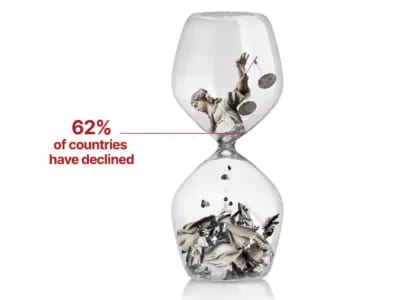
According to the Index’s insights, the global rule of law has declined for 9 consecutive years. Civic participation and the freedoms of speech and assembly each fell in over 60 percent of countries, and Hong Kong is among them. The city also sees the global trend of improper government influence that undermines civil and criminal justice.
The Rule of Law Index is particularly crucial to global financial centers; as the WJP notes, when the index scores reach 0.66, countries tend to have high sovereign credit ratings. Currently, Hong Kong’s score is 0.71 and trending down, while its Asian competitor, Singapore, ranks 14th with a 0.79 score and an upward trend. Watchdogs indicate this could be a bad sign for the city as it seeks to secure its spot as the region’s top economy.