Young Nigerians still face structural and financial barriers to contesting and winning elections
Originally published on Global Voices

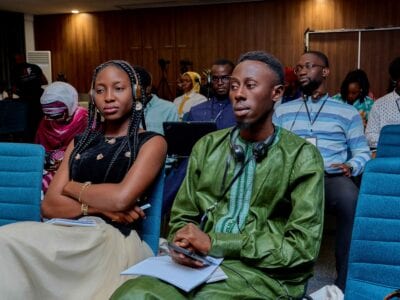
A section of young delegates at the West Africa Youth Democracy Conference held in Dakar, Senegal. 8-10 September, 2026. Photo by Legis360. Used with permission.
This post is part of Global Voices’ September 2026 Spotlight series, “Protest in Democracy.” With this Spotlight, we seek to explore the many forms of protest, the tactics states use to delegitimize and suppress them, and the complex relationship between protest and democracy. You can support this coverage by donating here.
In 2018, young Nigerians won a fight that had taken years to organise. The Not Too Young To Run campaign helped push through a constitutional amendment lowering the age limits for several elective offices. Eight years on, the legal victory has not made politics much easier for them. Party nomination and expression-of-interest forms can cost as much as 100 million naira (USD 75,000). Earlier this year, one Nigerian state set the nomination fee for a local government chairmanship at NGN 30 million (USD 22,000), reportedly more than the office’s official earnings over a full four-year term.
At the legal ceiling, election campaign spending is now at an all-time high in Nigeria. In February 2026, President Bola Tinubu signed the Electoral Act 2026 into law, doubling the presidential spending limit from NGN 5 billion to 10 billion (about USD 7.5 million) and raising the governorship limit from NGN 1 billion to 3 billion (USD 2.2 million). These are no small numbers for a young candidate.
That gap between being allowed to run and being able to run hung over a conference room in Dakar from September 8 to 10. Convened by the Economic Community of West African States (ECOWAS) Commission and Legis360, the West Africa Youth Democracy Conference brought delegates from 12 countries together to discuss the barriers to young people’s political participation in the region.
Nelson Asusiya, a young parliamentarian from Ghana, described a generation told to wait its turn while being used as poster children for political parties and civic movements, and rarely given actual power.
Yet, the people being asked to wait are the majority. Young people make up about 70 percent of the region’s population, according to the conference communiqué.

Nelson Asusiya, a young delegate from Ghana, speaking at the West Africa Youth Democracy Conference held in Dakar, Senegal. 8-10 September, 2026. Photo by Legis360. Used with permission.
Barriers to youth participation in West African politics
Across West Africa, young people remain largely absent from decision-making bodies despite their demographic weight. Political parties remain important gatekeepers, controlling who gets nominated, how candidates are selected and, in many cases, whose networks and resources can carry them through an election.
The Not Too Young To Run campaign in Nigeria showed what organised pressure can achieve. But it also exposed that changing the rules is not the same as changing who can afford to use them.
Cynthia Mbamalu, director of programmes at Yiaga Africa, which led the campaign, told the conference that while the amendment lowered the legal barrier, the political space remained more open on paper than in practice, with young aspirants still facing structural and financial barriers to contesting and winning.
Ezenwa Nwagwu, a Nigerian civil society leader, called the result a contradiction: Young people are old enough to vote and old enough to protest, but are often told they need experience before they can hold political office. He also rejected the idea that young Africans are impatient and drifting from democracy. Democracy, he argued, is measured not by its “dividends” of roads, hospitals and jobs, but by the freedom to question power.
Protests in West Africa
Across West Africa, protest has long been one of the ways citizens challenge political power. In 2012, Senegal’s Y’en a Marre movement mobilised young people against poor governance and President Abdoulaye Wade’s bid for a third term. In Burkina Faso, Le Balai Citoyen (“The Citizen’s Broom”) drew on young urban citizens to oppose Blaise Compaoré’s attempt to change presidential term limits. These movements showed how street politics could turn constitutional questions into issues people could see and feel in everyday life.
But protest has also met repression and contributed to distrust in formal institutions, as the #EndSARS protests in Nigeria showed.
An estimated 577 protests took place across West Africa in 2020 alone, according to a 2025 study of social movements in Africa. The frequency of such mobilisation points to a region where citizens, particularly young people, are repeatedly demanding a greater say in how they are governed.
But the region’s political institutions are themselves under strain. On January 29, 2025, Burkina Faso, Mali and Niger formally withdrew from ECOWAS, the regional bloc that convened the Dakar conference. The three countries, all under military rule, had formed the Alliance of Sahel States (AES) and established a confederation in 2024, deepening a political rupture that has reshaped West Africa’s regional order.

Director of political affairs, Dr Babatunde Afolabi, speaking at the close of the West Africa Youth Democracy Conference held in Dakar, Senegal. 8-10 September, 2026. Photo by Legis360. Used with permission.
For young West Africans, the withdrawal means millions of young people in Burkina Faso, Mali and Niger now live outside the regional bloc that convened the Dakar conference. Yet many of the questions discussed there: political participation, democratic governance and youth inclusion, remain relevant to them.
Speaking with Global Voices in Dakar, Babatunde Afolabi, director of political affairs at the ECOWAS Commission, said negotiations with the Sahel states are progressing cautiously. He said:
One of the benchmarks for measuring progress is the ability of the parties to engage. We’ve already started on that trajectory. It’s still early days.
He said a July summit in Freetown, Sierra Leone, called for the talks to expand to peace and security, because “we’re still the same people. Although the AES countries have left, we have a lot in common.”
But the most concrete measure he offered was a year away.
“One year from now,” Afolabi said, he wants the West Africa Youth Observer Network (WAYON), the conference’s main outcome, established, operating and partnered with ECOWAS. “That would be a good measure of progress,” he said.
Nigeria’s campaigners proved in 2018 that young people can rewrite the rules. The harder test, in Dakar and far beyond it, is whether anyone will rewrite the price.
For now, getting through the door can cost as much as NGN 100 million (USD 75,000).


