All Togolese are affected by the country's economic and political crisis
Originally published in Global Voices in Spanish

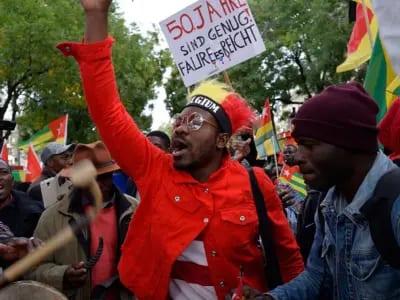
Protest against Faure Gnassingbé in Belgium, October 2017. Since the 2025 Z-Generation protests, the Togolese State has taken repressive measures against demonstrators and civil society. Image of Wikimedia Commons (CC BY-SA 2.0).
This article is part of the Global Voices Spotlight series of September 2026, "Protest in Democracy. " This series seeks to explore the different forms of protests, the tactics that States use to de-legitimize and suppress them, and the complex relationship between protest and democracy. You can support this coverage with adonation.
In Togo, demonstrations and opportunities for civil disobedience are being exhausted while the Government takes drastic measures against civil society and tightens restrictions on freedom of expression in the midst of a persistent political crisis. However, this does not mean the end of the protests, as citizens find other ways to make their voice heard.
As face-to-face concentrations have become difficult to organize or too risky for citizens, online protests have become an increasingly common form of political dissent in Togo.
Constitution at issue
To understand what is at stake today, it is important to know the reforms that have transformed the institutions of Togo. On 25 March 2024, the National Assembly approved a new Constitution which transformed the country's system, which passed from a a parliamentary system. In the context of this restructuring, the office of President of the Republic, now elected by the Members and not by direct universal suffrage, became a majority ceremonial. Most of the power lies with the President of the Council, an office with no mandate limit. Faure Gnassingbé since May 2025, after 20 years as Head of State.
The Government said that reform would promote stability and collaborative governance, while the opposition disagreed. The Hadj Madi Djabakaté, political scientist and president of the Centre for Democratic Governance and Crisis Prevention, summarized this change and said that the reform has "enshrined the concentration of power in the Constitution," rather than creating a new balance of power.
This controversial change and the reaction it caused triggered the June 2025 protests, one of the largest in Togo since 2017, CIVICUS Lens. The protests were triggered following the arrest of the Togolese rapper Aamron, who had spoken online about the deterioration of living conditions and political corruption. The demands of the demonstrators were mainly of an economic and social nature: they required a minimum wage of CFAF 52,500 per month (approximately $93) one of the lowest in the subregion, and that the Government limit the power outages a maximum of four to six hours per day, according to the same source.
Police forces violently repressed the protests, leaving at least seven dead and over 140 detainees throughout the month.
The former Minister of Defence Esossimna Marguerite GnakadéHe publicly condemned the violence. Three months later, on 17 September 2025, he was arrested for incitement to rebellion, according to the Amnesty International annual report 2026. Aamron was again arrested on 19 September 2025 on the same charges, before being released on parole.
The M66 (June 6 Movement), formed following these events, illustrates the change in the country's organizational structures. For not having an official spokesman or recognized legal personality, he was unable to register a demonstration legally, which made things difficult for the authorities seeking an objective, but also deprived the protesters of the protection that normally offers an authorized demonstration, explains Ahouefa Sossou, a human rights lawyer and defender of the Human Rights Documentation and Training Centre, in an interview with CIVICUS Lens. In December 2025, the movement called for another demonstrationwhich coincided with the opening of the 9th Pan-African Congress in Lomé.
Digital technology: the second line of front
Since the protests began on 26 June 2025, the Togolese authorities have imposed a Internet blocking at national level. More than 15,000 data points collected between 25 and 27 June revealed systematic interruptions on fixed and mobile networks. The interruptions, which mainly affected Facebook, TikTok and YouTube, lasted far beyond the three days of protests: at the end of the August 2025 They were still registered, which forced some Internet users to use virtual private networks (VPN) to continue working or communicating.
The change became evident in the second half of the year. On 3 October 2025, Mawama Talaka, the general prosecutor of Togo, publicly denounced the "abusive and anarchic" use of social networks, and warned that any publication or comment considered outside the legal framework would expose its author to legal proceedings, including what he called "complicity by approval." On the same day, Grâce Koumayi Biyoki, a midwife and human rights activist, was arrested at his home following a video posted online, according to Article 19, which described the period between August and October 2025 as an "alarming reduction" in Togolese civic space. In November 2025, a decree further expanded the scope of judicial actions to include simple online interactions, such as giving "I like" a publication.
Consequences of self-censorship
According to Ahouefa Sossouthis "silent reduction of the space of expression" is more worrying than the arrests themselves, as it leaves no trace that can be quantified. In his view, those who expressed themselves freely two years ago are now forced to remain silent. Sossou highlights a specific gender-related risk: women human rights defenders who are forced to reduce or stop their online activism due to the pressure of harassment and their families.
The price of public expression is also measured by those who have chosen to leave. Rodrigue Ahégo, national coordinator of the pro-democratic movement Toursons La Page- Togo, was arrested in September 2024.
"It is not easy; it is difficult," he confesses, in describing the threats and intimidation that led him to leave the country, according to a Icilome report.
The same source documents two cases of journalists forced to delete their recordings under police pressure: Flore Monteau, correspondent for TV5 Monde, on 6 June 2025 in Lomé, and Albert Agbéko on 8 April in Tsévié.
The resistance becomes digital
On social media, some young people are trying to challenge the ban by opposing the situation. They are not political or professional activists, they are driven by the desire to see a change in their country. A young man named Brice says:
The situation of mon pays is wrong. Je n'ai pas besoin d'être Affilié à un parti politique ou militant quelconque pour contester la mauvaise gouvernance dans le pays. J'ai participé à plusieurs manifestations et parce que, comme tout togolais, je ne suis pas épargné par les conséquences de la vie chère.
The situation in my country makes me sad. I don't have to belong to any political party or any activist group to realize the country's mismanagement. I have participated in several demonstrations because, like any Togolese, I have also not been rid of the consequences of the high cost of living.
In early September 2026, civil resistance materialized in a call for action against rising fuel prices, issued by a journalist who gave the alarm from exile through social networks, and artists who announced peaceful protests scheduled for October.
On 12 September 2026, four Togolese opposition groups, Monsignor Kpodzro Dynamics (DMK-Originale), People's Majority Dynamics (DMP), Light for Development in Peace (LDP) and the Front "Don't touch my Constitution," issued a Joint communiqué in which they opposed the last increase in the price per litre of high-quality lead-free petrol. Petrol prices increased by more than 20% in four months in Togo, reaching 817 CFA francs ($1.44) in September 2026, while the average monthly salary about 100,000 CFA francs ($176). The communiqué urges citizens to prepare for "peaceful general mobilization."
Eleven days earlier, on September 1, a completely different kind of protest hoarded social media: investigative journalist Ferdinand Ayité live broadcast on Facebook to reveal that, once again, it was receiving death threatsdespite being exiled in France.
Ayité's case reveals another phenomenon. It is true that the repression has changed the picture of the protests in Togo and has forced some activists to leave the country, but has not silenced them. Ferdinand Ayité was forced to exile in 2023 after facing a prison sentence for a report on corruption; and continues to influence the Togolese public debate from France. In early September 2026, a coalition of opposition parties and civil society organizations expressed their support and extended it to other activists in exile, such as blogger Zaga Bambo, who also presents live broadcasts and round tables from abroad.

Ferdinand Ayité on a live Facebook broadcast. Screenshot from Facebook. legitimate use.
What happened to the protests a year later?
A year after the June protests, it is no longer just the most committed rappers and urban youth who drive the movement. A broad coalition of political parties, artists and public figures in exile has joined the cause and continues to raise the voice from abroad.
On September 10, 2026, the Togolese Music Federation announced a series of peaceful protests for October in order to demand the implementation of the National Fund for Cultural Promotion and the resignation of Isaac TchiakpéMinister of Culture. The initiative is not presented as a counter-revolutionary movement; however, publicly mobilizing a whole professional collective, even for a specific sector issue, remains a political act in itself, in the current context of Togo.
It remains to be seen how this combination of face-to-face and online mobilizations could influence and influence the Government. But, judging by the reactions of the activists, one thing is clear: the people of Togo will not be silent.