Gender diversity, resistance and ritual cross-dressing in Venezuela's sacred cult
Originally published on Global Voices

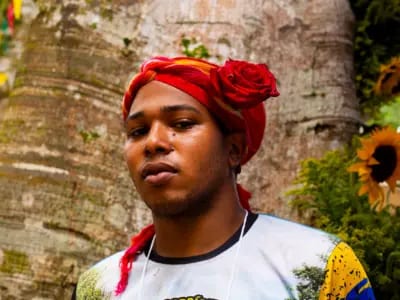
Portrait of Wander Rodríguez, part of the María Dolores Rodríguez Caravan and its powers, and the LGBTIQ+ community. Sorte (Yaracuy, Venezuela). October 12. Freisy González Portales. Used with permission.
In Venezuela, Spiritism as a religion is part of the collective imagination, of our identity; popular beliefs and ritual practices that take us back to our ancestors in colonial times. Over the years, Spiritism has evolved into a vibrant, contemporary national cult centered on the figure of María Lionza as the principal protector of waters and the charms of nature, a figure who challenges the notions of the patriarchal state and opposes monotheistic religions.
This religious system has been studied in depth by anthropologists in our country (Daisy Barreto, Angelina Pollak-Eltz, Michelle Asencio, Francisco Ferrándiz, Cesar Escalona, among others), which I had read about and found interesting at the time, but which I later witnessed for the first time in its most important sites, such as Quibayo and Sorte, in the state of Yaracuy, Venezuela.

Altar to María Lionza in Quibayo (Yaracuy, Venezuela). October 11. Freisy González Portales. Used with permission.
These sites are part of the Cerro María Lionza Natural Monument, popularly known as the Montaña de Sorte, and they represent the most prominent expressions of this cult nationwide, so they are visited year-round by practitioners or “caravans” (as these groups are commonly called),
But few days are as important as October 11 and 12, when thousands of people flock there to celebrate the Day of Indigenous Resistance in Venezuela.
These dates offer an opportunity for ethnographic and cultural observation, specifically how oral histories and our ethnic origins are reclaimed; including those of Indigenous peoples, some of them warriors who fought against Spanish colonization, and African populations — enslaved people and maroons [AN: this will need context] — as we can understand through the figure of the Three Powers: Queen María Lionza as the central figure of the cult, the leader, accompanied by El Indio Guaicaipuro and El Negro Felipe.

Altar to Queen María Lionza in Quibayo (Yaracuy, Venezuela). October 11. Freisy González Portales. Used with permission.
For this celebration families gather among the trees and along the banks of the Yaracuy River, which runs through the entire mountain, setting up lavish altars to the various deities of Venezuelan spiritualism, which embody the sacred rituals characteristic of the Marialioncero cult.
The figure of María Lionza is profound, and I believe it is risky to oversimplify her, as she is regarded as a Queen, a Goddess, a mother, and a guardian, yet there are also aspects linked to her sensuality, as evidenced by the iconographic representations of her that have emerged -naked or clothed, for example-.
In this regard, I draw upon the writings of Francisco Ferrándiz and César Escalona from the perspective of Venezuelan anthropology, combining them with my own observations and field interviews, to address issues related to gender and sexual diversity that are essential to the fascinating debate within the cult on its various courts — such as the Black Court, the Viking Court, the Malandra Court, the Chamarrera Court, and the Medical Court, among others — and entities.

Detail of flowers and bottles of the Baile del vidrio (Glass Dance Ritual) in Sorte (Yaracuy, Venezuela). October 12. Freisy González Portales. Used with permission.
Gender diversity, gender discrimination
The Sorte Mountain is a setting where gender stereotypes are called into question, and I believe they undermine androcentric perspectives and rigid notions of masculinity and femininity found within Christianity, since the entities pose a challenge due to their wide spectrum in terms of strength, height, voice, attire, and other details of the mediums who embody them, as well as the particular characteristics of each spirit.

Strenght between banks and Viking Court entity. Baile del vidrio (Glass Dance Ritual) in Sorte (Yaracuy, Venezuela). October 12. Freisy González Portales. Used with permission.
In his ethnographies and writings, Ferrandíz offers interesting reflections on the body and masculinity in this religion, and how male mediums (from a position of stigmatized masculinity) resisted possession by female spirits, something that did not occur as frequently among female spiritualists.
That is why my encounter in Sorte with the María Dolores Rodríguez Caravan and its powers — led by Osmer Padrón and his godchildren — allowed me to also explore these aspects.

Osmer Padrón embodies the spirit of María Dolores. Sorte (Yaracuy, Venezuela). October 12. Freisy González Portales. Used with permission.
Osmer Padrón, Wander Rodríguez, and Jhonaiker Díaz are all male mediums that belong to the LGBTQ+ community, and are part of this caravan that channels female entities from the Black Court, such as María Dolores Rodríguez, Francisca Martínez, Rita Encarnación, and La Negra Tomasa; but in Osmer’s case, he also channels Mister Piter, a male entity from the Viking Court, a warrior and healer.
Wander tells me that in the LGBTQ+ spiritualist community, “there’s a lot of discrimination, both inside and outside the mountain [of Sorte], but Queen María Lionza is love and affection, and as many spiritual beings have said, we are all deeply cherished by her. We are here first and foremost to fulfill a mandate from Goddess and our Majesty María Lionza. Nothing else matters.”

Portraits of Jhonaiker Díaz (who works with the spirit of La Negra Tomasa) and José Rojas. They are part of the LGBTIQ+ community. Sorte (Yaracuy, Venezuela). October 12. Freisy González Portales. Used with permission.
Regarding the practice of channeling female entities from the Black Court, Rodríguez tells me:
Most of us spiritualists in the LGBTQ+ community dress up in dresses — or find ourselves transported into that state — not because we want to… Right now, there’s a lot of talk from people saying that men who want to be women channel Black Court entities just to wear dresses, but that’s not the case. When a spiritual entity is a woman or was a woman, she always seeks to be fully covered, to cover her breasts, and why? Because she feels exposed; she feels alive. There are many spiritual entities, such as the Negra I work with — who is Rita Encarnación Martínez Chávez — as well as María Dolores Rodríguez Rodríguez, Francisca Martínez Martínez, and Negra Tomasa, who have their dresses made for them. It’s not because we want to wear dresses; if they were our own bodies, we’d walk around shirtless, but no, they always… Spirituality always seeks to feel alive; that’s why they put on their dress, their turban, and some even seek out a flower.

Dresses for female entities from the Black Court: Francisca Martínez, Francisca Palacios, María Dolores Rodríguez, Negra Tomasa and Rita Encarnación. Sorte (Yaracuy, Venezuela). October 12. Freisy González Portales. Used with permission.
There are curious details regarding what the entities ask of their “banks” —people who also care for the physical forms of the entities — such as tobacco and aguardiente; but in the case of the black women, just as they ask for their dresses, they also ask for makeup and make gestures as if looking at themselves in a mirror.
Wander tells me that, in the case of Rita Encarnación, “her favorite flower is the cayena, since it was the flower with which she learned to perform her magic, while she labels “other flowers as hypocrites, since those other flowers remain alive for many days after being plucked from nature, whereas the cayena once plucked from nature wilt immediately.”

Altar to Las Tres Potencias (The Three Powers), in Quibayo (Yaracuy, Venezuela). October 11. Freisy González Portales. Used with permission.
All of this demonstrates that Venezuelan spiritism must be examined through a gender lens, from a feminist perspective, reflecting on the power dynamics established between men and women, the presence of ritual cross-dressing during trance and possession rituals, and other aspects that enrich our understanding of this important Venezuelan religion.

Wander Rodríguez enters a trance to receive the spirit of Rita Encarnación. Sorte (Yaracuy, Venezuela). October 12. Freisy González Portales. Used with permission.