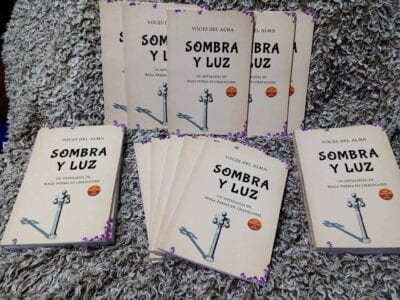
Ten authors and 23 poems are featured in the anthology
Originally published on Global Voices

Photo from the Facebook page of Voces del Alma. Used with permission
A new poetry anthology features writers of Chabacano, one of the Philippines’ 170 languages, which is widely spoken in the southernmost city of Zamboanga, and stands out as Asia’s only Spanish-based creole language.
The Philippines was a colony of Spain for more than three centuries, but the Spanish language was only used by the elite, friars, and colonial rulers. Only in Zamboanga did a Spanish-based creole language develop.
In 2018, Global Voices featured Bien Chabacano, a blog dedicated to promoting and documenting Chavacano de Zamboanga. Its creator, Jerome Herrera, launched a book project this year by inviting writers to submit poems to be compiled in an anthology. This led to the launch of the “Sombra y Luz” book in July, featuring 23 poems by 10 authors. The poems are mainly about love, family, and Zamboangueño identity.
Herrera said, “The project highlights not only the continued vitality of Chavacano as a literary language, but also the efforts of its speakers to create new literature and preserve the language through writing.”
He added that the book title aims to convey a message of contrast about the changes in Zamboanga City. The book cover also provides a nostalgic reference to the flowers that decorated the city in the past.
The cover features an American-era style lamppost that can be seen along the Zamboanga boulevard. The cover also features bougainvilleas which my dad tells me were ubiquitous in Zamboanga City back when it was known as the Ciudad de Flores.
Herrera’s poem in the anthology mentions flowers and birds that enrich life in the city.
Maga pajaro que ta vola-vola,
Na maga rama de pono ta queda,
Alegre con uno y otro ta grita-grita,
Twit! Twit! Twit! Entero el dia.Mio pueblo Ciudad de Zamboanga,
Ciudad de Flores que llama.
De noche mucho pajaro ay columbra,
Na maga cable de corriente ta esta.
Birds that fly and flutter freely,
Perched upon the branches of trees,
Singing and calling each other joyfully,
Tweet! Tweet! Tweet! All day long.Oh, my beloved City of Zamboanga,
City of Flowers, they call you.
At night, many birds can be found,
Sitting on wires, that’s what they do.
In an interview with Global Voices, Herrera noted the heavy use of Spanish words in the selected poems:
…there is a lot of debate with regards to what Chabacano poetry should look like. For some, they like it with a lot of Spanish words and for others, they like it to be exactly as how Chabacano appears in everyday conversations. Most of the poems submitted leaned heavily on Spanish words, I think primarily because Chabacano writers rely on Spanish words to make their works sound more formal as well as more poetic. Since it’s poetry, I thought that it was alright to present Chabacano in an idealistic manner.
He added that the anthology seeks to encourage more people to accept the various ways that Chabacano is used.
For a very long time, people have been putting Chabacano inside a box. I hope that these books open up conversations regarding Chabacano literature and make people receptive to different kinds of writing styles in Chabacano.
This approach is evident in the poem “Escribi Chavacano, Conversa Chabacano,” which celebrates Chabacano as a living language.
Through references to poems, essays, fables, and the stories passed down by elders, the author reminds readers that the language continues to thrive when it is written, spoken, and shared with others.
The title itself is noteworthy for its use of both Chavacano and Chabacano, reflecting the coexistence of two accepted spellings of the language. In doing so, the poem highlights not only the importance of preserving Chabacano, but also the richness and diversity of its written tradition.
Herrera’s interview with Asymptote Journal noted the challenge of finding Chabacano contributors, and his hope that the book project can lead to more literary initiatives.
The biggest challenge is keeping the momentum going, since it’s hard to find Chavacano poets. Even so, I hope this anthology is just the beginning and that we’ll be able to publish a second volume in the future.


