"There can be no legitimate development when doing so depends on destroying what underlies the existence of a people."
Originally published in Global Voices in Spanish

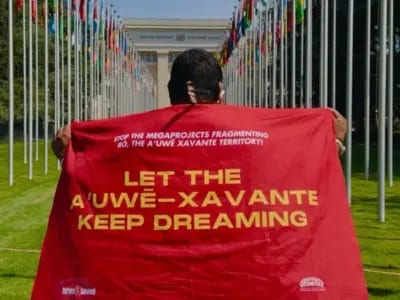
"Let the a'uwț -xavante keep dreaming." Indigenous bears a flag for the campaign in front of the United Nations headquarters in Geneva, Switzerland. Photo from Cultural Survival, used with permission.
East Article of Djalma Ramalho (Aranã Caboclo) was originally published in the Cultural Survival website August 17, 2026. Global Voices reproduces it with permission. Read more on the campaign.
This article is part of the Global Voices "Spotlight" series of August 2026, "Indigenous rights. "This series provides a vision of the lives and experiences of indigenous peoples in order to establish links between regions, highlight indigenous experiences and tell stories of leaders, activists, community members and others. You can support this coverage with a donation.
Under a very heavy sky, on the shores of Lake Léman in Geneva, red words cut the landscape. In front of the jet d'Eau of Bains des Pâquis, the emblematic source of Geneva, two messages appeared: "Let the a'uwē -xavante continue to dream" and "Stop the megaprojects that fragment Ró, the territory a'uwț -xavante."
The intervention took place at the international opening of a campaign led by leaders, communities and organizations to 'uwț -xavante during the United Nations Expert Mechanism on the Rights of Indigenous Peoples in July 2026. They're a indigenous group of the central west region of Brazil, with a population of about 25,300. According to census of 2022Brazil has 1.69 million people who identify as indigenous of 391 ethnic groups.
While government representatives were discussing international policies and standards at the United Nations, the indigenous delegation occupied public spaces to convey a message: there can be no legitimate development when doing so depends on destroying the material, spiritual and political conditions that support the existence of a people.
Dreaming is not a metaphor
For the people a'uwț -xavante, dreaming is a concrete dimension of social, spiritual and political life. In his research on the performance of dreams between the a'uwț -xavante, anthropologist Laura Graham shows that dreams establish relationships between living, ancestors and immortal. The songs received during the dream are spread with the community and can become collective performances that gather narrative, music, dance, memory and cultural continuity.
In an episode documented by Graham, an old man tells that he receives songs from ancient creators addressed to the living, so by singing them collectively, the a'uwț will continue to exist as a 'uwț. Therefore, the dreamer does not appear as the individual owner of a creation, but as a mediator of knowledge that belongs and circulates among the people as a whole, and becomes part of the living legacy of the community.
In recent years, according to the leaders who have managed the campaign, dreams also began to convey warnings related to growing pressures on their territories. The expansion of railways, roads, hydroelectric, monoculture and other large-scale projects is therefore not merely understood as a physical transformation of the environment, but as a threat to the relationships that make it possible to receive, transmit and apply this knowledge.
So, to defend the right to dream is to defend the territorial conditions that make dreaming possible.
Ró: Closed, world, territory and life
The word "ró" does not have a complete equivalent in the conventional translation of "territory." The Geographer Maria Lucia Cereda Gomide explains which ro can simultaneously mean "closed, world, our land, everything." It refers to a territorial and cosmological complex that extends from the village space to the closed [bioma in the center of Brazil], and it includes its waters, animals, plants and spirits that live in this world. Ro is a living network of relationships. It covers hunting, collecting and fishing; ancient villages, burial lands, rivers and roads, medicinal plants; ceremonial places and ancestral presence that support collective life.
A technical note from the Brazilian Anthropological Association, published in 2025, emphasizes that territoriality to 'uwț -xavante depends on practices such as going through the closed, collecting roots, fruits and fibres, fishing, hunting and reciprocal circuits that connect families, clans, age groups and different indigenous lands. Thus, territorial fragmentation compromises access to natural resources and the ability to perform ceremonies, transmit knowledge and maintain the social and cosmological relations through which the a'uwswana are constituted as a people. It also goes beyond relations that cannot be contained within the administrative limits set by the State.
So, the message projected in Geneva - "Let the a'uwț -xavante continue to dream" - is a request to protect the integrity of ró and for the continuity of their own existence. Hiparedi Top 'shooting, leader to' uwț -xavante, says in the campaign document: "Any project that affects one of our territories is a problem for the whole people to'uwț -xavante."
Territories, lives and dreams cut off by tracks
The central demand of the campaign is to protect the rights of the people to 'uwē -xavante before the construction of the Central West Integration Railway (FICO), also known as EF-354. The Brazilian Government has presented it as a strategic project to reduce logistical costs and expand rail freight transport, and is part of a broader corridor designed mainly to transfer soy, corn and other products from the region. By advancing the project without ensuring adequate, free, prior and informed consultation, the Brazilian State has failed to protect the rights of indigenous peoples.
The FICO track is a federal project of approximately 1641 kilometres (1020 miles) under the responsibility of Infraa S.A. The mining company Vale is building the first section, which runs 363 kilometres (226 miles) between Mara Rosa, in Goiás State, and Água Boa, in Mato Grosso State, as compensation for the premature renewal of another concession. Administrative studies and processes related to the route have identified the Xavante territories within their area of influence, which raises serious concerns about the territorial, environmental, social and cultural impact.
In May 2026, the Infra S.A. reported that approximately 80 kilometres (50 miles) of the final part of the section that is currently under construction depended on the completion of the Basic Environmental Plan - Indigenous Component (PBA-CI) and negotiations with the Xavante communities. This makes it clear that the relationship between the railway and the indigenous territories is not merely indirect, but a central issue affecting the implementation of the project.
The technical note issued by the Brazilian Anthropological Association states that the railway affects areas of traditional occupation, land claimed to have not yet been demarcated, has gathered areas, ancient villages, land of graves, navigable rivers and sacred sites. The document recommends that the construction and installation licence be suspended until appropriate consultation has been made, and that the route be altered so that the railway does not cross territory to 'uwț -xavante.
The campaign's defence report Let the 'uwň-xavante keep dreaming, started in Geneva, argues that FICO cannot be assessed merely as an isolated railway line. It is part of a wider architecture of roads, railways, watercourses, and exports corridors that are likely to increase the flow of goods, non-indigenous occupation and economic pressure in already fragmented territories.
Consultation in dispute
In February 2026, the Coordination of Indigenous Organizations of the Brazilian Amazon (COIAB) reported irregularities in the consultation process related to FICO. According to the organization, meetings scheduled for some indigenous lands were held at very short intervals, leaving communities with little time to have internal discussions in accordance with their own decision-making processes. There are also documented reports of pressure on indigenous leaders, lack of independent technical assistance and difficulties in communication between communities distributed between historically fragmented territories. The Federal Public Prosecutor's Office initiated an administrative procedure to follow up the consultation process.
The International Labour Organization (ILO) and the United Nations Declaration on the Rights of Indigenous Peoples states that States should consult and cooperate in good faith with indigenous peoples after adopting projects affecting their lands, territories or resources, to obtain their free, prior and informed consent.
The consultation not only means informing a community that a project will proceed, but will also respect its decision-making schedules, without coercion and its ability to retain the consent of measures that might compromise its future.
To Europe: Colonialism only travels by train and electric cars
The intervention in Geneva has a particular symbolic weight. The city is the headquarters of the United Nations Office and many institutions related to the international human rights system. Indigenous representatives are given little minutes to present territorial conflicts marked by decades of violations.
The campaign also challenges the contradictions of the so-called ecological transition. Railways, logistics corridors, mining operations and large-scale infrastructure projects are often presented as tools needed to build a low-carbon economy. But when they move forward without the effective participation of the affected peoples, they can reproduce colonial mechanisms that last: territorial appropriation, concentration of economic benefits and transfer of environmental and social costs to indigenous peoples and traditional communities.
The projection in front of Jet d'Eau confronts this paradox. Europe, historically involved in the colonization of indigenous territories, continues to be connected to these regions through finance, consumption, mining, agro-industry and export infrastructure networks. Changing the energy source without transforming these relationships is not enough. A transition that continues to threaten indigenous territories as areas of sacrifice can be technologically new, but remains politically colonial.
For a'uwț -xavante, a fragmented territory does not simply mean reducing physical space. It means interrupting paths, songs, ceremonies and memories, and ancestral relationships. No megaproject can say that it represents the future if its existence depends on destroying the dreams of those who have always cared for the earth.