Emerging technologies have become central to systems of coercion and control
Originally published on Global Voices

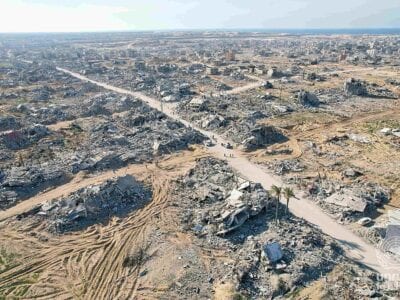
An aerial view showing destruction in Rafah, Gaza Strip, on January 21, 2025. Photo by Ashraf Amra on Wikimedia Commons (CC BY-SA 3.0 IGO).
By Jalal Abukhater
This post is part of Global Voices’ October 2026 Spotlight series, “Big Tech and Authoritarianism.” In this Spotlight, we explore how Big Tech facilitates and hinders authoritarian governments and practices, and how these choices influence the Global South. You can support this coverage by donating here.
For Palestinians, the relationship between technology and authoritarianism is a lived reality, rather than predictions or science fiction. Israel’s settler-colonial regime has long fused military force with legal, economic and technological mechanisms to dominate Palestinian life.
Surveillance, data harvesting, facial recognition, telecommunications blackouts, digital censorship and algorithmic systems are now woven into this architecture of control. The genocidal war on Gaza has exposed the consequences with devastating clarity, where technologies built to collect, process and classify information have been absorbed into systems that surveil, target and kill Palestinians.
But Palestine is also a warning about what comes next. Technologies developed, tested and refined under occupation do not stay there. They become products, expertise and business models that circulate globally. What emerges is a political economy in which military and intelligence institutions, technology companies, investors and governments converge around the extraction and processing of data as a means of exercising power.
This is one of the central arguments of Digital Domination, a publication of The Arab Center for the Advancement of Social Media’s Maryam Abu Daqqa Fellowship, which brings together five studies on artificial intelligence, surveillance, data extraction and corporate power in Palestine and beyond. The fellowship is named after Maryam Abu Daqqa, a Palestinian journalist murdered by Israel in Gaza in August 2025 while documenting life under siege. Across different cases, the research points to the same transformation, showing how emerging technologies have become central to systems of coercion and control. It is becoming their infrastructure.
Intimate ties
Israel’s surveillance industry shows this plainly. It operates through intimate ties between military and intelligence institutions, private companies, venture capital and international markets. Tools tested on Palestinians are refined, repackaged as commercial products and exported to the world as security solutions. This is no accident of a thriving tech sector. It is a political and economic system in which security technologies gain value precisely because of their capacity to monitor, classify and control populations.
The violence these systems enable is increasingly literal. Investigations into Israel’s AI-assisted targeting systems, including Lavender, The Gospel and Where’s Daddy, have documented how machine-learning systems and mass surveillance data have been folded into the identification and targeting of Palestinians in Gaza.
A new film, NAZA, produced by The Guardian and built on testimony from 24 Israeli military and intelligence insiders, details the secret systems used to select people for bombing in their homes at night, in the knowledge that their families would be killed, too. At a military conference in London in late June, an executive from the Israeli arms manufacturer Elbit Systems presented a slide crediting its digital command system with 850,000 “real-time intel targets” across Gaza and Lebanon between October 2023 and the end of 2025. The company has since tried to recast the figure as aggregate system activity, a claim that sits uneasily with the slide itself.
The significance is not that an algorithm has replaced human violence. It is that these systems increase the scale, speed and bureaucratic distance at which violence is organised, while cloaking life-and-death decisions in the appearance of technical objectivity. In June, Amnesty International and more than 100 other signatories warned that systems such as Lavender, Gospel and Where’s Daddy dilute human responsibility and obscure international crimes behind a veneer of algorithmic objectivity.
Digital erasure
The same architecture extends beyond weapons. At 7amleh, we have documented how platforms suppress Palestinian speech, how state-linked actors use commercial platforms to shape information environments, and how Meta profits from content and accounts tied to illegal settlement expansion and violent rhetoric against Palestinians.
Two studies in Digital Domination make the point from different angles. One examines the Israeli government’s use of Google advertising to place its preferred narratives in front of people searching for information. Another examines algorithmic voice surveillance, showing how Palestinian speech itself is captured as data for systems of control.
This is where digital erasure becomes inseparable from physical violence. The destruction of Gaza also threatens the evidence and memory through which Palestinians can establish what was done to them. Platforms have removed or restricted documentation of Israeli violence, while physical archives, cultural records, cemeteries and the evidence beneath Gaza’s rubble have been destroyed or put at risk.
The UN refugee agency UNRWA ran a covert 10-month operation to smuggle millions of documents out of Gaza and East Jerusalem, amid fears that the originals, and even their digital copies, could be seized or destroyed. This September, the UN Special Rapporteur on the occupied Palestinian territory, Francesca Albanese, warned that Israel’s clearance of Gaza’s rubble could destroy evidence of atrocity crimes, and called it unacceptable that Gaza’s reconstruction be conditioned on the erasure of its past and the evidence needed to secure justice for its victims.
The problem, therefore, goes far beyond whether a post stays online. It concerns who retains the power to document reality, preserve history and establish evidence after violence has taken place. We have described this wider process as platformicide: the destruction and denial of the digital spaces through which Palestinians communicate, organise, document and preserve collective memory.
Epistemic power
Now the same problem is entering the systems through which people increasingly access knowledge.
Large language models and AI agents are becoming intermediaries between people and information, yet they are acutely vulnerable to manipulation. Microsoft’s security researchers have documented “AI recommendation poisoning,” in which companies embed hidden instructions that plant persistent biases in AI assistants’ memory, with 31 companies across 14 industries identified.
Salesforce researchers found that web-search agents fed authoritative-looking false content will reproduce it as fact: in controlled tests, around 80 percent of queries returned the attacker’s preferred answer, and in more realistic conditions, with poisoned documents buried among more than 100,000 clean ones, nearly one in four did.
For Palestine, this is not hypothetical. Drop Site News reported that Israel awarded a USD 46.5 million contract to Brad Parscale’s firm Clock Tower X to build networks of websites and blog posts aimed at shaping what chatbots tell users about Gaza, content written for machines rather than readers. Journalists have since put leading chatbots to the test to see how far the campaign has reached.
A society already subjected to censorship, propaganda, data extraction and the destruction of evidence is now entering an information environment in which people increasingly depend on AI systems to tell them what is true, what happened and what matters, and in which the party responsible for the violence is paying to shape those answers.
The danger is not only inaccurate information. It is the concentration of epistemic power in systems whose training data, retrieval mechanisms and decision-making processes remain largely opaque. Information manipulation can move from suppressing a Palestinian post to shaping what an AI system retrieves, remembers, or presents as knowledge.
A warning to heed
Meanwhile, the technologies and companies enabling these systems are becoming embedded in public life elsewhere. In the UK, Palantir’s GBP 330 million National Health Service (NHS) contract led a parliamentary committee to call the company’s growing public-sector role “an unacceptable point of weakness”, and the government is now reviewing the contract amid pressure to use a break clause in 2027. In the United States, Amnesty International has documented how technology from Palantir and Babel Street is used to monitor and target migrants and people speaking out for Palestinian rights.
These developments should be understood as part of a wider transformation in how power is organised. Palestine shows what happens when data, surveillance infrastructure, artificial intelligence and corporate power are integrated into systems of domination. It also shows how quickly technologies developed in one context travel into another, stripped of the political conditions of their making and repackaged as innovation, efficiency, security or digital transformation.
The authoritarianism of the digital age does not require every state to build its own surveillance apparatus. It can purchase one. It does not require governments to control every source of information. It can outsource the infrastructure through which information is filtered, ranked and delivered. It does not require violence to disappear from public view. It can make violence more scalable, more automated and harder to attribute.
Palestinians are already living with the consequences. The rest of the world should heed the warning before these systems become too deeply embedded in its own institutions to challenge.


