"Bad Students" led protests for democratic reforms in 2020
Originally published in Global Voices in Spanish

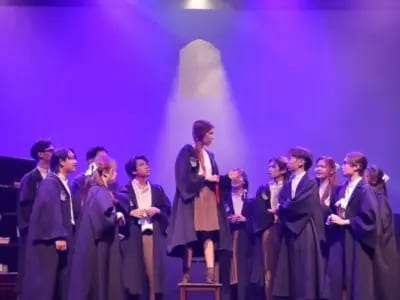
The scene of the musical "Club Lazo," Photo from the Esperanza Theatre. Source: Prachatai, Global Voices content collaborator. Used with permission.
East Article of Tara Abhasakun was originally published on Prachatai, Thailand's independent news website. Global Voices reproduces an edited version as part of an editorial association contract. It is also part of the Spotlight series of September 2026, "Protests in democracy". You can support this series with a donation.
Last year, the Thailand Bad Students Organization used a new mechanism to question the seemingly unbreakable cultural and educational taboos: the theatre.
In 2025, the organization founded the Esperanza Theatre to create a space for dialogue related to the old Thai cultural norms and practices, in particular those related to education and student rights. Some of the problems they address include physical punishment, acceptance of what teachers have said, compulsory use of school uniforms and compliance with haircut standards.
In September 2025, the Esperanza Theatre made its first presentation, a musical called "Club Lazo," which revolves around four students who seek to discover the truth behind the mysterious death of a classmate in a magic academy similar to Harry Potter's Hogwarts school. At the request of Jinny, one of the best students in the school, students meet to talk about the institution, its rigid standards, the violence that teachers exercise against them and the identities they are forced to adopt.
As Thamjuthi Thiangtham, 18, said, who recently finished his first year at Chulalongkorn University and works as an editor for the Organization Malos Students, "we begin with the issue of violence in the context of Thai schools... authoritarianism and violence against the life and freedom of students."
He referred to the prolonged use of physical punishment in schools in Thailand. This is prohibited officially in March 2025, but the law has not been strictly applied. Thamjuthi reports that, throughout 2025, his organization received over 200 complaints of student rights violations, including physical punishment, psychological abuse and discrimination against LGBTQ + students.
Thai teachers often continue to appear in headlines after imposing physical punishment on students. In June 2025, three months after the ban was implemented, a teacher in Bangkok forced a student to do 200 Chairs for not delivering duties in time. In February 2026, another student was hospitalized after your teacher ordered you to do 800 seats for not having delivered a task.
Planting this situation on the stage allowed students to address violence against their peers. It also allowed them to defend themselves with the magic of violent teachers.
Another theme that was raised during the musical "Club Lazo" is the repression of debate and questions within the classroom. In the play, the characters have a special room where they can go to talk with solture, similar to the room where Harry Potter and his friends met in secret to learn to face dark magic after a corrupt teacher refused to teach them. It gives them a safe space for students to free themselves from the strict rules of school. There you can talk about anything, ask, challenge and debate with friends. According to Thamjuthi, it gives them the freedom "to openly question the power structure of the school."
The room is a narrative resource that serves to question the cultural notions of what it means to be a "good student." In Thai society, Thamjuthi says that "ideal" students not only have academic capacity, they also obey their teachers and do not ask questions. "On the contrary, a student who has enough courage to ask questions and disagree is considered arrogant... and label it as bad." However, in the work, when the "good" and "bad" students meet and speak in the secret fourth, they discover that there are no differences between them.
In the world of the Lazo Club, magic serves as an indicator of who is a good student. Everything that is not related is considered useless. Students are expected to use magic every day or - according to an ancient belief - some great disaster will happen. Thamjuthi says that the idea of using magic as a symbol was thought to help members of the audience who were not Thai, and who may not know the context of the Thai educational system, to understand the issues that the work addresses. The hearing included members of the Swedish embassy, and some Chinese and American citizens.
According to Thamjuthi, about 80% of the audience were young people who already agreed with the message and criticism of the Esperanza theatre. The rest were older adults who agreed with the message of the work, but who did not necessarily support the explicit protest. The younger among the audience thanked the theatre for making them more optimistic and hopeful about the change in Thai schools. As for the elderly, although the work "was not respectful enough for them," the work of defending the Esperanza theatre received praise from some, such as the very conservative director of a secondary school. Thamjuthi found it impressive that "art has such power to convince people, even those who may not be on our side, to have more faith in us."
The next performance on the stage of the Esperanza Theatre is likely to be in late 2026 or early 2027. They have not yet written a script, but Thamjuthi said he will explore the intense competition to enter the most prominent schools in Thailand. A developing idea is that of a reality program or games in which students will have to compete ferociously in order to test their skills. According to Thamjuthi, "participants can do anything, no matter whether it's good or bad, to compete for the prize."
From the most critical moment of youth protests In Thailand between 2020 and 2022, the student movement has already been largely calmed down. In 2020, Malos students led numerous demonstrations in defense of student rights and protection against strict policies on the use of uniforms, the rules on haircut and abusive teachers. Those demonstrations They often included costumes and creative expressions, such as songs from the Japanese animated drawing "Hamtaro." These protests took place in the midst of a larger movement that required reforms to article 112 of Thailand, which prohibits criticism of the country's monarchy. Thamjuthi noted that Bad Students did not relate to national political problems, such as parties, the Constitution or the judicial system. However, with regard to the largest protest movement, he noted that, as a result of the subsequent severe action taken by the Government, "most of our protest leaders had to leave the country... which had negative consequences for the movement," he explained.
Despite outcome of the 2026 electionsThamjuthi still has hope for change. He points out that "Bad Students" has become a popular term throughout the country and no longer has a negative connotation. "If you're a bad student in your school, maybe it's because you're a rebel. Maybe it's because you're brave enough to question your teacher or challenge his power," he says.
The main obstacle to the Esperanza theatre, Thamjuthi continues, is the funds. In 2025, the initiative was fortunate to receive funds from the Swedish International Development Cooperation Agency (known as AIDS). This time, however, they must find a new source of income, which is not easy. "Working with students in this society, working with young people to promote democracy... few financiers or companies feel sufficiently confident."
The Esperanza Theatre is a continuation of the attention of the student movement in art and culture. At first, the organization used dinosaurs to portray the conservative and promoted the motto "Farewell, dinosaurs." Bad students have also given students illustrated guides to help them understand their rights. Another of his artistic initiatives was to translate the songs of the musical into Thai "Matilda"to explain the rights of students.