In Cameroon, 'bals dansants' are community dance meetings organized during the holidays
Originally published in Global Voices in Spanish

From children to older people, the bals dansants unites generations through music and dance. Photo by Julienne Hamba. Used with permission.
By Julienne Hamba
Every time the holidays come, the young people of Ebolowa in southern Cameroon and the surrounding villages meet for community dance nights that combine entertainment, socialization and economic activity.
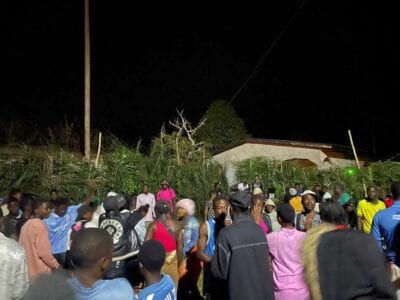
In Ebolowa, Cameroon, it is late when music finally sounds high enough to attract people to the dance floor. At that time, the village of Olemin the department of Mvila, in the southern region of Cameroon, it is usually quiet. But on July 26, the night of his annual dance, the atmosphere is different. Young people from Ebolowa or other nearby communities have traveled for a night many have been waiting for for months.
These meetings are usually known in French as bals dansants; community dances that are organized during the holidays. They are not necessarily formal festivals, there is no elaborate program, official ceremony or institutional support, but year after year people come.
Dylan Akono, 23, lives and studies in Ebolowa. For him, return to the village during the holidays to attend the bals dansants has become an annual tradition. "What I really enjoy tonight is the lively environment. You can meet and relate with many people," he said in an interview for Global Voices. "Getting close to people you don't know at the dance can be difficult, so it's easier to stay with your group of friends."
People from all over the region gather for the event. This is the case of Alice Ateba, 21, who lives in Yaoundé, the political capital of Cameroon. This was the first time I ever attended Olem's dance. "This is the village of a friend. He told me about this event and I decided to come out of curiosity, the night has been really nice. It's been a great experience," she says, smiling. "If I have a chance to come back, I'll come back."
The dance floor is the center of the whole thing. It is little more than a piece of green land, but at nightfall it acquires the air of a village discotheque. A few lights light the space, while four sticks nailed to the ground mark the limits of the dance floor and an opening serves as an entrance and exit. Beyond, the night continues around the dancers. Groups of young people talk standing while temporary bars and small places serve the attendees. Inside the improvised enclosure the music takes over.
The event is open to anyone who wants to participate, although the young people of the village make up a large part of the attendees. Their informal character may be one of the reasons why these meetings have lasted for generations. No invitation system is needed. The date is set. The voice is running. People go.
However, informal does not mean lack of organization. Julius Embolo, 23, a member of the organizing team, says that the dances have been part of the life of the people since they use reason. "These dances were already made when I was born," he told Global Voices. Each town has its own date for the meetings. Once the holidays begin, members of the organizing committee meet to discuss the practical details, such as where the dance will take place and what security measures should be implemented.
"The talks are informal," he adds. The organizers simply sit together and agree what to do. "The date is already known, but the location can change depending on the availability of the spaces in the villages," he continues. This means that sometimes the organizers have to contact the heads of the villages to get a proper space for that night. "We have reached agreements with the heads of some villages in order to use certain spaces."
The result is a meeting that seems spontaneous for those who come attracted to music, but that depends on a small network of people working behind the scenes to make it possible. There is no formal festival committee, no elaborate program, no fixed place. However, dance parties remain a meeting point for the community and a rare opportunity to meet and relate in person, far from the pressure of modern devices.
More than dancing
The dance floor is just a part of the story. Small businesses that give life to a prosperous informal economy are emerging around it. The temporary bars are installed for that night, while the sellers offer drinks and refreshments. The more people dance and talk, the more they need to drink. Jacqueline Mendomo, popularly known as Mamó Jackie, is one of the many sellers who see an opportunity in these crowds. That night he set up a little drink stand and took advantage of the meeting to make some money. "After hours of dancing and talking, people are thirsty," says Mamó Jackie. "Nights like this usually attract more customers because people spend several hours in the celebration, moving between the dance floor," he adds.
However, for anyone coming from Ebolowa or elsewhere, getting to town can be complicated. By the time the dance starts, the day transport has been reduced enough. To get to Olem, you have to go to the Newbell transport terminal in Ebolowa. The terminal is much quieter than it is during the day, and as many people already sleep and there are less transport options available, the rates can increase. Mototaxis become one of the main options. Sometimes motorcycles are shared between three or four people, depending on the circumstances. A trip that can cost about 500 CFA francs ($0.89) per person during the day can rise to about 1,000 CFA francs ($1.80) at night, according to those who travel to the meetings. The problem of transport is not only a question of price but also of safety.
A community that still wants to meet
Cameroon is increasingly digitally connected. However, connectivity does not necessarily mean that young people have stopped looking for physical spaces to meet. The question is not whether young people still like to dance. The most difficult question is whether meetings like these will keep the same appeal as entertainment becomes more digital. For now, what happens in Olem suggests they still have something to offer.
Perhaps the most interesting thing about these dances is what they reveal about the relationship of young people with the community. A phone can connect someone with hundreds of people without getting out of their room. A dance demands otherwise. We have to go in person. We have to see people. You have to talk and laugh, or just be by your side while the music sounds. Physical interaction matters.
The work of UNESCO on intangible cultural heritage) stresses that community participation can help support cultural practices and collective identities. In Cameroon, UNESCO has recognized the cultural traditions associated with the ethnic community of Ekang, like Mvet OyengThe tradition that combines music, epic narrations and dance. The dances of the villages around Ebolowa show that culture goes beyond museums and official festivals. It can also live in meetings where communities continue to meet generation after generation.
At a time when the young people spend several hours in front of a screen, dance in the village offers a different experience. For the girl who first attended a dance of these characteristics, the experience was more than enough to promise to return. For those who usually participate, there is no new thing to discover, only a family tradition they say will never get tired of. Perhaps simplicity is what keeps the bals dansants alive. The music still takes people out of the house, the temporary bars open and when the holidays come, the villages around Ebolowa have a reason to stay awake.


