Following a national pattern, Brasília concentrates green spaces in the most affluent areas
Originally published on Global Voices

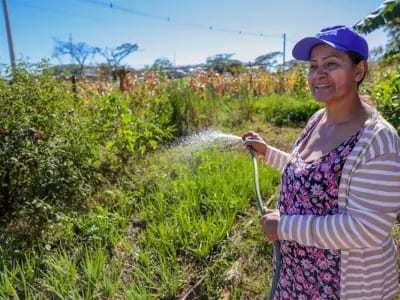
Nasaré Francisca da Silva waters crops at Floresta da Nasaré, in Ceilândia, Brazil, where her agroforestry project emerged from a rubbish tip. Photo by Fabio Pozzebom/Dialogue Earth, used with permission.
This story by Lobato Felizola was originally published on Dialogue Earth’s website on July 14, 2026. It is republished here under a partnership agreement with Global Voices, with edits. It’s also part of Dialogue Earth’s work on the Community Adaptations to City Heat (CATCH) project, in partnership with Boston University.
Brasília was designed to be a green city. Tree planting was so central to planning for the Brazilian capital that it was described as a park city. This is evident in its central area, with cool, tree-lined avenues and green parks where locals enjoy walks. The city was built in just 41 months, replacing the savanna-type biome Cerrado with a gleaming new capital.
But 30 kilometers (19 miles) away from the Plano Piloto, in the Sol Nascente favela, the central area designed as an airplane, this ecosystem was replaced with concrete. While the Plano Piloto averages 138 sq meters (1,485 sq feet) of green space per inhabitant, a University of Brasília (UnB) study of urban green spaces finds that in some peripheral areas of Brasília, that figure can be up to 23 times smaller. These outlying areas are characterised by “limited vegetation and greater distances to green spaces,” says the study.
Sol Nascente consists of mostly tarmac-surfaced streets, with houses crammed on top of one another and narrow pavements that can barely accommodate pedestrians, let alone trees. Heat is a huge problem. “There are times when the whole street is in the sun, and the air doesn’t circulate,” says resident Francisco Silva.
The health impacts can be severe. “Everything gets very dry, and my nose bleeds,” says the 34-year-old. Silva suffers from rhinitis and bronchitis that disrupt his sleep. “If I close the window, I can’t breathe; if I open it, dry wind and dust come in.”
During the dry season, he washes the yard every day, spreads wet towels around the house, and wears a mask. To beat the heat, Silva is renovating his house to make way for grass and saplings. On the pavement, he planted the only tree on the street – a solitary ipe, a common species in Latin America.
Valdir Steinke, who authored the University of Brasília study, says Brazil’s Federal District (where Brasília is located) reflects a national pattern of “green spaces concentrated in the most affluent areas, whilst the outskirts have almost none.” Indeed, the average per capita household income in Plano Piloto is 12 times higher than in Sol Nascente. “It is a stark and unvarnished portrait of a socio-economic segregation pattern in which urban planning in the outskirts ignores nature,” says Steinke.
These problems are being exacerbated as climate change drives up temperatures, increasing mortality and morbidity. In response, the local government is planning a tree planting program, and residents are turning to “guerrilla gardening” where urban planning has failed.
Green inequality is a global challenge
Sol Nascente emerged in the 1990s on illegally occupied rural land. Today, more than 70,000 people live in the 9-sq-kilometre (3.4-sq-mile) territory. This population density is almost 16 times higher than the Federal District average. With its tarmac, sparse vegetation and high concentration of residents, the favela provides ideal conditions for a so-called urban heat island.
“Concrete and tarmac absorb and retain the sun’s heat more efficiently than vegetation, whilst trees provide cooling through shade and humidity,” explains Gregory Wellenius, director of the Center for Climate and Health at Boston University in the US.
What has happened in Sol Nascente follows a global pattern. A recent analysis of 199 cities around the world concluded that inequality in access to green spaces is widespread, and the level of disparity in cities in the Global South is twice that of the North.
“Extreme heat maps look very similar to maps of low-income neighbourhoods,” Jeremy Hoffman, a researcher at Groundwork USA, a network of American organisations working for climate justice. “Heat hotspots tend to overlap with areas characterised by higher poverty, lower educational attainment, higher rates of chronic disease and less access to green spaces.”
3-30-300
Cecil Konijnendijk, an expert in urban forests and an honorary professor at the University of British Columbia in Canada, proposed the “3-30-300” rule to tackle green inequality in cities. The rule stipulates that every person should be able to see at least three trees from their window, live in a neighbourhood with at least 30 percent tree coverage, and be no more than 300 metres (984 feet) away from a park or green space to ensure visual and physical access to nature and its benefits.
The rule has been adopted by urban planners around the world. It already guides tree planting policies in Belgium, Sweden, the Netherlands, the US and Canada.
In Brazil, the National Urban Tree Planting Plan, launched at the UN’s COP30 climate conference in 2025, draws inspiration from this rule. It acknowledges that Brazil’s haphazard urbanisation has led to landscape fragmentation, deforestation and concrete-sealed soil which, combined with climate change, negatively impact urban life.
To reverse this situation, the plan sets targets to be reached by 2045. One is to increase the proportion of residents with at least three trees in their immediate surroundings, which would provide green space access to around 40 million additional people.
Some experts question how universally useful the 3-30-300 rule is. Paulina Achurra, from the educational platform Arq.Futuro, warns that greening programmes cannot help in communities with “barely even a pavement on which to plant a tree.”
According to Achurra, speaking during an event in São Paulo, “although there is a lack of innovative solutions that incorporate green spaces, they must be feasible to implement in our cities [in the Global South].”
Extreme heat brings extreme risk

One of the country’s largest favelas, Sol Nascente is characterised by tarmacked streets with almost no trees in sight. Photo by Fabio Pozzebom/Dialogue Earth, used with permission.
Larissa Brenda Cordeiro, who chairs the Daughters of the Earth Institute (IFT), a socio-environmental justice organisation in Sol Nascente, says the afternoon heat can make it impossible for the organisation to carry out meetings or work in its office. With her asthma and fibromyalgia, she also feels the physical effects: muscle and joint pain. “I feel really unwell in both the cold and during periods of extreme heat.”
Patricia Fabian, a heat expert at Boston University, says people living in urban heat islands are more exposed to the harmful effects of high temperatures: “The hotter the environment, the greater the risk of health impacts, including cardiovascular disease, cognitive problems, respiratory symptoms and even death.”
During the dry season, the temperature in some parts of central Brasília can climb to 37.8ºC (100ºF), while Ceilândia, which incorporated Sol Nascente until 2019, reaches 46.6ºC (116ºF).
Protecting and growing
One of the few green spaces in Sol Nascente is a remnant of Lagoinha Park, which was gradually deforested by encroaching settlements. Buriti palm trees indicate abundant groundwater, but rubbish accumulates haphazardly, including in the springs that feed the Melchior River and the Descoberto Basin, which provide more than 60 percent of the Federal District’s water supply.
In December 2025, the Federal District approved its own plan to reduce the “green deficit” in its outlying areas. In Sol Nascente, the government told Dialogue Earth that planting cannot start until problems such as narrow pavements and a lack of stormwater drainage are fixed, because the saplings would not survive. They did not specify if or when these works would take place.

Garbage strewn across one of Sol Nascente’s few green spaces, Lagoinha Park. Photo by Fabio Pozzebom/Dialogue Earth, used with permission.
Today, Lagoinha Park is like a large lawn with few native trees. Activists like Cordeiro hope it can someday become a wooded area with picnic tables and sports courts: “Our dream is for Lagoinha to become a proper park that the public can enjoy.”
They have a role model for such a project: on the border between Sol Nascente and Ceilândia, a conservation project dubbed Floresta da Nasaré grew out of a rubbish tip. In 2009, housewife Nasaré Francisca da Silva took it upon herself to clear a football pitch-sized plot of public land opposite her home. Next, she planted a seedling. “People used to dump all sorts of things there, from building rubble to dead animals,” she recalls. “I’d look at it from my front door, and it made me sad.”
From a seedling grew the agroforest now maintained by neighbours, NGOs and University of Brasília researchers. Da Silva’s care for the land was formalised in 2023 by the Federal District’s government. Although it does not receive public investment, there is less risk of land seizure or their work being interrupted without warning.
On hot days, it is still cool beneath the tree canopy. “Everyone is welcome to come here and cool off from the heat,” says da Silva.