Politics
Former PLO official says Netanyahu-Eisenkot coalition could be possible
Former PLO official says Israel’s election outcome remains uncertain, with polls divided between Netanyahu and Eisenkot.
International news in seven languages
Topic
Former PLO official says Israel’s election outcome remains uncertain, with polls divided between Netanyahu and Eisenkot.
Ramallah residents say they hope to see Israeli Prime Minister Benjamin Netanyahu lose power in elections. "Netanyahu remaining in power means that there will be a clash, a build-up of tension and an explosion in the region", says one resident. Israel has committed the crime against humanity of "extermination" in the West Bank, while continuing to commit "genocide" against Palestinians in the Gaza Strip, United Nations-mandated investigators said Monday (October 27).
David Rigoulet-Roze, editor of the magazine Orient Stratégiques, is our guest.
Prime Minister Benjamin Netanyahu faces a fight for political survival in Israel's election on Tuesday (October 27), with voters weighing his leadership after the 2023 Hamas-led attacks, wars in Gaza and with Iran, and Israel's deepening international isolation. FRANCE24's Douglas Herbert gives us his analysis.
A deeply divided Israel headed to the polls on Tuesday (October 27) for the first time since the October 7, 2023 Hamas attack, with voters delivering their verdict on veteran Prime Minister Benjamin Netanyahu and the country's rightward drift. FRANCE 24's Noga Tornapolski tells us more.
Israeli voters are invited to vote on Tuesday and the turnout rate was 16.68 per cent three hours after the opening of the offices, the highest since 1981. This election must decide the fate of Prime Minister Benjamin Netanyahu and examine his assessment since the October 7 attacks. He accused his Israeli Arab opponents of trying to "fly the election", after targeting them throughout his campaign. Follow the legislative election on our direct.
Israelis vote as Netanyahu faces Gadi Eisenkot amid divisions over the wars in Gaza and Iran and growing isolation.
Polls opened Tuesday in Israel’s critical national election viewed as a referendum on Prime Minister Benjamin Netanyahu’s policies. Reporting from Jerusalem, FRANCE 24’s Noga Tarnopolsky explains that “the name of the game” after Election Day is whether the country’s fractious opposition, including an Arab-Israeli majority bloc, can come together to form a government.
The Israelis began voting in the first elections since the Hamas attack of 2023. The Jewish opposition block is favorite in the polls in front of the Prime Minister's coalition, but none will get the majority
Netanyahu seeks to extend rule at helm of far right alliance facing off against predominantly right-wing bloc.
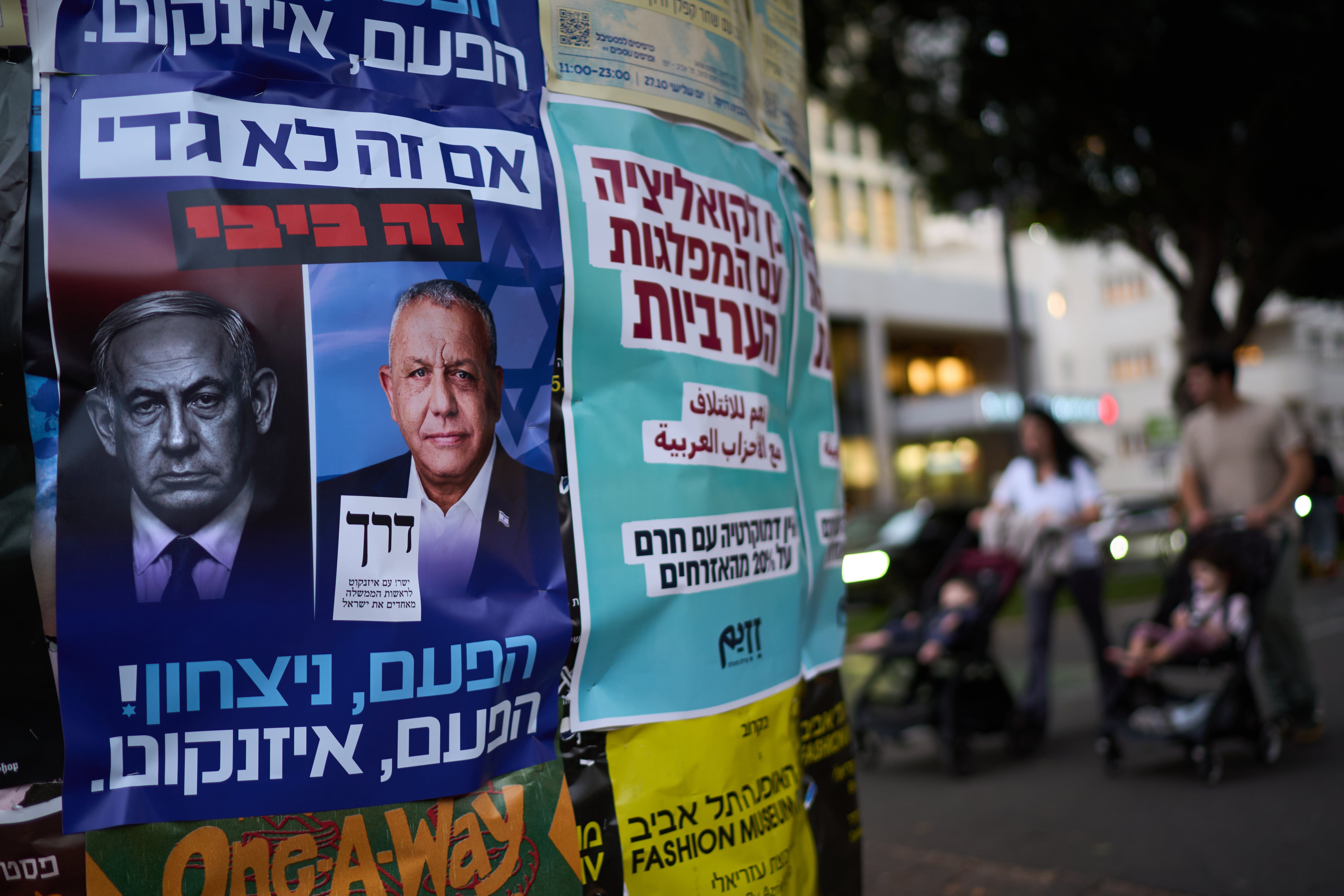
The legislative elections in Israel have been marked by an intense confrontation between Prime Minister Benjamin Netanyahu and his main rival, former Chief of Staff and leader of the Yashar party, Gadi Eisenkot.
Millions to cast ballots in election widely billed as the most consequential in Israel's history.
He is the most long-standing Israeli Prime Minister and hopes to obtain another term when Israel holds parliamentary elections on Tuesday.
Israelis are voting Tuesday in the first general elections since the October 7, 2023, Hamas attack with Prime Minister Benjamin Netanyahu facing a fight for political survival. The vote follows three years of regional wars, with Netanyahu running neck and neck with centrist rival Gadi Eisenkot.
The campaign for legislative elections in Israel is taking place in an environment of strong polarization and political tension. Prime Minister Benjamin Netanyahu has focused much of his speech on security threats, especially in relation to Iran and alliances with Palestinian actors. In parallel, Israeli media reported on alleged discussions around a possible attack on Iran, information that both Donald Trump and Benjamin Netanyahu himself have publicly rejected. In the face of this strategy, the opposition has taken a message of reconciliation
The promise made on Sunday by Israeli presidential candidate Gadi Eisenkot to "heal" Israeli society following the controversial mandate of Prime Minister Benjamin Netanyahu resonated among some voters who attended his last campaign rally before the elections on October 27 began. Meanwhile, Netanyahu, who qualifies Eisenkot as "indulgent" with Iran, received new support for his re-election by Donald Trump.
550,000 Israelis between the ages of 18 and 22 vote for the first time in their lives, following a youth marked by almost all Netanyahu governments, the Hamas attack and several wars with Iran and Hezbollah. A context that exacerbates an already existing dynamic in Israel: and new voters are increasingly religious and more nationalist.
1999, 2006, 2019, 2023... How many times have Benjamin Netanyahu been announced as a political end? The Israeli Prime Minister went through electoral defeats, was dropped by his allies, prosecuted, and even accused of war crimes and crimes against humanity by the ICC. In every crisis, many predicted the end of his political career. Every time, however, he thwarted the prognosis. On 27 October, the Israelis were called to the polls to elect their deputies and so choose whether Netanyahu would again remain Prime Minister. How did he manage to maintain his
Israeli and American media have pointed to the Israeli Prime Minister's alleged insistence on launching a new offensive in Iran before the elections, versions denied by the Israeli Executive. While the opposition accused him of being willing to do everything for his political survival, Netanyahu highlighted the support of Donald Trump, who again called for the reelection of the premier to "finish the work" against the Iranian regime.
Israel's defence minister denied on Monday (October 26) reports of a rift between PM Netanyahu and the army over Iran, before the vote. Netanyahu has campaigned heavily on his security credentials, insisting only he can "finish the job" in the US-Israeli war on Iran. His main rival, ex-army chief Gadi Eisenkot, has accused him of playing up the Iran threat when it suits him politically, and of failing to accomplish his war goals. FRANCE 24's Kethevane Gorjestani tells us more.