Advertisement
Advertisement

Topic

Large Hadron Collider

Science

Large Hadron Collider reveals evidence of Big Bang matter in surprisingly small collisions

Scientists at CERN's Large Hadron Collider have uncovered compelling new evidence that even relatively small atomic collisions can recreate the extraordinary state of matter that filled the universe moments after the Big Bang. Known as quark-gluon plasma, this exotic substance forms at temperatures more than 100,000 times hotter than the center of the Sun, causing ordinary particles to break apart into their fundamental building blocks.

Science

Physicists just saw quarks make waves in the Big Bang’s primordial soup

Physicists at CERN’s Large Hadron Collider have captured the clearest evidence yet that quark-gluon plasma, the scorching-hot matter that filled the newborn universe, behaves like a true liquid. By tracking individual quarks as they blasted through the plasma, researchers saw them leave behind ripples, splashes, and swirling wakes much like a duck moving through water. The finding suggests this primordial “soup” is so dense that it can slow speeding quarks and respond collectively as a fluid.

Science

CERN has begun disconnecting the Large Hadron Collider

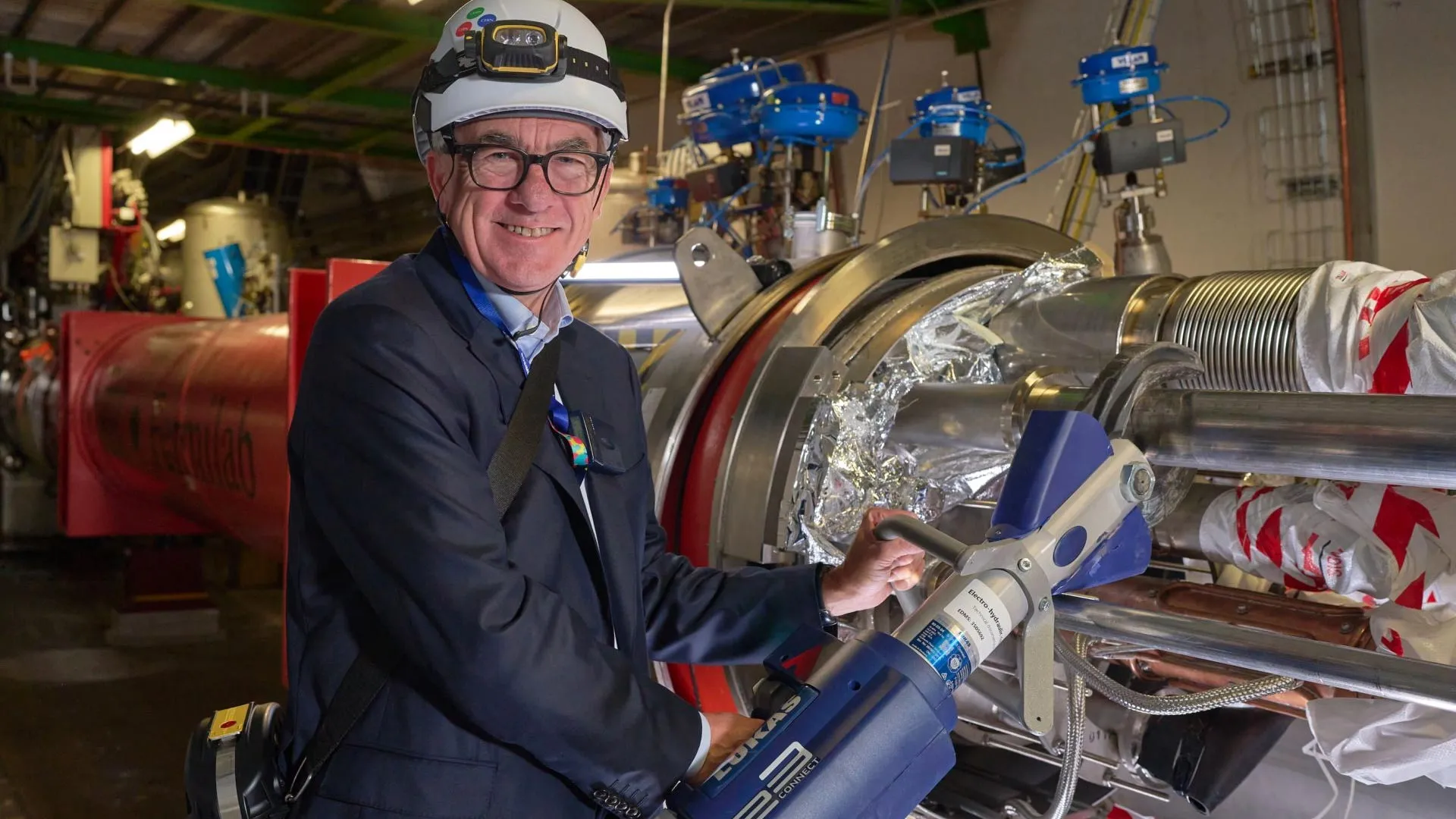
CERN has started replacing some of the Large Hadron Collider’s most important magnets as part of its High-Luminosity upgrade. The new superconducting magnets will produce fields about 40% stronger, allowing particle beams to be squeezed more tightly before they collide. That should create far more collisions for the ATLAS and CMS experiments to analyze, giving physicists a much larger window into the fundamental workings of the universe.

Science

The LHC just ruled out another hiding place for quantum black holes

Physicists searching through Large Hadron Collider data found no evidence that the machine has been producing microscopic quantum black holes, but the result sharply narrows where such exotic physics could still be hiding. These hypothetical black holes could form if extra spatial dimensions make gravity much stronger at extremely tiny scales, potentially offering clues toward the long-sought theory of quantum gravity.