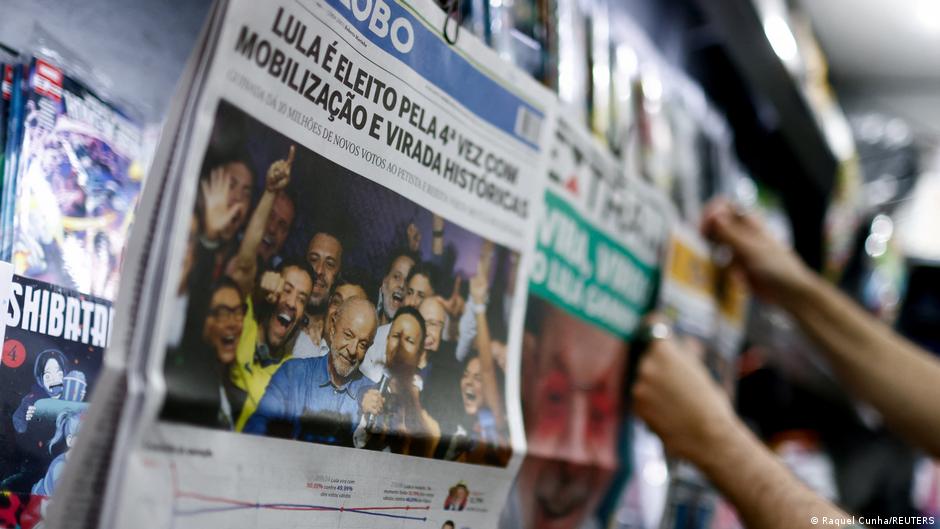
Brazil’s real sinks after Lula’s re-election victory
Investors react to Lula's victory with a sharp decline in the real and concern over increased spending and fiscal challenges.
International news in seven languages
Investors react to Lula's victory with a sharp decline in the real and concern over increased spending and fiscal challenges.
Courseup, lack of places at university, state of buildings: the anger of high school students and students pushes the government to announce new measures. But will these answers live up to the expectations of young people, as the mobilization continues and the presidential elections approach? Olivier Guyottot, professor-researcher in political science at l'Inseec, analyses the government's announcements and the stakes of this mobilization.
Although the October 25 triumph guarantees the immediate continuity of Luiz Inácio Lula da Silva's project, his fourth term of office will have to deal with a Congress led by the opposition and with a right-wing majority, a picture that will mark the challenges that the re-elected president will face to move forward with his initiatives. Angela Gómez and Lionel Poussy bring us the report.
Niger requested troops to secure shared energy interests in what would be Algeria’s first deployment abroad since 1973.
On November 3, Americans decide which party controls the US Congress for the second half of Donald Trump's presidency.
From Texas to Michigan, Senate candidates are challenging US weapons transfers to Israel.
Israel's defence minister denied on Monday (October 26) reports of a rift between PM Netanyahu and the army over Iran, before the vote. Netanyahu has campaigned heavily on his security credentials, insisting only he can "finish the job" in the US-Israeli war on Iran. His main rival, ex-army chief Gadi Eisenkot, has accused him of playing up the Iran threat when it suits him politically, and of failing to accomplish his war goals. FRANCE 24's Kethevane Gorjestani tells us more.
Climate activists in Brazil are celebrating President Luiz Inacio Lula da Silva's election victory as good news for the Amazon rainforest. His last four years in power saw a record decrease in deforestation in the world's largest rainforest.
The spokesman and Minister of Social Security insists that the Executive wants to approve the SMI's rise before the elections
The Community replied that the demands of teachers meant a "failure of the system" and 700 million more in salaries alone.
Brazilian President Lula secured a surprise win over far-right challenger Flavio Bolsonaro, whose party recognizes Lula's election victory.
The Student List-Students Win aren’t politicians, but the movement won the snap election
France paints 24 images of the most prominent opponents of the outgoing Israeli Prime Minister Benjamin Netanyahu in the legislative elections scheduled for Tuesday. Vocational course, political weight, attitude to the Palestinian-Israeli conflict...
In Israel, it is impossible to vote from abroad. Then some expatriates return especially for the election.At Tel Aviv airport, the activists of Gadi Eisenkot are already waiting for them as soon as they arrive. The "Fly and Vote" programme, launched by an expat association, helps those who want to return to vote, despite attempts by Benjamin Netanyahu's Likud to limit it.Several hundreds of thousands of Israelis live abroad. In a very tight election, their voice could weigh heavily.#Israel #Elections #TelAviv #Netanyahu #Eisenkot #France24
A student-led list won Serbia’s elections by a convincing majority, ousting the most powerful politician in the country.
On the eve of Israel’s general election, some Israelis call for change while others back Netanyahu to stay in power.
Climate activists in Brazil and beyond are celebrating President Luiz Inacio Lula da Silva's election victory as good news for the Amazon rainforest. His last four years in power saw a record decrease in deforestation in the world's largest rainforest, appropriately nicknamed the planet's lungs. FRANCE 24's Environment Editor Valerie Dekimpe tells us more.
The French government sought to draw a line Monday under weeks of protests that have been marred by violence, with President Emmanuel Macron heading to Marseille. France has been rocked by widespread anger over the rising cost of living, with nationwide demonstrations on October 17 degenerating into some of the country's worst rioting in years.
Israelis can’t vote from abroad, so tens of thousands of expats are expected to fly home for the election. At Tel Aviv airport, supporters of opposition figure Gadi Eisenkot are already waiting at arrivals. A “Fly and Vote” initiative helps expats organise their trip, despite a failed petition from Netanyahu’s Likud party to restrict it. With polls predicting a tight race, every vote could count, and the result will decide the Prime Minister’s fate.
Erin Ogunkeye is pleased to welcome Christopher Sabatini, Director of Chatham House's Latin America Programme. Sabatini examines how Lula's campaign reinvention, youth mobilisation, and the changing dynamics of Bolsonarismo are reshaping Brazil's political landscape. By embracing social media, mobilising younger voters, and shifting attention from his historical achievements to the economic anxieties of ordinary Brazilians, Lula managed to transform the electoral contest. As Sabatini explains, voters were no longer satisfied with hearing about the past. They wanted an answer to a more immediat