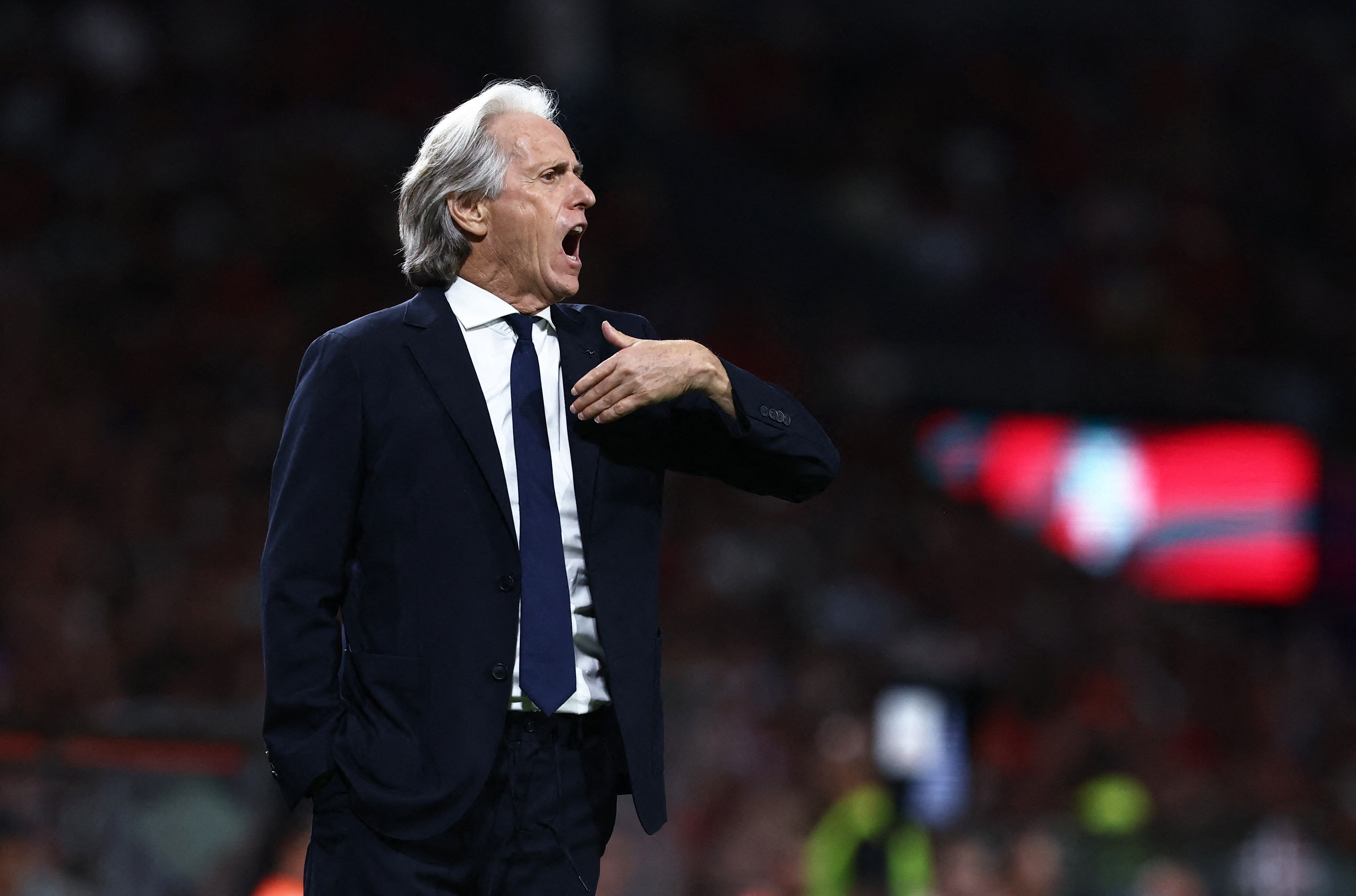
The technician says he'll call the Al-Nassr football player if he wants to, but he refuses to apologize: "Excuse me why? What was the reason to apologize?
Spain is heading for an early general election after the President of the Government, Pedro Sánchez, announced the dissolution of the Cortes and the call for elections for November 29. The decision comes after the parliamentary rejection of the Executive-led housing decrees, amid increasing social pressure for access to affordable housing. The electoral advance coincides with mobilizations and protests in different cities of the country, where thousands of people have called for more forceful action in the face of the housing crisis. Ruth Ferrero,
The results of the presidential elections in Brazil have caused the supporters of Lola Dasilva a great disappointment. In return, the joy of Fluffio Polsonnaro is untold.
The Spanish Prime Minister Pedro Sanchez, Monday, called for early public elections, after the House of Representatives, on Friday, rejected the Government ' s attempt to contain the housing crisis in the midst of hard protests. The possible decision to submit the date for the elections scheduled for next year is the result of a Government ' s refusal to confirm the nature of the declaration in advance.
US President Donald Trump said on Sunday he had named Director of National Intelligence Jay Clayton the administration's AI czar, tasking him with coordinating the federal government's efforts to maintain US leadership in the technology. Trump, who has pushed to rename artificial intelligence as "super intelligence," said Clayton would head the newly created Super Intelligence Force (SIF).
The internationally recognised Yemeni government announced on Sunday the launch of an offensive to recapture territory held by Houthi rebels, with President Rashad al-Alimi swearing to fight "until the country is liberated from the grip of the terrorist militia".
Brazil’s veteran leftist President Luiz Inacio "Lula" da Silva trailed Flavio Bolsonaro, the son of his far-right predecessor, in the first-round presidential vote on Sunday. Some analysts suggest that the sweeping anti-poverty measures Lula put in place over two decades may have helped give rise to a growing lower-middle class drawn to the far right’s promise to get the government out of people’s lives.
The authorities prepare a possible temporary ban on intelligent lenses in certain public spaces in the fear that they will allow people to be recorded or photographed without their consent. The government-driven measure could reach parks, beaches, museums, shopping centres, schools and public events in a new chapter of the European debate on privacy and devices capable of recording images in a discreet manner.
The first round of the presidential election was held on Sunday in Brazil, in a elections in which artificial intelligence played an increasingly important role: an avatar of former President Jair Bolsonaro to support his son's candidacy, a clone of a governor to request donations from his voters and campaign jingles created by a few real ones. Disinformation thus became one of the main challenges of these elections.
ultra-conservative Senator Flavio Bolsonaro thwarted the prognosis on Sunday by ahead of the outgoing left-wing president Lula in the first round of the presidential election. A Bolsonaro clan that also made a big deal in the parliamentary elections.
Israel's foreign ministry says it has banned Green Party leader Zack Polanski from entering the country, after party members adopted a motion declaring Zionism a form of racism.
Spanish Prime Minister Pedro Sánchez has called an early election for 29 November after recent defeats on legislation aimed at addressing the country's housing crisis.
Far-right candidate Flavio Bolsonaro has pulled off a surprise win in the first round of Brazil’s presidential election. He defied most polls to win with 47 percent, compared to 45 percent for leftist incumbent Luiz Inacio Lula de Silva. We spoke to Thomas Zicman de Barros, a research fellow at CEVIPOF, the political research centre at Sciences Po University, and columnist for our sister radio station RFI. He told us that never before in Brazilian history has a candidate who was behind in the first round then succeeded in the second.
Eve Irvine is pleased to welcome Felipe Krause, the head of Oxford University's Brazilian Studies Programme. Brazil's election reflects a political landscape that has become increasingly polarized, explains Krause. And he describes the current mood as one of “tired polarization: People are just exhausted. They feel that the political class is just kind of offering more of the same". The first round reveals a significant consolidation of the Brazilian right in government. Brazil's expanding middle class is increasingly attracted to entrepreneurialism and individualism, constituencies that "Bols