After being defeated in the elections, the senator fled to the US with his family
Originally published on Global Voices

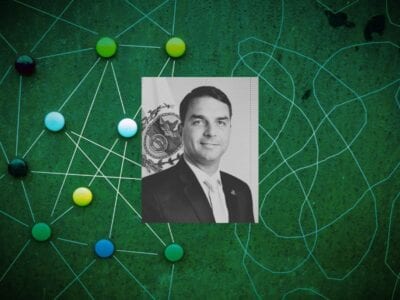
Art by Global Voices with Canva Pro. Photo by the Brazilian Senate. Fair use.
Forty-eight hours after losing the runoff in Brazil to incumbent Luiz Inácio Lula da Silva, Flávio Bolsonaro, former president Jair Bolsonaro’s eldest son, a senator representing Rio de Janeiro, fled to the United States. From there, where his brother Eduardo, a former congressman, has lived since February 2025, he continues to challenge the results of the election he lost by 4.4 million votes, as attested by the Electoral Court (TSE), the Organization of American States (OAS), and other right-led governments in the region.
Upon landing in Miami, Flávio published a letter proclaiming himself “the true president of Brazil” and “president-elect of Brazil.” After 22 minutes — and a demand from the US Department of State — he retracted to “the leader of Brazil.”
US President Donald Trump had said that Brazil’s elections “looked rigged,” but he wouldn't “get involved.” The New York Times reported, however, that Flávio was helped by Trump's aides. “The jet [he traveled on] had been arranged by a White House official,” affirmed the newspaper.
Flávio’s narrative is that he is being persecuted by the Brazilian justice system and Lula’s government as an opposition leader, since the Supreme Court ordered the seizure of his passports — he also has Italian citizenship — right after his defeat was announced.
Justice Alexandre de Moraes, considered a foe of the Bolsonaro family and himself under suspicion for having links to the same disgraced banker connected to Flávio, issued the order in response to a Federal Police request that considered Flávio a flight risk. In Brazil, a president cannot be investigated for alleged crimes committed before their term, meaning that once elected, all pending investigations involving Flávio would have been suspended. This is also the first time in 24 years that Flávio will not have a seat to ensure his parliamentary immunity.
According to the Brazilian Federal Police, three elements indicated a flight risk in Flávio’s case: an interview his brother Eduardo gave to a podcast in the US defending the idea of him leaving the country, on October 23, his considerable economic power, and well-established structures abroad that could support him in a long stay.
The day after the election, after visiting his father, who is under house arrest convicted for a coup attempt, Flávio recorded a video complaining about the measure, claiming “he never thought about leaving the country” and promising to stay and answer to investigations. Overnight, apparently, he had a change of heart in time for a new plan.
Investigations and corruption suspicions have long surrounded his name. In 2020, Sergio Moro, the judge who convicted Lula, resigned as Bolsonaro’s justice minister, accusing the president of trying to intervene with the Federal Police to protect Flávio in an embezzlement and money-laundering inquiry. In a cabinet meeting, then-president Bolsonaro shouted at his ministers: “I won’t wait until they fuck my entire family,” saying he would fire whoever got in their way.
During this election campaign, skeletons in Flávio's closet were further exposed in stories published by the Brazilian press. Global Voices gathered the main ones here. Flávio is currently under three investigations at the Supreme Court.
Rachadinha
This is the case that led Jair Bolsonaro to allegedly interfere in the Federal Police in 2020. Flávio was indicted by Rio’s Public Prosecution Office for embezzlement, money laundering, and criminal organization. The case was later adjourned. Rachadinha (“split” in English) is a salary kickback scheme in which a politician hires someone for a certain position and then reclaims part of their salary.
In 2018, after Bolsonaro’s election, a report by the Council for Financial Activities Control (Coaf) pointed to atypical financial movements in the account of Flávio’s aide, Fabricio Queiroz, an old friend of his father. Queiroz, who was filmed paying for Flávio's daughters’ tuition in cash, was identified as the scheme’s operator. For the Public Prosecution Office, according to UOL news outlet, the scheme was used to cover Flávio’s personal expenses and to increase his patrimony.
There were also suspicions that a chocolate franchise shop, owned by Flávio, was used for money laundering. The investigation found 1,512 cash deposits in repeated amounts between March 2015 and December 2018 at the establishment.
An audio recording found by police in 2024 shows then-president Jair Bolsonaro, Flávio’s attorneys, and Alexandre Ramagem, former director of the Brazilian Intelligence Agency (Abin), currently a fugitive living in the US, allegedly discussing a plan to free Flávio from the investigations through Federal Revenue Service employees.
‘Dark Horse’ and Vorcaro
On May 13, 2026, The Intercept Brasil published a story and an audio recording showing that the movie “Dark Horse,” a biopic about Jair Bolsonaro, starring Jim Caviezel, could have been financed by disgraced banker Daniel Vorcaro. Before the story went out, a reporter from the news outlet asked Flávio about the case. The senator laughed and dismissed the question, saying: “That’s a lie! Where did you get this from?”
Vorcaro is at the center of one of the country's biggest scandals, involving politicians, members of the Supreme Court and other judges, and celebrities, through his bank, Master — its license was approved during Jair Bolsonaro’s government. Vorcaro is investigated for a fraud scheme that caused a BRL 47 billion (around USD 8.7 billion) loss to the Credit Guarantee Fund (FGC), which backs Brazil's banking system.
The messages published by The Intercept show Flávio negotiating with Vorcaro on WhatsApp. Flávio asked for BRL 134 million (USD 24.9 million) and received at least BRL 61 million (USD 11.17 million). In one of the last messages between them, before Vorcaro was arrested while trying to flee the country, Flávio tells him: “Brother, I am and will always be with you; there is no half-talk between us,” reported TIB.
Since he couldn’t deny their link, Flávio has repeated that the money he negotiated with Vorcaro was “private money for a private movie.”
This is also one of the investigations into Flávio at the Federal Supreme Court (STF), which targets the movie’s financing operation. Despite the movie being filmed in Brazil, Vorcaro sent the money to a fund in the US (Havengate), managed by a friend of Eduardo Bolsonaro’s. The final destination for the money hasn't been confirmed yet.
Willer Thomaz, a friend
Another inquiry investigates Flávio for money laundering and currency evasion, along with his friend Willer Tomaz, a Brazilian lawyer also currently in the US. Tomaz is under investigation for money laundering through betting companies and involvement in another scandal, a fraud scheme at the national pension fund (INSS).
Documents accessed by Brazilian news outlets showed that Tomaz alone moved BRL 5 billion (around USD 930 million) in betting sites and cashed out BRL 200 million (USD 37.2 million).
When Piauí magazine revealed that Flávio had travelled in Vorcaro’s plane with his family, the senator’s first reaction was to say that “fortunately, it was Willer's.” His friend shared the plane’s quotas with a Vorcaro company. Tomaz denied ever meeting with the banker.
In October, O Globo newspaper published that Flávio had been registered as a “master user” on an offshore account under the name of a company managed by Tomaz and registered on Madeira Island, Portugal. This status could give him “significant operational access,” according to the Federal Police. Piauí magazine also says the senator could have been an indirect partner in a betting company based in São Paulo, but controlled by another company registered in Madeira, also linked to Tomaz. Flávio denies it.
Folha de S. Paulo newspaper says that the relationship between Flávio and Tomaz began in 2019. During the COVID-19 parliamentary inquiry commission at the National Congress, two years later, the senator defended Tomaz, calling him a friend. They always denied being business associates, claiming they were only friends.
Ana Clara’s death and the militias
On the morning of February 2, 2021, five-year-old Ana Clara Machado was shot and killed while playing at the doorstep of her home, in Rio de Janeiro. The Military Police denied any confrontation or the presence of narcos in the area where their operation was taking place. Later, the Civil Police identified police officer Bruno Delaroli as the shooter and arrested him. In March, 2026, ICL Notícias, a news website, reported that Flávio Bolsonaro worked on the officer's defense team in the higher courts, trying to avoid a jury trial. Another news outlet, UOL, revealed he worked pro bono. Lula questioned the senator about his motives during a debate on TV Globo.
Also, according to ICL, this wasn’t the only case Flávio advocated for officers accused of killings. Folha says his career as a defense lawyer gained traction after he was elected senator.
During his political life, Flávio has had a long history of links to police officers identified as members of so-called militias — paramilitary groups mostly formed by active and retired officers, carrying out vigilante and organized crime activities in dominated territories. When a state deputy in Rio, Flávio employed at his office the mother and wife of Adriano da Nobrega, an ex-military policeman, linked to a militia known as Crime Office, whose main activities were to execute ordered killings. He also sent parliamentary money to an NGO connected to another police officer involved in the murder of Rio’s city councillor Marielle Franco. According to Piauí magazine, the militia man known as “Peixe” (fish) referred to Flávio as “our senator.”
ICL News says the UN will examine Flávio's links to the militias when analyzing Ana Clara’s case.