When many people gather, some states are not prosecuting people. Instead, it cuts the network
Originally published on Global Voices

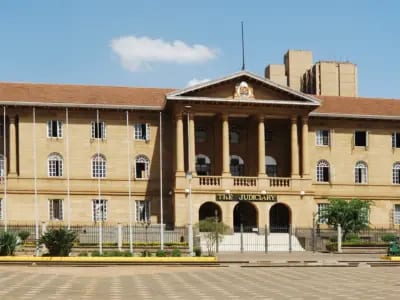
Kenya Judiciary building. Image by Wing via Wikimedia Commons (CC BY-SA 4.0).
This piece is part of Global Voices’ September 2026 Spotlight series, “Protest in Democracy.” With this Spotlight, we seek to explore the many forms of protest, the tactics states use to delegitimize and suppress them, and the complex relationship between protest and democracy. You can support this coverage by donating here.
On a Saturday in late July 2025, Angola shut down its internet for the first time in its recorded history. Not during an election, and not during a war. People had taken to the streets to protest the rising price of fuel. At least 22 people were killed according to the authorities’ own figures; civil society monitors counted 30 dead and more than 1,500 arrested.
I have kept a monthly record of technology, media and telecommunications law across Africa since January 2014; this August it reached its 152nd consecutive edition. Counting only entries where a government restricted, throttled or cut a network itself, and setting aside closures of individual broadcasters, I found more than 70 separate episodes across 32 countries, every year since 2014. Access Now’s KeepItOn coalition counted independently and arrived at the same number.
These events raise a question still debated in the abstract: What is digital protest, and do people have a right to exercise it?
The usual definition is inadequate
Typically, when thinking about online protest action, people picture hashtag campaigns, coordinated posting, online petitions, and a profile picture changed in solidarity. Using those examples, the right to the internet becomes a branch of free expression, and the argument becomes how much online speech a government must tolerate.
Online protests are legitimate, and Africa has produced some of the most consequential campaigns: #ThisFlag and #ShutDownZimbabwe in 2016, #BringBackOurInternet during the Cameroon disconnection, #DataMustFall in South Africa, and in Nigeria’s #EndSARS 2020 and #EndBadGovernance in 2024.
In each of these cases, governments take one of two approaches and reach for a different instrument for each.
The first approach is when a person posts, and the state prosecutes that person. I have found roughly 70 examples of exactly that every year since 2014, including Ethiopia’s Zone 9 bloggers in 2014, the co-founder of Jamii Forums under Tanzania’s Cybercrimes Act in 2016, Ignace Sossou in Benin in 2019, and two more journalists in Mali this June. Governments use cybercrime statutes, false-news provisions, or computer misuse acts to silence them, and the target is always a named individual.
The second approach is when many people gather, and the state prosecutes nobody. Instead, it cuts the network.
Algeria, every June during exams
Algeria has cut the national internet every year during the baccalaureate exams to stop candidates from circulating exam papers. Kenya blocked Telegram during its own national examinations in 2023 and 2024. No crowd, no protest, no opinion the state wanted suppressed.
So assemblies of dissent are not the only trigger, and an argument that says otherwise overstates its case. But notice what the exam shutdowns settle. Nobody claims Algeria switched off a national network to silence a view. The state reached for the network because the network was what people would use to coordinate. A shutdown is not a speech instrument; it is an instrument for preventing coordinated action, and examinations and demonstrations are two instances of the same reach.
Cut the network during a protest, and you have not silenced a conversation. You have dispersed an assembly before it forms.
Article 9 or Article 11 of the African Charter
Viewing the right to the internet this way changes which provision of the African Charter applies, and what states owe their citizens.
Shutdowns are almost always litigated as freedom of expression problems under Article 9 of the African Charter on Human and Peoples’ Rights. Article 11 protects the right to assemble freely with others. The two clauses are not the same. Article 9(2) gives everyone the right to express and disseminate opinions “within the law.” Article 11 permits “only necessary restrictions provided for by law.” Necessity is on the face of Article 11 and absent from Article 9.
None of this is an African peculiarity. The International Covenant on Civil and Political Rights protects peaceful assembly in Article 21. In 2020, the UN Human Rights Committee, the body that interprets the Covenant, issued General Comment 37, which sets out what that article means. It reads Article 21 as covering assemblies held online, and the organizing of assemblies held in the street. On shutdowns, it is explicit: States must not “block or hinder Internet connectivity in relation to peaceful assemblies,” nor engage in “geo-targeted or technology-specific interference with connectivity.” That has been the settled reading for six years.
The African Commission’s 2017 Guidelines on Freedom of Association and Assembly go further, treating assembly as something a state must positively enable rather than merely refrain from crushing. Its 2019 Declaration of Principles says at Principle 37(1) that states “shall facilitate” expression and access to information online. Principle 38(1) permits interference with content where it is “justifiable and compatible with international human rights law and standards.” Principle 38(2), which prohibits “any disruption of access to the Internet … for segments of the public or an entire population,” carries no such qualifier. The asymmetry is deliberate, and it is doing far less work than it should.
Cameroon’s Anglophone regions lost access for more than a year from January 2017 in a bid to clamp down on dissent. Fizi territory in South Kivu, Democratic Republic of the Congo, was offline for over a month from July 2026. The Declaration is soft law, which is a real limitation; it is also the clearest statement of the continent’s standard on access rights.
It is not just litigators who heavily rely on Article 9. It goes to the top. In 2024, the African Commission itself adopted a resolution on internet shutdowns during elections. The resolution treats a shutdown as harmful to expression and access to information under Article 9. It does not mention assembly at all.
The claim nobody argued
Ndiaga Gueye runs a Senegalese technology users’ association. After the government cut mobile internet during the protests of June and July 2023, he took Senegal to the Economic Community of West African States (ECOWAS) Court of Justice. He pleaded for expression and access to information under Article 9, the right to work under Article 15, and assembly under Article 11 of the African Charter and Article 21 of the Covenant.
On May 14, 2025, the Court ruled in his favor on grounds of expression, applying a four-part test of legality, legitimate aim, necessity, and proportionality and holding that Senegal failed on all four: no law authorized the cuts, no evidence of the threat was produced, fewer restrictive measures existed, and a blanket shutdown was neither necessary nor proportionate. It also ruled that the shutdowns violated his right to work. However, his claim that the shutdown violated his right to assembly went nowhere.
Two applicants had brought it forward: the association and Gueye himself. The Court dismissed the association’s assembly claim because it was not argued or supported. It accepted that Gueye was entitled to bring his claim, but then it decided the case on expression and the right to work, and never ruled on whether the government’s shutdown violated his right to assembly. The UN’s General Comment 37 had been in force for five years by then.
That is the actual state of the argument. The assembly claim has been put to a regional court and gone nowhere, not because assembly is the wrong right, but because nobody argued it.
The judgments are thinner than they look
Less than the advocacy suggests. Zimbabwe’s High Court set aside the January 2019 shutdown directives within days, but on the ground that the minister of state had no power to issue them, the president having reserved the administration of the Interception of Communications Act to himself; the court expressly declined the constitutional question. The ECOWAS Court held Togo’s 2017 shutdown unlawful in June 2020, but because Togo conceded that no law authorized it, the Court never reached whether a shutdown could ever be necessary or proportionate. In Kenya, Justice Bahati Mwamuye issued a conservatory order on May 14, 2025, restraining a shutdown pending hearing, and by June rights groups were demanding compliance with it.
Zimbabwe and Togo are wins on legality rather than on the content of the right; neither tells a government what it may do once it has passed a law. Senegal is the exception: It is the first African ruling to hold that a shutdown fails a necessity and proportionality test. It reached that holding under Article 9, and failed to mention Article 11. Meanwhile, the shutdowns continued. Tanzania cut the internet during its October 2025 election and Uganda ordered a blackout before the January 2026 vote. Angola’s first shutdown in its history came 10 weeks after two courts ruled on the same day.
How to change the pattern?
If litigators and human rights activists want to change this pattern, they must argue the assembly claim; not just merely list it. Gueye’s case shows what happens otherwise: The right was named in the pleadings and disposed of for want of evidence and argument, while the court went to work on the claims that had been built. The positive duty in the 2017 Guidelines is harder for a government to argue around than a proportionality test on content, but only if someone puts it in front of a judge properly.
We must name the operators. Shutdowns are executed by licensed companies on instructions that are frequently unwritten and sometimes unlawful under the licensee’s own domestic law. Civil society wrote to MTN, a leading telecommunications provider, about Sudan in 2019. License conditions remain a lever barely pulled.
Finally, we should treat non-compliance as an enforcement failure rather than an open legal question. When a Kenyan court restrains a shutdown, and the disruption continues, the deficiency is not in the law.
The right to digital protest in Africa does not need inventing. It needs locating, and governments have spent 12 years showing us where it sits: every time a crowd has gathered and the network has gone quiet.